Glenbuck Heritage Village Memorial Page 2
Glenbuck, East Ayrshire
National Grid Reference NS 74909 29507
Page 2 of 2
Glenbuck Beginnings

The first community of 40 people started around 1650, eking out a living by farming and trapping.
In 1760 the Mills Weaving Company of Lanark set up a branch in Glenbuck, now boasting a population of 580, improving the standard of living and providing the means to barter in the markets of Muirkirk.
Following a geological survey of the River Ayr valley, a small ironworks was built and by 1790 was in full production, giving 23 years of employment.
In 1808 it produced the rails for the Duke of Portland's first double tracked railway between Troon and Kilmarnock.
By 1800 the population was around 800 and numerous pits and quarry produced coal, ironstone and limestone.
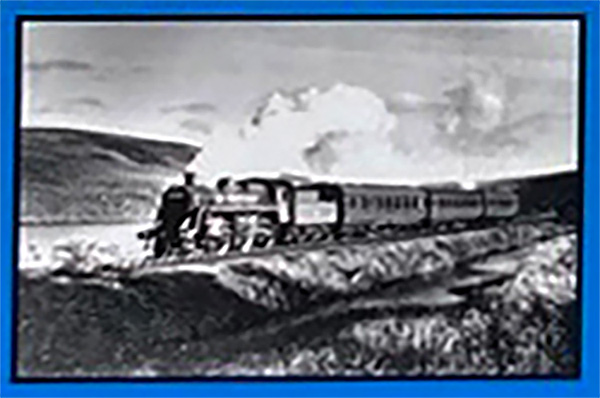
In 1802 Cartine Mills Company created 2 dams to store water for this mill. The sluice gates controlled the flow of water in the river Ayr which rises at Glenbuck and reaches the Firth of Clyde some 38 miles later. The Ayr - Lanark railway line crossed the dam.
Glenbuck Houses
Early miners' houses were typically terraced rows of 2 apartments with shared dry closets and a village pump for water. With a population of 1750 in 1900, there was a thriving community. In 1910 a new water supply was piped in from the springs on Hareshaw Hill. New council houses also improved the standard of living.

Glenbuck School
The first school was held in a 'single end' and then the byre at West Glenbuck, though the winter of 1875/76 forced its closure for a few months. A purpose built school was opened on Monday 13th March 1876 with 106 children and one teacher. The role gradually increased and early in the 20th Century, the school had a role of around 300 pupils, taught by 6 teachers and 1 pupil teacher. As pits closed and families moved away, the school role dropped unti with the prospect of only 3 children on the role at the start of the new session 1951, the decision was taken to close the school.

Glenbuck Fame
During the latter half of the 19th Century, Mr Charles Howatson, the Laird, bred a strain of blackface sheep best suited for the climate and pasture.
The resulting Glenbuck flock won acclaim and his shearling rams won 12 successive blue ribbons and the Prince of Wales gold medal at the 1867 Royal Agricultural Show. He built the imposing Glenbuck House in 1888.


Glenbuck man, Tom Bone (1868-1916) first won the Scottish Championship for quoits in 1889 and went on to win the Ballochmyle Silver Quoit 14 times, the Howard-de-Waldon Cup 6 times and in 1908, the Championship of Great
Britain.
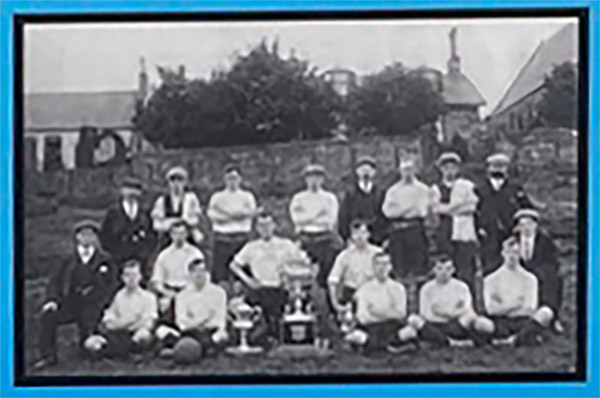
The Glenbuck Athletic Football Club was instituted in 1888 and won the Ayrshire Junior Cup in their first 3 years. From this junior club, later known as the Glenbuck Cherrypickers, came 43 professional footballers
The team lasted until 1932 when it had to disband due to the declining population. Notable in the 5-a-side games were the 5 Knox brothers who in one season won 40 of their 41 matches.
In 1901 two Glenbuck men (Alex Brown and Alex Tait) were players in the Tottenham Hotspur team which won the English Cup Final. Brown scored all the goals in the semi final and final games of the tournament. The English Cup (the original golden one) was displayed in a Glenbuck shop.

Although never one of the Cherrypickers, Bill Shankly was a Glenbuck son who won 13 caps, was manager of Liverpool from 1959-1974 and received an OBE in 1974
GLENBUCK CHURCH
The Church's first service was on 16th July 1882 and its last on 25th May 1954. Many previous members, some coming from abroad as well as from around Scotland, joined the congregation on this occasion.
Three stones were removed from Glenbuck Church and graveyard prior to its demolition. The burning bush emblem of the Church of Scotland, the Victoria Stone and the Covenanters' Stone were taken to various places in Muirkirk for safekeeping. They are now back in place in the new Heritage Village in Glenbuck.
GLENBUCK ENDS
Just as passing years brought improvements in living conditions, they also brought a decline in population. The ironworks closed in 1813 and without an outlet for the coal and ironstone, the pits closed too, Grasshill being the last in 1933. Without work, families left, yet it is ironic that by 1993 the last three families had been forced to move because of a new industry - open cast coal mining.
The days of Glenbuck are past, but its' contribution to the locality and further afield should not be forgotten.

GLENBUCK HERITAGE VILLAGE

Following completion of the opencast restoration works the official opening was held on the 2nd September 2019. The opening ceremony was carried out by Scottish Government Minister Fergus Ewing.
The site is owned by East Ayrshire Council who took it over from the Mines Restoration Trust who completed the reinstatement of the area following the demise of Scottish Coal.
The village comprises hutches in remembrance of the miners who lived and worked there. There are information boards, football memorials, and one with the names of Glenbuck men known to have played for the Glenbuck Cherrypickers. There is also one dedicated to Bill Shankly which is situated at the footprint of the house where he was brought up. In addition there are three original memorials that were taken to Muirkirk for safekeeping prior to the demolition of the Glenbuck Church and graveyard. One dedicated to Richard Cameron and his troops for their exploits at the battle of Airds Moss. One which was erected during the reign of Queen Victoria after she had served sixty years on the throne and, finally the Burning Bush emblem of the Church of Scotland.





