Huntingdon Beaumont
Transport in 1600 was appalling despite dedicated "wainways". The primitive collieries closed in winter; coal could be won but not transported to users. Something new was desperately needed. The innovatory breakthrough during James 1's reign can be placed, with provenance, to Nottinghamshire and the twelve-months ending on 30th September 1604.
This breakthrough, the earliest rudimentary British railway to have documentary provenance, was the Wollaton Waggonway laid by Huntingdon Beaumont west of Nottingham and built to carry coal from his concessions near Strelley down to an existing coal wharf at Wollaton. Approximately two miles in length it was laid during his annual lease period for coal rights after October 1603 but before negotiation of his next lease from 1st October 1604.
The 1604 renewal lease indenture document confirms the right of Beaumont to carry coals "alonge the passage now laide with Railes" and it is the earliest document currently known to record the use of a waggonway/ railway in Britain, however primitive.
He built further waggonways in Northumberland and a continuous rail trail can be traced back to Wollaton from today.
Despite the fact he came from a titled family he was one of the younger sons.
Therefore because he did not carry the baton of the title we know only a little about Huntingdon Beaumont the man and much more detail is needed about his immediate family. He was the son of Nicholas Beaumont (Born possibly in 1527 at Coleorton) and Ann Saunders.
|
Example of a coal wharf, much later,
Possibly an L shaped rail waggonway.

Other waggonways were built later.
Research into this cutting at Moor Lane,
Bramcote is continuing as it is a
suspected later waggonway feature
but as yet the purpose for which
it was cut is uncertain.
Photo © John New 2003.
Graham is carrying out further research
into this cutting.
|
His elder brother was Sir Henry Beaumont, who married Elizabeth Lovis at Breedon on the Hill on 11 Jan 1571, he had two other brothers,
Thomas (later Sir Thomas) and Francis and also probably two or three sisters, Katherine (& Catherine?) and Margery.
We have also established that the famous Francis Beaumont, the Playwright and Poet contemporary with Shakespeare, was related through the family (possibly as close as a cousin) but was neither Francis Huntingdon's brother nor Francis his own son.
Huntingdon was born circa 1560 and it is known he died in Nottingham Gaol in March 1624 (date adjusted for the calendar change). He was married with a wife Joan. He had three children for certain at the time of his death. It is known that these three children, all sons, were called Nicholas, Francis and Huntingdon. It is believed this third son is the same Huntingdon Beaumont who is recorded as a witness on a surviving will document, dated with provenance to 1650. As the father's name was usually applied to the first born son it is also plausible that a fourth, and his eldest, son died in infancy.
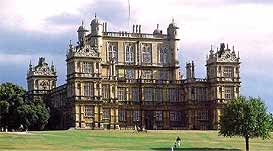
| It was also believed he was godfather to Huntingdon Smithson, the grandson of Robert Smythson who built Wollaton Hall, and the architect of Bolsover Castle.
Wollaton was a common factor and probably where Huntingdon Beaumont and the Smythsons' met. Undoubtedly successful as an innovator Beaumont was extremely unsuccessful in business. |
|
All his children were probably born before 1618 as in 1618 he was imprisoned in Nottingham Gaol due to debt, from where he was not released, and he finally died there as a bankrupt in March 1624.A highly significant person in the development of mining in Nottinghamshire and through his waggonway on a worldwide basis there is much work still to do to establish his background details, those of Joan, who became his wife, and of his sons. If anyone has these details, or can point us at a book or internet site that has them, we will be extremely grateful.
*NB - The valued assistance of Keith Hunt and Graham Crisp in preparing this feature is gratefully acknowledged. This article is a synopsis of much wider, joint, avenues of research currently being undertaken into C17 Nottinghamshire and other early waggonway developments. |