|
1657
Old Workings At Fackley
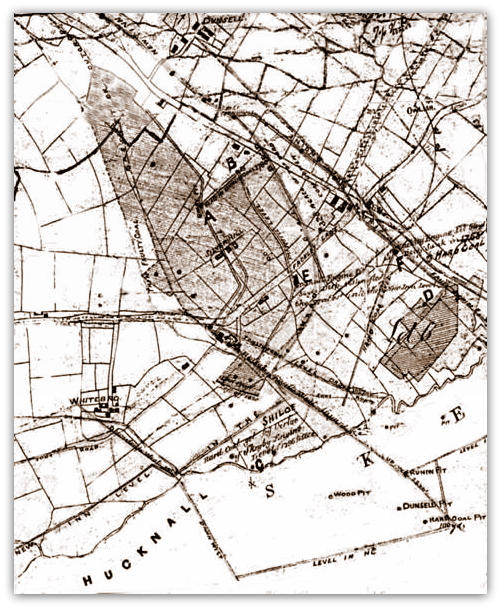 The old plan of the area around Wild Hill, Teversal shows a roadway driven in the Top Hard coal seam in 1657 called Tomlinson’s Level. The seam was about 5 feet (1.52m) thick and fairly level towards the Meden Valley, from one of the pits on the hillside below Silverhill farm. The coal seam bassets out in this area, i.e. it is exposed at or close to the surface. The old plan of the area around Wild Hill, Teversal shows a roadway driven in the Top Hard coal seam in 1657 called Tomlinson’s Level. The seam was about 5 feet (1.52m) thick and fairly level towards the Meden Valley, from one of the pits on the hillside below Silverhill farm. The coal seam bassets out in this area, i.e. it is exposed at or close to the surface.
Pinxton
Mining had been carried on for many years before this as the Top Hard seam outcrops or basits (bassets) out to the west of the village of Pinxton and many old shallow shafts have been located. The full dip is approximately due east. The pit lay to the west of Pinxton Church and was later referred to as the Old Pinxton colliery.
Machinery
Machinery either for pumping water or haulage of the coal was not used very much until the 17th Century.
Ventilation
At the very shallow pits the methane gas, which is lighter than air was not generally a serious problem unless the ventilation air became stagnant. More than likely they were more bothered with stythe or blackdamp (CO2) which is mainly carbon dioxide and heavier than air and asphyxiates.
Oliver Cromwell Died
Oliver Cromwell died in September 1658 and his son, Richard, became his successor. However in May 1659 he resigned and the 'Rump Parliament' was recalled. There was growing anarchy in the country.
In May 1660 Parliament voted for the restoration of the Monarchy.
Hearth Tax
Hearth Tax (or Chimney Money) taxed at the rate of 2/- (2 shillings or 10p) paid in two equal installments, paid on 'Lady Day' and 'Michaelmas Day', this began in April 1662. Obviously this was another impediment to using coal but more money into the government coffers.
Dispute
There was a dispute in 1671 between the Lords of the Manor of South Normanton and the 'Honour of Peverill'. Thomas Thorpe (79) once a servant at Carnfield Hall stated that he had mined coal 'at open worke' in Hill Top Lane (just south of Carter Lane End) where the Top Hard seam basits out. George Revell was very angry when he found out and said that he would not have his soil broken up without his consent.
Coke Family
Robert Coke leased land adjacent to the highway between Pinxton and South Normanton to Geoffrey Hazlehurst of Carter Lane House, length was 35 perches and 12 acres to the south to extract Top Hard coal. When he died in 1689 he left his coal mining operations to his father and brother.
Ogilby's Map
Ogilby’s map of Derbyshire in 1675 showed topographical features and referred to several cole pits.
Adrian Morewood owned mines of coal at Broadmarsh and Broomfield near Hill Top.
1676 'Great Frost'
Frost lasted from Martinmas (11 Nov) to 3rd Jan 1677. This would impede working at shallow mines.
Fatal Accidents 1677
Kimberley, Henry Sorr fell into a coal pit, and was buried on 21/2/1677.
The Spedding Mill

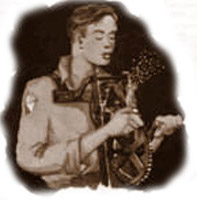
Young Boy Operating A Spedding Wheel  The famous steel mill invented by Carlisle Spedding in the Cumberland Coalfield. It was worked by hand, and by cranking a series of cogs that scraped along a piece of flint a shower of sparks was created giving a light for miners to work by in gaseous coal seams. The famous steel mill invented by Carlisle Spedding in the Cumberland Coalfield. It was worked by hand, and by cranking a series of cogs that scraped along a piece of flint a shower of sparks was created giving a light for miners to work by in gaseous coal seams.
It was the task for a young boy. The sparks were not hot enough to explode any gas. I have found no written evidence that suggests the machine was used locally.
Use Of Candles
 Candles were preferred as they gave the best light. These were sometimes shielded with reflective material such as glazing to create a better light and also to prevent the flame being extinguished in a strong airstream. Candles were preferred as they gave the best light. These were sometimes shielded with reflective material such as glazing to create a better light and also to prevent the flame being extinguished in a strong airstream.
The gas (methane) was sometimes set alight before dangerous levels were reached and was known as ‘Wildfire’. This then allowed the miners to return to work until the gas built up again.
Wages
Some Derbyshire miners in 1680 were now being paid 1s (5p) a day.
Twentyman Pit
Twentyman pit at Tibshelf was closed. (Some of the workings would be exposed by opencasting in the late 20th Century.) The £ equivalent to 2010 was about £90.
Barber And Walker
The partnership between two coal mining engineers, Thomas Barber and Thomas Walker of Derbyshire began in 1684. Thomas Barber Junior was born at Selston Common in 1687. The Barber, Walker Co would still be operating coal mines until the mines were nationalised on 1st January 1947.
Coldest Winter In Living Memory
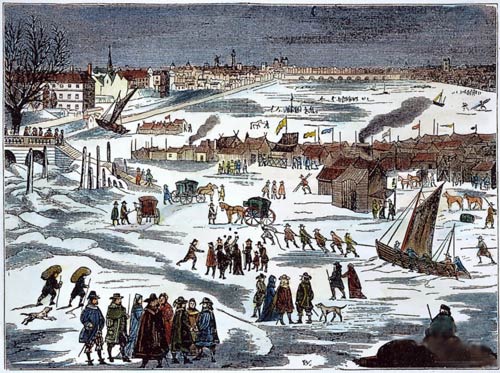
 1684 was the coldest winter in living memory, it was called the 'Little Ice Age', the river Thames was frozen with 6' 6" (2 metres) of ice. 'Frost Fairs' were held on the ice and even ox roasting. No doubt coal sales would have been high, the product being in great demand. 1684 was the coldest winter in living memory, it was called the 'Little Ice Age', the river Thames was frozen with 6' 6" (2 metres) of ice. 'Frost Fairs' were held on the ice and even ox roasting. No doubt coal sales would have been high, the product being in great demand.
Output
Output from the Midlands was app 850,000 tons, around 30% of total UK output of approximately 2.92m tons estimated.
Monarchy
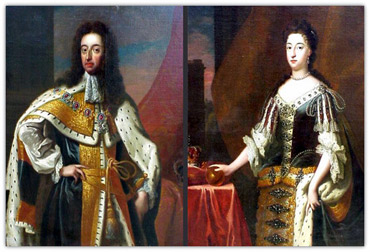
William III and Mary II jointly ruled from 1689-1702.
 Horse Gins Horse Gins
Around this time horse gins began to gradually take over the winding of coal up shafts at the ‘larger’ mines whereas hand wound windlasses continued as before at the small shallow pits. Cog and rung winding (made out of wood) was a popular system to around 1690. Several horses would be needed to operate a fair-sized mine for raising coal and they would have cost between £5 and £12 each.
Coal Merchants
Coal merchants at the time included Godfrey Haselhurst of Carter Lane, Alfreton, (Derbyshire), noted as ‘a great dealer in Coles’ and considered to be worth £10,000. Another dealer was William Horne of Butterley.
Shaft Sinking
Gunpowder was first used in a shaft sinking in a Midlands pit in 1687.
According to Camden there were mines at
- Coleorton (South Derbyshire) in the 1680s.
It is likely that mining was also still being carried out at
- Heather
- Measham
- Newbold
- Newhall
- Oakthorpe
A Wingfield pit was sunk.
Newhall Dethicks And Beaumont
It is known that Newhall Dethicks worked coal at Swadlincote but not Newhall. The line of the Main Coal seam outcrops in the North and North West side of the (South Derbyshire) Coalfield shows that there was a split in the seam into 2 layers with 40 feet (12m) of strata between the 2 leaves in the area of Bretby Middle Place pit and Bretby Stanton Lane pit and only 1’ 6” (0.46m) of strata between at Stanton pit (Nadins) and Hawfields colliery.
Beaumont leased Silver Hill (or Villier’s Piece) (South Derbyshire) to Wilkins in 1685 for 8 years. He had to drive a sough costing £2,000 because the underground workings were flooded. Another sough costing £300 was driven from Thringston Field in order to continue to work the Nether coal seam. However the mine was flooded in 1692 when Beaumont’s men blocked the sough. James Hawkins was Wilkin’s Bailiff and his nephew James Adams the colliery Manager.
Parliament
Following the Revolution of 1688, a Whig Administration was in Parliament until 1702.
Monarchy

George II suceeded in 1702
Land Owners And Entrepreneurs
Sir Wolstan Dixie and Sir Robert Sutton around Underwood area.
Water Wheels
Water wheels were established at Swannington sometime between 1690 and 1720.
Smalley
In 1693 at Smaley (Smalley) there was a vein of coal about six feet (1.83m) thick. It was 20 fathoms deep (120 feet or 40 yards or 36.5m) sunk in 1690. It was accessed by a series of wooden ladders of 12 staves each and the coal was drawn up the shaft by horses and windlass and sold at the pithead for 6s 6d (32½p) a load. This pit was at the head of a sough. Sam Richardson owned the pit. He was able to sell his coal at 3d a hundred. John Lowe spent upwards of £1,000 driving and perfecting a sough to keep his ‘delf’ dry, finished in the following year. That year he delivered coals at 3½d a hundred. At Denby, (Derbyshire) coal was sold for 5s 6d (27½p) a load or 3s 2d (15¾p) a ton.
Thomas Houghton wrote that as well as at Smaley (Smalley) there were mines at Denby (owner John Lowe) and Heanor (Sam Richardson). The Donington Park mines at Oakthorpe and Measham (owner Hastings) were on a larger scale. The Turners of Swanwick were the largest coal owners in North Derbyshire.
South Derbyshire
Pits in (South Derbyshire) were at Swadlincote (Hortons of Catton) and Gresley. Copperas pit was abandoned before the end of the Century.
Winding In Shafts
  Two men fell down a shaft at Stretton in 1694, sunk in 1690 and were killed. They fell off their pickaxes, which were stuck in the hemp winding rope. When children were introduced into the pits later, they would sit on the legs of an adult in this manner, this being the only way into the mine. It would be many, many years before cages would be introduced into shafts. Two men fell down a shaft at Stretton in 1694, sunk in 1690 and were killed. They fell off their pickaxes, which were stuck in the hemp winding rope. When children were introduced into the pits later, they would sit on the legs of an adult in this manner, this being the only way into the mine. It would be many, many years before cages would be introduced into shafts.
Tax On River Borne Coal
A Bill had been passed by a Tory Government in 1694 to tax river-borne coal at the same rate as sea-borne coal and the Commission set up offices near to the collieries on the River Trent and River Severn. However the tax was repealed by the Whigs in 1696.
Wilkin's Leases
Wilkin's leased coal mines in 1696 at Coleorton, Newbold and Worthington for 21 years from Lord Thomas Beaumont.
John Wilkins now worked mines at Coleorton, Measham, Newbold, Oakthorpe, Ravenstone, Swannington and Worthington in 1700.
1697 Act
Vagabonds
An Act was passed in 1697 conferring on coal masters the rights of apprehending vagabonds and their children without the need for trial in a Court of Law. Cheap labour?
Convicts
17 convicts had their jail sentences remitted – they were ordered to work in the mines for 5 years.
First Steam Pump
 Thomas Savery, an English military engineer and inventor, invented the first steam pump in 1698; however when it was used in the region is not known. It was referred to as a ‘Fire engine’. The term came from the fact that a fire was necessary to heat the water to produce the steam that was needed to drive the pump. Thomas Savery, an English military engineer and inventor, invented the first steam pump in 1698; however when it was used in the region is not known. It was referred to as a ‘Fire engine’. The term came from the fact that a fire was necessary to heat the water to produce the steam that was needed to drive the pump.
Thomas Savery had been working on solving the problem of pumping water out of coal mines, his machine consisted of a closed vessel filled with water into which steam under pressure was introduced. This forced the water upwards and out of the mine shaft. Then a cold water sprinkler was used to condense the steam. This created a vacuum which sucked more water out of the mine shaft through a bottom valve.
(More information from Wikipedia)
Opposed Dredging Of River Trent
Following an Act of Parliament in 1699, to make rivers navigable, Nottingham Corporation opposed all projects to dredge the River Trent above the town, through fear of the competition from the Derbyshire pits in the lower Trent Valley, a market served almost exclusively by the pits around Wollaton.
Erewash Canal
The Erewash Canal was in use for carrying coal in 1699 from Ilkeston and Langley Bridge to the River Trent and up the River Soar to Loughborough.
Output
Professor John Ulrick Nef estimated that the Trent Valley pits alone produced between 100,000 and 150,000 tons with 75,000 tons from the Nottinghamshire pits. He also thought that these pits were able to produce more but there was no demand for the coal at that time.
Celia Fiennes
 During her journey throughout Britain 1698-1699, Celia Fiennes described the mines around Chesterfield (famous for its crooked spire) - “they make their mines at the entrance like a well and so till they come to the coals, then they digg all the ground about it where there is coals and set pillars to support it, and so bring it to the well, where by a basket like a hand barrow by cords they pull it up, so they let down and up the miners with a cord’. She had noted that ‘approaching Chesterfield the Coale pitts and quaraes of stone are all about even just at the town end, and in the town it’s all built of stone; the Church stands in a place of eminency, the town looks well, the Streets good, the Market very large; it was Saturday which is their market day and there was a great market like some little faire, a great deale of corne and all sorts of ware and fowles… in this town is the best ale in the kingdom generally esteem’d”. During her journey throughout Britain 1698-1699, Celia Fiennes described the mines around Chesterfield (famous for its crooked spire) - “they make their mines at the entrance like a well and so till they come to the coals, then they digg all the ground about it where there is coals and set pillars to support it, and so bring it to the well, where by a basket like a hand barrow by cords they pull it up, so they let down and up the miners with a cord’. She had noted that ‘approaching Chesterfield the Coale pitts and quaraes of stone are all about even just at the town end, and in the town it’s all built of stone; the Church stands in a place of eminency, the town looks well, the Streets good, the Market very large; it was Saturday which is their market day and there was a great market like some little faire, a great deale of corne and all sorts of ware and fowles… in this town is the best ale in the kingdom generally esteem’d”.
William Cory and Son
Around this period William Cory and Son was founded. The firm eventually grew into one of the leading coal traders and steamship operations in Britain building up a large coal-bunkering agency for fuelling ships to travel around the World.
(see 1976) |


