1850
Steam Engines
Between 1832 and 1850 boilers and steam engines were installed at Newfield (South Derbyshire) to operate haulages.
Winter (Nottingham Guardian Newspaper 24th Jan 1850)
Pinxton Collieries are frozen out....severe bad weather. A party of men and boys are parading the neighbourhood drawing a load of coals.
Very inclement weather has made coals extremely scarce, there was none at Fulwood wharf for more than a week and teams frequently return empty from pits at Skegby.
Collieries Sunk or Opened in 1850
- Butterley Park No5 (a new High Holborn) (Butterley Co).
- Canal Head pit at Moira (Hastings).
- Clay Cross No2 and 3 pits were sunk (Clay Cross Co), and opened, began sinking in 1846.
- James Oakes and Co sank Cotes Park (Barker pit) at Somercotes to 284 yards (260m). There was another pit called Coates Park already working nearby, owned by Copeland and Co.
- Cotmanhay (Barber Walker ) Soft coal start 1850?
- Heanor West Hill (FB Charlton) sunk.
- Job’s New (Job Broughton?) Brinsley.
- Kilburn pit (John Ray) second shaft was sunk near Denby.
- Marlpool (Gould and Checkland) sunk to Top Hard, Coombe and Waterloo.
- Oakthorpe (South Derbyshire).
- Measham and Minorca (Earl or Countess of Chesterfield) (Leicestershire).
- Top Mexboro’ pit (Nottinghamshire) was being sunk by Butterley Co at Selston at about 9 feet (2.74m) dia. A large beam engine stood between the shafts and a lot of water was encountered.
- Plumptre (Butterley Co) sunk.
- Butterley also opened their Portland No 6 pit that had a ventilation airflow of 12,668 cu ft per minute. They were still sinking Portland No 7 pit nearby. All the Portland pits were around 180 yards (165m) deep.
- Pinxton Colliery Co re-opened the Green shaft at Pinxton as a pumping pit to protect their other mines
- Tapton (John Clayton) Blackshale.
- Watnall No5 and No6 pits sunk (Barber Walker). Royalties were to be paid to Lady Palmerston, Duke of Rutland and Lord Melbourne in the future.
The second shaft at Kilburn Colliery (J Ray) was sunk in 1850. The headstocks were constructed from deal and oak with twin 10 ft (3.05m) dia pulley wheels and a flat hemp rope used to raise coal and raise and lower men 204 yards (186.5m).
Russia, Blews And Rock Pits
Russia and Blews pits (South Derbyshire) (…?) worked Little and Main seams around this time. Rock pit (Derbyshire) was sunk prior to this, shaft position E447780 N378810, E447880 N378290.
Collieries Closed in 1850
- Clay Cross No1 (Clay Cross Colliery Co).
- Coal Aston (Rhodes?).
- Cotmanhay (Thomas North) Deep Soft and Deep Hard, August.
- High Holborn pit at Cossall (Thomas North) was closed permanently.
- Hollingwood Common (Richard Barrow or Joshua Thornley?) Blackshale.
- Morley Park (Messrs Mold) Clod or Blackshale and Deep Hard.
- Park pit (Drinkwater) was closed around this time at Furness Vale.
- Pit to west of Chesterfield (Sam Beale and Co) got Blackshale and ironstone, belonging His Grace the Duke of Rutland and occupied by Mr George Holmes the ‘tennent’.
- Staveley Colliery, Speedwell pit, (Richard Barrow), Surveyor John T Woodhouse of Overseal, Feb 1850.
At Bath pit (Moira Co) the workings were reaching exhaustion.
Nuthall
At Nuthall pump shaft 326 ft (99.4m) above sea level in 1850 the High Hazles had been proved previously as 2’ 10” (0.86m) at 179’ 7” (54.7m), Cinderhill Main 2’ 9” (0.84m) at 262’ 0” (79.9m), Main Smut 1’ 11” (0.58m) at 359 ‘ 0” (109.4m) and Top Hard 5’ 1” (1.55m) at 408’ 7” (124.5m).
Clay Cross
John Parker Overman at Clay Cross No1 (Clay Cross Colliery Co) was appointed Head Underviewer at the new pit. He had worked as an Overman under Martin, a contractor at Clay Cross No1 previously during the early 1840s.
Corporals at the pit were generally in charge of young boys and the haulage system but at Clay Cross acted more like a modern day Deputy and could have had several stalls under their control.
More Inspectors Appointed
Under the 1850 Mines Act, four more Mines Inspectors were appointed. They were to have at least 7 years experience as a Manager of a mine.
These new Inspectors were appointed to oversee the construction and safety aspects at a mine.
Surveyor's Dial
‘Correct Plans’ Of Mine Working
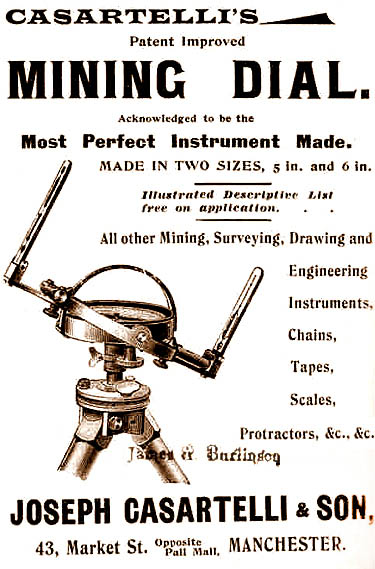
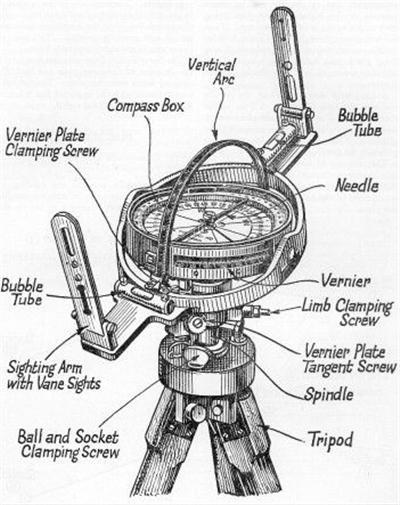
The Inspector appointed for this region was Charles Morton 1850 - Nov 1855. Mine owners were now required by law to keep ‘correct plans’ of mine workings. These would show the position of the working faces and main underground roadways and were made up to date every 6 months. To some degree this entailed employing surveyors using survey instruments periodically to do the surveys twice a year, or in the case of the larger companies a permanent Surveyor or in many cases the surveys of the workings were carried out by the Owner or Manager. The suggestion had been made in the 1780s and the Act was passed following the Select Committee report of 1835.
Gas Blower
At Tupton colliery (Wingerworth Coal Co) in August 1850, a gas blower was ignited by a candle flame and set fire to the coal.
Plan Of Ilkeston
A plan was made of the Parish of Ilkeston in 1850 by HC Roper, Surveyor from Doncaster.
Value Of The Pound
The value of £1 in 1850 in terms of today’s money in 2010 would be about £58.50.
Output
Nottinghamshire output for 1850 estimated at 3,400,000 tons.
Winding Ropes
Hemp ropes for winding in use since the 1500s were now being phased out around 1850 but would still be used at smaller collieries for years to come. Wire ropes had been tried and tested by 1830 and brought into use over a wide area.
Round wire ropes became popular by 1845. Flat ropes were in use by about 1830 would continue into the late 1880s and in isolated cases would be used for many years.
Cage Guides And Detaching Hook
Cage guides were invented in 1795 and detaching hooks, such as King’s patent and Ormerod’s as well as an overwind preventer would not be invented for several years (1867 and 1868).
Fatal Accidents 1850
- Eastwood (Barber Walker and Co), Joseph Bradley (31) collier was employed as a header and on some occasions gunpowder was used to blast the material when on other occasions picks were used to cut material down. It became necessary to blast on that day and witnesses saw Bradley apparently burying the charge but did not see him light the charge however they heard a report and realising something was amiss ran to the spot and found him lying there. He was raised to the surface but was found to be dead before the surgeon arrived, 3 Apr 1850.
- Cinder Hill, (Thomas North), Joseph Wilkinson (36) and Benjamin Hickling were working together when a huge fall of roof about 10 yards (9m) long fell and buried them. Men working nearby worked up to a quarter of an hour to release them, however Wilkinson was dead and Hickling was badly injured but survived, 24 May 1850.
- Ilkeston (Messrs Barber Walker), on 26th June 1850, Moses Aram aged 19 was killed under a fall of roof estimated at a ton and a half.
- Ripley, (Butterley Co), on Saturday 28th April 1850 John Roper, aged 15, was killed when the corve he was sitting in, with 3 others, caught the bridge tree, upset and he fell down the 150 yards deep shaft.
- Ripley, (Butterley Co), William Fletcher aged 55 was killed on 22nd Dec 1850 when a large quantity of bind and stone fell on him.
- Stanley, on 9th July, Thomas Hartshorne aged 50, whilst at work sinking a shaft, suddenly leaned forward and died. Mr Cade, a surgeon who had attended Hartshorne in the past was of the opinion that he had died from disease of the heart and not from an accident.
|