1868
Collieries Sunk or Opened in 1868
- Ashgate (S Hoskin and Co)
- Bank End pits (Messrs Levi and Elijah Hall) re-opened the pits to extract coal left in pillars
- Bretby No2 dev
- Brinsley (Earl of Mexborough) start
- Bulwell shaft (Thomas North) to Top Hard
- Clay Cross No8 pit, known as Flaxpiece was sunk by the Clay Cross Co but leased to the Clegg Bros.
- Clifton colliery (Nottingham and Clifton Colliery Co) was sunk close to the River Trent at Clifton, Nottingham. John Thomas Boot of Huthwaite was the Consultant for the Co
- Furness Clough (Levi and Elijah Hall) Yard mine, Bank End pits began extracting old pillars from a previous mine
- Holmewood No1 (Wingerworth Coal Co) was sunk to the Top Hard at 4 feet 7 inches (1.4m) thick at 63 yards (57m) 1867-1868. The No2 pit was sunk to the Tupton at 330 yards (301m) and No3 pit to the Blackshale at 450 yards (412m)
- Moor Green, (Barber, Walker and Co) at Eastwood, opened, was sunk from 1865 to the Top Hard? at 367 yards (335m), 13 feet (3.96m) dia shafts
- Netherseal (Coton Park Co) was formed by Charles Binns, Edward Ellis and George Hague, 2 shafts one at 12 ft (3.65m) and the other 13ft (4m) down to the Eureka seam at 880 ft (268m), was originally named Coton Park
- Park House Nos 6/7 (Clay Cross Co) opened
- Renishaw (Chesterfield and Boythorpe Coal Co) E444502, N378079
- Teversall 1 Silver Hill (Stanton Iron Works Co) Top Hard sunk 1865 opened for coaling
- Swanwick (CRP Morewood) at Alfreton
- West Hill (HH West) Heanor, start 7th Dec 1868, Top Hard and Comb, shaft 45 yards (41m) – see 1871.

Cotes Park Colliery
- Cotes Park (James Oakes) sunk 143 yards (131m) to Deep Soft and 160 yards (146m) to Deep Hard reference was made to a ‘dumb’ fault and ‘dumb ground’ crossing the Carnfield tunnel area.
- Nailstone sunk to Upper Main in 1862 was deepened to Roaster or Lower Main.
- Rawdon (Leicestershire) (CF Hastings) (sunk 1821) was deepened in 1868. Coal was transported by the Ashby canal in the early days but would later be transported by the Burton/Leicester railway (1849)
- Beard and Bugsworth, North West Derbyshire, taken over from Stott and Hall 1856-30 Jun 1868 by Levi and Elijah Hall. Section at Lady Pit, marl, rock, shale, Yard coal 2’ 10” (0.86m) at 22 yards (20m) deep, floor rock, Jowhole Tunnel (40 yards (36.5m), Bullbower pit, 122 yards (111.5m) to Yard mine, some areas of barren ground, some coal got by Drinkwater prior to 1855, Deans Piece pit, Furnace pit 35 yards (32m) to Yard mine, Chain pit 19 yards (17.4m) deep and 2 Blind pits. Some coal got by Drinkwater and Hall previous to 1856, Barn or Dolly pit, Surveyor JW Fearn Oct 1869.
Thomas North Died In Abject Poverty Thomas North of Basford Hall died in London of abject poverty at the age of 57 (28th February 1868). He had come on hard times when his money had run out. Thomas North’s pits at Cinder Hill, Kimberley and Newcastle had reverted to his partner John Wright. He died owing £190,000 and the bank then owned his collieries. A collection was made from the employees of the pits who raised sufficient money to have an obelisk made and erected to his memory in Old Basford cemetery, because he had given work to so many. Some of the mine owners in similar circumstances of debt ended up in the Marshallsea Debtors’ prison. The Broxtowe pit had been opened in the Strelley royalty held under John Thomas Edge. The seams were thinner than at Kimberley but little exploration had been done. In view of the great depression in the trade further outlay in opening up the pit had not been carried out. The headgear had been completed but further convenient accommodation for the loading of trucks was necessary. The winding engine was of the vertical beam type and had a 14” (0.36m) dia cylinder with a 3 feet (0.91m) stroke. 2 plain egg-ended boilers of 4 feet (1.22m) dia and 30 feet (9m) long supplied the steam.
Change Of Ownership
At Nesfield there was a change of ownership on 16th July from Fox to Sheepbridge Coal and Iron Co. Ltd.
Gresley Wood (Gresley Wood Colliery Co. Ltd.) was put up for sale in Jan, however it was found to be in poor condition and the new Co. was partly to blame for the death of two miners who, contrary to instructions, went into workings lacking ventilation and were suffocated by fumes from a spontaneous combustion fire. George Lewis the Manager closed the pit.
High Park
On 21st July 1868, John Harrison reported that to make High Park colliery (Barber Walker) more efficient and profitable, it would be necessary to install a ventilating fan at the top of the upcast shaft in place of the 2 furnaces, one 9 feet x 6 feet (2.74m x 1.83m) and the other 6 feet x 4 feet (1.83m x 1.22m) which were now burning over a hundred tons of coal a week and more so, the intense heat was damaging the 360 feet (109.7m) deep shaft walling.
Two officials William Weston and
C Houfton were sent to South Wales where they met Mr Thomas Evans Inspector of Mines and they viewed the various methods of ventilation for mines there. However at Pelton in the North of England a new machine was being erected, anyhow a Waddle mechanical fan, 30 feet (9.14m) dia, the first in Nottinghamshire or Derbyshire was erected at the Upcast shaft at High Park as previously mentioned. The cost was worked out at about £1,500 which equated to the amount of coal used in a year plus the labour to man the furnaces. A second fan 12 feet (3.65m) dia would be installed in 1892.
Parliament
  A Liberal Administration was in Parliament from 1868 until 1873. Prime Ministers Benjamin Disraeli (left) (Conservative) 1868. A Liberal Administration was in Parliament from 1868 until 1873. Prime Ministers Benjamin Disraeli (left) (Conservative) 1868.
William Gladstone (right) (Liberal) 1868-1874. President of Board of Trade, John Bright (Lib), Dec 1868-1870. Principal Secretary of State Henry Austin Bruce MP 1868-1872.
Inundation at Whiteborough
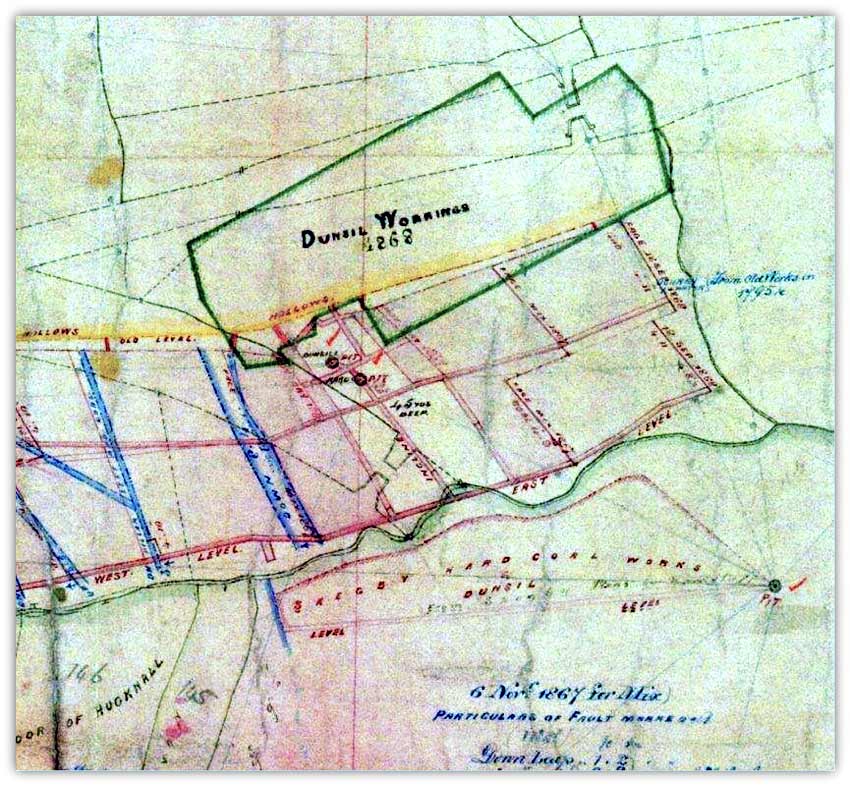
There was an ochrey or inundation or inrush of water at the Whiteborough mine, (Nottinghamshire) off Wild Hill (Skegby Colliery Co.) as the workings in the Top Hard seam broke into an old water gate in 1868. These works had been abandoned in 1832, having begun in 1795. Fortunately there was no loss of life, but the deeper Dunsil seam workings at the pit were drowned out and abandoned. The workings in the Top Hard at 59 inches (1.5m) thick were able to continue afterwards and stripped the old water gate, now dry, and the workings continued up to the Newton Wood fault, near to Chesterfield Road.
Because the workings were flooded, the water gate to the dip side must have been flooded also and this was the gate that was broken into in April 1869 (See Molyneux inrush)
New Safety Equipment
New safety equipment to do with winding was installed at a Hall and Boardman’s pit c1 Jul 1868.
Protection Pillar
Shipley colliery (Newcastle pit) (Derbyshire), left a pillar in the Soft coal to protect Heanor Hall.
Contract rules were issued at Sleight’s pit, Pinxton, (Derbyshire), (Pinxton Colliery Co) in 1868. In the same year a mechanical fan was installed at No2 pit, only the second one in the area.
Union
A further Amalgamated Association of Miners was formed in 1868, but lasted only until 1873. It was in direct competition to the Miners’ National Union. It was stated that the Derbyshire and Nottinghamshire Miners’ Association was affiliated to both. The failure of the ‘Billy Brown’s Union’ encouraged employers to meet requests by colliers for improved working hours and wages.
Collieries Changing Hands in 1868
- E Nicholls sold Alton and Brampton New to Jackson and Co
- Springfield Main owned by S Addy and Ward became a Limited Co
- Eastwood and Swingler took over Molineux (Molyneux) from Eastwood and Co (1868-1877)
- South Normanton transferred from William Swann to Joseph Swann
- Tibshelf, R Storer sold Tibshelf to J Moseley
- Hick, Whittaker and Co sold Bennerley to FC Gillatt
- Beard and Bugsworth mine owned by J Stott and Hall transferred to L and H Hall
- R Broome and Co sold Whaley Bridge mine to the Buxton Lime Co.

Hucknall No1 and No2 collieries at Hucknall Torkard were now owned by the Hucknall Colliery Co, with John Edward Ellis aged 27, (Edward Ellis’s son) as Managing Partner. He would later enter Parliament as Liberal MP for Broxtowe in 1885. The original partners were Alfred Ellis, Edward Shipley Ellis, William Paget and William Walker.
Fined For Ill-Treating A Donkey
At Clay Cross No1 pit (Clay Cross Co), a collier was fined 10 shillings (50p) for ill-treating a contractor’s donkey.
Collieries Closed in 1868
- Alton (Joseph Buxton) adit and 5 shafts, No1 4’ 6” (1.37m) coal, No3 4’ 8” (1.43m) coal, No5 4 0” (1.22m) coal, Alton seam
- Two small pits at Blackwell (Booth and Co) were closed, having been stood for some time
- Coates Park and Birchwood (W Morewood) leased to Messrs Seely, Bottom Hard coal lease to May 1856, again to Aug 1857 and again to Dec 1862, then to Messrs Seely from Aug 1867 at a pit sunk in 1821 to Furnace coal then to Midsummer 1868 from (Cotes Park) Heighington pit Hard coal, where the plan shows main horse roads and benk faces, Jan
- (Skellingthorpe pit Soft coal adjacent, Jan), John Thos Woodhouse Surveyor, Midland Road, Derby
- Digby (Lord Middleton) Hard coal to Lady Day 1868
- Foxley Oaks (Whittington Coal Co Ltd), Blackshale
- Glebe (Rodes and Pole), Barlborough Common, Clown seam, 22 yards (20m) deep, 3 shafts
- Gresley Wood, (Gresley Wood Co Ltd) (South Derbyshire), Main seam, sunk in 1853
- Hasland (Hasland Coal Co)
- 'Old Hucknall' Huthwaite, (Mellers), to north of Hopkin Lane, Mr Eddison stopped the Top Hard pit on 2nd July due to water and the Dunsil seam worked since 1809 was stopped on Lady Day 1864 and abandoned. Eddison’s lease from Lord Carnarvon, £15 per acre (0.4 ha) per quarter. The Top Hard had been gotten by Mellors to the South previously 1825-1844 under a lease granted by Duke of Devonshire
- Ingmanwell (JW Day and Co) Blackshale
- Killamarsh (T Webster)
- Lount (W Worswick) (Leicestershire)
- New Brampton (Holmes and Wilcockson) sunk 1863
- New Hall Field (New Hall Field Co Ltd)
- Oakerthorpe (Oakerthorpe Iron Co) (Derbyshire) Furnace or Tupton, connected to Castle Hill pit
- Pewit (Wingerworth Coal Co) North Wingfield
- Salter Wood (Mr Lowe) Ell seam, met old workings, also Black Rake ironstone (Messrs Dawes) met old men’s hollows up to outcrop, Surveyors Woodhouse and Jeffcock
- Senior’s Deep Soft pit, Chesterfield
- Shaw Wood (Oakerthorpe Iron Co?) Oakerthorpe
- Sheepbridge (Sheepbridge Iron Co) Deep Hard or Potters at 78 yards (71.3m), June 1868, very well organised ‘short’ longwall working
- Speedwell (Staveley Coal and Iron Co) Top Hard seam
- At Old Skegby (1840) (Skegby Colliery Co) the Dunsil was abandoned on Lady Day 1868 having met old hollows to the north.
- Tibshelf Mosely’s (J Mosely) Clay Cross Soft, a good house coal, sunk 1863, Surveyors John Boot and Son) – (abandonment plan deposited 28/2 1936) and a note by him to say that the Waterloo seam and ironstone had been gotten to 10 yards (9m) deep about 1750
- Wallsend (Abbott, Baker and Co?) Chesterfield, Blackshale, Sep
- West Staveley (Bainbridge and Co) near Barrow Hill
- Woodhouse (Messrs Booker and Co), Dronfield, Blackshale, hard coal 3’ 5” (1.04m), dirt 1’ 8” (0.50m), coal 1’ 10” (0.55m), Grace and Archer, Land and Mining Surveyors, Wakefield and Sheffield, 1868.
Fatal Accidents in 1868 included:-
- Alma, John Lomas (30), run over by tubs 16 Sep 1868
- Birchwood, John Sharp (13), run over by tubs 28 May 1868
- Bramcote, John Kirk (40) was killed on 10 Sep 1868
- Britain, John Fearn (35) and William Langdon (34), shotfiring accident 8 Apr 1868
- Britain, William Green (15), fell out of cage 5 Aug 1868
- Campbell, Thomas Branson (37), fell down shaft 25 Aug 1868
- Cinder Hill, John Fletcher (14) 6 May 1868
- Cinder Hill, William Hardy (40) 20 May 1868
- Cinder Hill, John Charlesworth (77) 10 Jun 1868
- Cinderhill, Dennis Millward (34) 27 Aug 1868
- Clay Cross, Joseph Barlow (38), fall of roof 14 Mar 1868
- Clay Cross, Abner Stanley (44), fell from a scaffold on the surface 24 Apr 1868
- Clay Cross, John Price (22), fall of roof 30 Jul 1868
- Clay Cross, Peter Kite (25), explosion of powder 5 Nov 1868
- Clay Cross, GH Russell (14), run over by tubs 26 Nov 1868
- Coleorton, Thomas Saddington (60), crushed by cage 30 Jan 1868
- Cotes Park, Charles Haydom (35), run over by tubs on the surface 23 Oct 1868
- Cotmanhay, William Tunnicliffe (36), fall of roof 17 Jan 1868
- Danesmoor, John Holmes (28), fell down shaft 7 Jul 1868
- Denby, William Brown (?), fell down shaft 29 May 1868
- Denby, Thomas Brown (45), fell from scaffold in shaft 1 Sep 1868
- Granville, William Wignall (32), fall of coal 26 Feb 1868
- Gresley Wood, 2 men? suffocated underground c9 Nov 1868
- Hollingwood, William Samuel (?), fall of coal 21 Feb 1868
- Hollingwood, Martin Ruddy (34), fall of roof 25 May 1868
- Ibstock, Charles Boobier (13), crushed by tubs 10 Oct 1868
- Kimberley, Edwin Ward (14) 21 Apr 186
- Lings, John Winter (17) run over by tubs 27 Jun 1868
- Morton, William Tracey (15), fall of side 23 Jan 1868
- Morton, William Grey (25), fall of roof 18 Mar 1868
- Morton, Thomas Cooper (30), crushed by tubs 27 Aug 1868
- Nailstone, James Hawkes (26), fall of roof 12 Feb 1868
- Nesfield, William Johnson (38), fall of roof 6 Feb 1868
- Nesfield, George Lowe (50), fall of roof 15 Oct 1868
- Newhall fatal accident of inexperienced imported collier c6 Jan 1868
- Newhall fatal accident ? c10 Nov 1868
- New Hollingwood, Herbert Stack (12), run over by tubs 23 Jan 1868
- New Hollingwood, Brigham Laxton (18), fall of coal 16 Dec 1868
- Newbold, John Barnett (55), fall of roof 23 Nov 1868
- Oakthorpe, William Jones (28), fall of roof 21 Oct 1868
- Park Hall Eckington, Lawrence Monks (10 or 16) 20 Apr 1868
- Renishaw Park, William Stones (17), fell out of bucket in shaft 30 Mar 1868
- Renishaw Park, Henry Monks (11), run over by wagon on the surface 18 Apr 1868
- Ripley, Arthur Simpson (19) 2 May 1868
- Ripley, Joseph Riley (40), fall of coal 12 Jul 1868
- Ripley, Thomas Parker (22), fall of roof 25 Jul 1868
- Seymour, John Bell (28), fall of roof 17 Jan 1868
- Seymour, John Jones (..), stone fell down the shaft and struck him 15 Jun 1868
- Seymour, John Cross (19), crushed by cage 2 Jul 1868
- Sheepbridge, John Smith (18), fall of roof 20 May 1868
- Shipley, Johnathan Moore (14), run over by tubs 2 Jan 1868
- Shipley, John Limit (27), explosion of powder 25 Feb 1868
- Shirland, Isaac Feul (16), run over by tubs 30 Apr 1868
- Snibston, Isaac Billings (37), overwind 12 Feb 1868
- Speedwell, John Beresford (17), fall of roof 20 May 1868
- Speighthill, James Reddish (?) 20 Apr 1868
- Springwell, Owen Bradley (30), shotfiring accident 3 Apr 1868
- Staveley John Cross (18) 10 Jul 1868
- Stoneyford, John Vickers (42), explosion of powder 28 Jan 1868
- Sutton (Derbyshire), David Taylor (23), fell down shaft 8 Jun 1868
- Swannington, William Foster (40), run over by tubs 20 Feb 2868
- Swannington, John Halfpenny (31), crushed by wagons on surface 15 Apr 1868
- Swannington, Solomon Siddons (29), fall of coal 23 Apr 1868
- Swannington, Matthew Martin (29), fall of roof 19 Jun 1868
- Swannington, Fred Whittaker (32), fall of coal 24 Dec 1868
- Swanwick, George Legge (26) and George Stephenson (22), explosion of powder 3 Mar 1868
- Swanwick, Albert Staples (?), explosion of powder, 2 Oct 1868
- Tapton, William Rowland (45), suffocated in a shaft sinking 26 Mar 1868
- Tibshelf, William Tomlinson (30), fell from scaffold in shaft 27 Apr 1868
- Waingroves, William Wright (14), fall of roof 8 Apr 1868
- Whitwick, William Holt (23), fall in roadway 1 Aug 1868.
R Eley had an ankle severely crushed at Gresley colliery (Hastings) c 28 Jan 1868.
Digby Colliery Fatality
William Vardy, aged 11, had left school without a certificate and had begun work at Digby Colliery on 6 July 1868 (He would have been 12 on the 24th March 1869) William Hall, the Manager for Digby Colliery Co. was charged with neglecting to ascertain the real ages of boys and was fined £5. Charles Smith was a Colliery Overseer and he had employed William Vardy at the end of April to open and close doors on a main road. Vardy was killed whilst ganging a pony to No.6 stall, along a roadway that was in a very poor condition and only 4 foot 8 inches (1.42 m). He went into the stall after being told not to and should only have ganged 2 trams. He was found under one of the wagons at No. 6 gate.
Output
In 1868 there were 3,262 pits in the UK, employing 347,000 men and boys, giving 306 tons per man per year output.
The output from 142 Derbyshire pits was 4,957,879 tons and 1,508,439 tons from 27 Nottinghamshire pits and 608,088 tons from 10 Leicestershire pits.
1868 Was A Bad Year For The Industry
Due to the depression and prices for the coal fell and of course wages fell also as a consequence. Many men were disillusioned with the unions and left fearing reprisals from the owners when things improved. Those who held out soon found that unless they had a leaving certificate should their late employer refuse them work then they would be unable to find work at any other pit elsewhere. It was blackmail of the highest order and it would be to my Grandfather’s cost some 58 years later in 1926 when he too was blacklisted for his union activities and refused work at any other colliery. |


