1889 - Page 1
Bolsover Colliery Co Was Founded
The Bolsover Colliery Co was founded in 1889 with Emerson Bainbridge as Director and John P Houfton as Manager
(1897). They began sinking 2 shafts at 14 feet (4.26m) diameter to the Top Hard seam at Bolsover (Derbyshire), commencing in April 1890. Area of Royalties 11¼ sq miles. 194 houses were built for 400 men plus 30 for officials.
No Man Should Work For Less Than £2 A Week
Problems were experienced at New Whittington and Whittington Moor (Derbyshire) in May 1889. It was stated that ‘no man should work for less than £2 a week’.
Unions
The South Derbyshire Miners’ Association was formed in 1889. The Nottinghamshire Miners’ Association membership had grown to 3,636 by June with 23 Branches and 7,549 members in 29 Branches by December.
The Miners’ Federation of Great Britain (MFGB) was formed. Trade began to improve after a long depression of 16 years. Union leaders were fighting for an eight-hour day.
The Derbyshire Miners’ Association held a demonstration in Chesterfield in 1889. 51 Lodges attended accompanied by 15 brass bands. In June the Derbyshire Miners’ Council of the Association had purchased 6,000 medals at 1d (⅓p) each to be worn as cap badges for all union members.
Netherseal Into Liquidation
Netherseal (Leicestershire) (Coton Park Co) was subjected to faulting and flooding and the firm went into liquidation in 1889
Barber Walker Co
The Barber Walker Co appointed Edward Linley as Manager, under Mr Harrison. It was stated that the output for the year was almost 472,000 tons. The Company had about 220 horses underground and 4,000 trams. There were around 65 miles of underground roadway open, of which around 44 miles were inspected daily.
Colliery Name Change
Forge Long Acre colliery name was changed to Wreaks Lane (Lucas and Son).
Teversall
A Capel electric driven fan was installed at Teversall in 1889. This fan was 16 feet (4.87m) in diameter and 6 feet 6 inches (1.98m) wide and delivered 127,000 cubic feet of air at 4 inches (0.10m) water gauge. The 250 hp AC motor was powered by 2,200 volts at 25 amps, and had six 1⅜ inches (0.03m) thick cotton driving ropes. This was one of the earliest electric fans to be installed. The standby fan was a Waddell steam driven fan at 30 feet (9m) diameter with 24 inch (0.61m) bore and 36 inch (0.91m) stroke. Manpower at the pit was 400.
Suicide
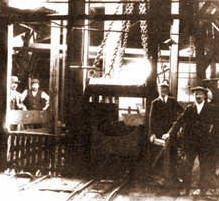 It was stated that William Clark (985) Managing Director of the Stanton Iron Co died suddenly! He committed suicide by jumping down Teversal shaft. Maybe the fact that water from the old New Inn Level sough draining pits in the Upper Meden Valley would have to be pumped at Teversall forever preyed on his mind. Workings to the rise from the pit had had encroached too near the sough and water broke in, whereas precautions should have been taken such as leaving a good barrier as the sough was known about, and no doubt he would have been severely reprimanded as it would have cost a lot of money installing pumps and pipe work and of course manpower.
Surveyor was Ernest Stokes. It was stated that William Clark (985) Managing Director of the Stanton Iron Co died suddenly! He committed suicide by jumping down Teversal shaft. Maybe the fact that water from the old New Inn Level sough draining pits in the Upper Meden Valley would have to be pumped at Teversall forever preyed on his mind. Workings to the rise from the pit had had encroached too near the sough and water broke in, whereas precautions should have been taken such as leaving a good barrier as the sough was known about, and no doubt he would have been severely reprimanded as it would have cost a lot of money installing pumps and pipe work and of course manpower.
Surveyor was Ernest Stokes.
Strikes
There was a strike at Pilsley (Pilsley Coal Co) in November 1889 over banks men’s’ wages, 12s 6d (62½p) – 13s (65p) a week.
The daily rate was increased from 3s 0d (15p) to 3s 2d (15¾p). At the new Alfreton colliery (Blackwell Colliery Co) there was a strike over victimisation (Derbyshire).
Bentley For Sale
Bentley colliery, came to end of the lease, March 1889. The whole of the colliery plant was for sale on 13 May 1889.
Demonstration
The first large scale demonstration by the Derbyshire miners was held in 1889 on the recreation ground, Chesterfield with 51 Lodges and 15 bands in attendance.
Collieries Opened or Sunk in 1889
- Alma No1 (Thomas Holdsworth), North Wingfield, Second Waterloo
- Glasshouse (Redhead and Sellars), Whittington, Silkstone Heather (Heather Colliery Co) Main and Spire, Manager Robert W Knighton (419)
- Highfield (Manor Colliery Co), Oakerthorpe, Waterloo
- Kilburn (Kilburn Colliery Co), Kilburn, Kilburn seam
- Langer Lane (Theophilus Pearson), Chesterfield, Tupton
- Marehay No1 (Marehay Colliery Co (Ford’s), Ripley, Kilburn
- Monkwood No2 (Crow Hole) (Monkwood Colliery Co), Chesterfield, Silkstone
- New Foxley (New Bridge Lane) (Herbert Waller), Whittington
- Peacock (Peacock Colliery Co), Ilkeston, Waterloo
- Swadlincote 4 (J and N Nadin), Swadlincote
- Two Oaks (Henry Rangeley), Unstone, Piper
- Hucknall No2 colliery one shaft was deepened to the Deep Hard seam (Hucknall Colliery Co)
- Walton (James Pearson) - London colliery Threequarter coal and clay
- West Hallam sunk to Kilburn
- Wingfield No2 (West Hallam) 15 feet (4.57m) diameter to 385 yards (352m), the High Main shaft also at 15 feet (4.57m) diameter at 101 yards (92m) east from No2 Wingfield shaft (West Hallam Colliery Co). The complex was greatly troubled by faults.
- George B Blakesley sank 2 pits at the Pottery Works near Woodville station to work 3’ 0” (0.91m) coal and 2’ 3” (0.69m) clay and would continue to 1900.
- Bailey Brook DC shaft was enlarged to 14ft (4.27m) dia and deepened (Butterley Iron and Coal Co).
- Birley East sunk 1887/89 just over the border of Derbyshire into South Yorkshire, East 442263 North 384147. Many of the Bevin boys and Poles entering the industry from 1944-1948 would have their initial training there and then sent to Derbyshire, Yorkshire or Nottinghamshire pits.
At West Hallam Many Pits Lay To The South Of The New Sinkings
- Engine Close (Thomas Gregory)
- Wharf Close (William Ling)
- Engine Ground (Charles Ling) south side of pit opposite Lowcote Gate
- Engine Close (Robert Evans) northeast side of High Lane midway between Lowcote Gate and Moor’s Bridge
- Gin Ground, nearer to Moor’s Bridge
- Pit Close (James Borebank)
- Close pit (Hallam’s) lay about a third of the way between Lowcote Gate and Pumping pit, Engine pit worked up to 1867
- to the west were Brickhill pit (alongside Mapperley Lane) and Stoppard’s at the end of the railway
- Coppice 16 pit (William and Matt Warren).
At the West Hallam colliery (West Hallam Colliery Co) the Hard coal pit was 120 yards (110m) deep
Kilburn No1 380/387 yards (347m/354m)
Kilburn No2 (Wingfield) 379/387 yards (346m/354m), 400 yards (365m) to ‘High Main’
Tupton No3 175 yards (160m) which had a Guibal fan 12 feet (3.65m) diameter, 4 feet (1.22m) wide, horizontal engine, 1 cylinder 24” x 30”, (0.61m x 0.76m) belt and pulleys ratio 3:1, 65,000 cu feet per minute at 2½” (0.06m) water gauge, 6 cylinder boilers at 40lb pressure. The steam was taken down No3 shaft in 7” (0.18m) diameter pipes to work an underground pump.
Pump shaft No4 and
Winding shaft No4 124 yards (113m) to Hard coal and 127 yards (116m) to Soft coal winder by S Rollinson of Basford,
2 horizontal cylinders 18” x 36” (0.45m x 0.91m) slide valves, drum 8 feet (2.43m) diameter 5 feet (1.52m) wide raised 1 tub of 12 cwts in each cage in 20 seconds per wind, giving 500 tons in an 8½ hours shift. The winding rope was 1” (0.02m) diameter with a King detaching hook and the shaft conductors for the cages were pitch pine. Hard coal was worked at No6 shaft.
Boythorpe
Boythorpe Colliery Co Ltd owned Boythorpe colliery (Derbyshire) in 1877 but the proprietors in 1889 were Messrs Brewis Bros. The DC shaft was 14ft (4.26m) and 136 yards (124m) deep and the UC pump shaft was 10 ft (3.05m) dia and sunk to the Blackshale. J Pearce was the Manager.
Closures in 1889
- Awsworth (Awsworth Iron and Coal Co) lease from 1882, shafts 75 yards (68.5m), 70 yards (64m) to coal 3’ 4” (1.02m) finished Michaelmas 1889, Furnace coal gotten prior to lease
- Barlow Lees (Monkwood Colliery Co), Chesterfield, Silkstone
- Bentley (Lenthall, Stevenson and Co, the Bentley Colliery Co) Dronfield, Blackshale 3’ 9” (1.14m), clod above and clay below, Drawing shaft 62 yards (56.5m) and Air shaft 58 yards (53m), seam 1in12 dip, workings between faults, met old works, abandoned 11th Apr 1889, William Frederick Howard (1297) AMICE Surveyor
- Boythorpe (Boythorpe Colliery Co Ltd)
- Brimington (...) Chesterfield
- Bull Close (William Hewitt) proprietor and farmer
- Church colliery, (or Heanor) (E Gillott), Comb and Hard coal, June, unprofitable, owned by Heanor and Marlpool Colliery Co until 1875
- Clinton (Brinsley Brick and Tile Co) Coomb, 1876 – 12/1889
- Coton Park (Henry Green, John Taylor), Linton, (South Derbyshire), Main seam 14 feet (4.25m) thick. Dams were built of brick about 19 feet (5.75m) thick plus 2 feet (0.60m) wood. The workings were abandoned in consequence of water breaking in from side of a roadway, but workings were continued to the East for a time, George Lewis, Surveyor, Derby, 26th Feb 1889, Arthur H Stokes, Inspector 15th May 1889
- Dolly or Barn (John Drinkwater) Bugsworth, (North West Derbyshire), Little mine, 15” to 13” (0.38m to 0.33m) thick abandoned, sunk 1887, 36’ 6” (11m) deep, deposited under Coal Mines Regulations Act 1887, Cross and Eagle Surveyors
- Drift (Henry Rangeley) Unstone, Silkstone
- Goyte (Buxton Lime Co), Burbage (Top pit) abandoned Dec, (Goytes seam and Mountain seam worked out above the Water Level)
- Granville (Granville Colliery Co Ltd) Swadlincote, (South Derbyshire), Woodfield seam, dip 2½º, black bat 7½” (0.19m), bright coal 1’ 2” (0.36m), spiry coal 1’ 3½” (0.39m), bright coal 1’ 5½” (0.44m), holing coal 1’ 0½” (0.32m), finished 25th Mar, George S Bragge (683) Surveyor 27th May 1889, Arthur H Stokes Inspector 6th June 1889
- Newmarket (JH Bircumshaw) shaft 30 feet (9m) and 4 yards (3.65m) deep and drift to Blackshale 1876, and an old shaft 42 feet (12.75m) and another area of coal worked by a drift and 2 shafts, both UCs, finished June 1887, and was adjacent to Alma Cannel colliery with 2 shafts, Drawing pit 15 feet (4.5m) and UC 11 feet (3.3m), Arthur H Stokes Inspector signed plan 12th Sep 1890
- Oakley Lane (Oakley Main), Stubley, Dronfield, (John Stevenson and Co), Drawing shaft 43 yards (39.3m) and UC shaft 41 yards (37.5m), Blackshale seam, tops 3’ 0” (0.91m), dirt 1’ 8” (0.51m), bottoms 1’ 7” (0.48m), met old works, finished Mar 1889, Thos Henry May Surveyor, Arthur H Stokes Inspector 4th Oct 1889
- Peacock (Joseph Shorthose), Ilkeston, Waterloo
- Reservoir (James Fell) Newbold, Chesterfield, Tupton 50 yards (46m), Threequarter 67 yards (61m), abandoned
18th Jan 1889 (sunk 1874/75). To the South was Saunder’s old pit at Highfield and to the E was Orwin’s, signed by Arthur H Stokes Inspector of Mines 22nd Apr 1889
- Stanley Kilburne (SR Cox) Kilburne seam 70 yards (64m), best coal 1’ 11” (0.58m), seconds 1’ 0” (0.30m), thirds
1’ 1” (0.32m), ground coal (holing) 1’ 3” (0.38m), total 5’ 3” (1.60m) water and unprofitable, abandoned June 1889, plan received by Arthur H Stokes Inspector of Mines 27th Aug 1889
- Swanwick (CR Palmer Morewood Esq) Waterloo seam abandoned, 91 yards (83m) at Whites Lane pit, 119 yards (109m) at the Old pit, dip 1in8 to South, Surveyor Edwin Eardley Apr 1889 and plan signed as received by
Arthur H Stokes, Inspector of Mines 2nd May 1889
- Turnoak (Samuel Lowe and Sons) Hasland, 1886, Potters or Deep Hard, (Drawing shaft 45 yards (41m), Pumping shaft 46 yards (42m), passed through binds, strong rock 27 feet (8m), cat jingle 6 feet (1.82m) thick, blue bind 21 feet (6m), coal 4’ 8” (1.42m) plus 1’ 4” (0.40m) dirt, total 6 feet (1.82m), worked out by January, plan deposited under
Sec 38, Coal Mines Regulation Act 1887, via Arthur H Stokes (1505) Inspector of Mines to Secretary of State, Home Department, Surveyor WF Howard AMICE
- Unstone Main (Unstone Coal and Coke Co Ltd) Piper, 30 Mar 1889
- West Field (John Blair), Walton, Tupton Threequarters
- Woodhouse, Dronfield Woodhouse (…?) Drawing shaft 58 yards (53m) and Engine pit 63 yards (57.5m) met old works, dip 1in6 on bord, section- Top bed 3’ 2” (1.0m), Tinker 6” (0.15m), dirt 1’ 4” (0.41m), Soft coal 2’ 0” (0.61m), Thos Evans Inspector of Mines received and signed the abandonment plan on 26 Aug 1889
- Wreaks Lane (Lucas and Son) Blackshale, met old works, Surveyor Thos Henry May, at Dronfield Forge, there was an old shaft and some workings, and an Air shaft and a Drawing pit and drift and Forge colliery Thos Henry May Land Agent, Surveyor and Valuer. Note: the plan of the Forge colliery that worked a seam of coal, top coal 2’ 2” (0.66m), tinker 4” (0.10m), dirt 1’ 4” (0.41m), bottom coal 1’ 9” (0.53m) and finished in 1889 was received at the Records Office in October 1975 this example shows how plans have been lost or lodged with a solicitor or just forgotten about as mentioned previously.
Auction
Bull Close auction 17 Aug 1889. The advertisement stated that the whole of the fixed and loose plant for sale, by
William Hewitt. There was a horizontal winding engine 18” (0.45m) stroke with flywheel and 4’ 0” (1.22m) metal drum.
A donkey engine, to feed the boilers. Headstocks, 2 pulley wheels 4’ 0” (1.22m) dia, 2 winding ropes, 2 pit cages, pit bank weighing machine by Hodgson and Stead of Manchester, cart weighing machine by Pooley, 2 coal tipplers, 2 coal screens.
Rawdon
In July 1889 there were 10 contractors for coal production at Rawdon, 5 men doing heading one each for tramming the coal, banking and loading the boats. There were 13 others underground and a further 41 on the surface. Thomas Bradshaw was the Manager and James Bradford the Undermanager. |


