1928 - Page 4
Manton
Manton colliery at Worksop (Nottinghamshire) (Wigan Colliery Co) was also referred to as Newcastle colliery around this time. (This was another mine named after the Duke).
Digby and Speedwell
The Deep Hard seam at 108 yards (99m) was abandoned at Digby (Nottinghamshire) (Digby Colliery Co Ltd) in Mar 1928 because of roof water, and it was expensive to mine. The nearby Speedwell shaft was 134 yards (123m) deep. The Tupton seam workings at 3’ 2” (0.97m) thick were also left off due to the expense. John Rigby, Surveyor to Digby Colliery Co.
Wooden Headgear Replaced

The wooden headgears at Rufford The wooden headgears at Rufford (Nottinghamshire) (Bolsover Co) were replaced by steel lattice.
New Ollerton Welfare
A Miners’ Welfare was opened at New Ollerton with a £5,000 grant from the Mines Committee. A tug o’ war team was started.
Henry Waby continued to publish the ‘Ollerton Echo’ but it was still generally referred to as the ‘Penny Liar’.
Union
Henry Hicken had been elected Secretary of the Derbyshire Miners’ Association, replacing Frank Hall. Oliver Wright succeeded Hicken as Treasurer 1928-1938.
Explosives
1,537,000 shots were fired during the year. The average number of reportable accidents per year for the 4 previous years was around 4,000 for the two coalfield areas.
Under the Coal Mines Act 1911 and the Mining Industry Act 1920 an annual return to the Divisional Inspector of Mines JR Felton OBE at his office, 8 Oxford Street, Nottingham regarding the amount of explosive used in the year and was to be presented no later than 21st January 1929.
At Bilsthorpe mine 4,744 lb of Gelignite was used and 5,915 shots. Also 1,528lb of Super Rippite with 2,019 shots all fired by electricity (battery).
Pit Ponies
In North Derbyshire there were 108 mines employing 3,940 pit ponies, (about 100 at Williamthorpe).
Boys “ganged” the ponies, i.e. the ponies pulled tubs of coal or supplies and the boys supposed to guide them, usually rode on the crank (i.e. the joint from the pony’s harness that fastened to the tub or tram).

On steep downhill roadways a wooden locker (piece of wood, shown) was put in the back wheel, to act as a brake, and there was usually a drag placed in the rear tub coupling which would dig in the ground if a tub ran backwards whilst going uphill.

Pony with skull cap and eye shield
The ponies harness, called limmers was a pair of shafts either side of the pony’s body with leather and chains over the top, and also fastened to the collar at the front, which allowed the pony to pull the vehicle.
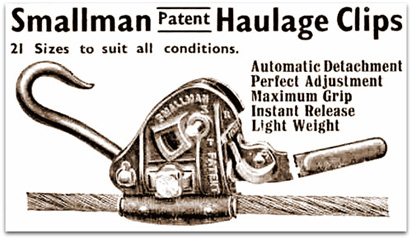
Some pits supplied skull caps and eye shields for the ponies also, as in low gates the pony could crack its head constantly in the darkness. At many pits the tubs were then transferred to endless rope haulages and fastened to the rope using “star” clips or short or long handled “Smallman” clips or screw clips. Some collieries had overhead endless ropes where the tubs were clipped or “lashed” on with a chain. On occasion some pits employed the main and tail system of haulage where a run of full tubs descending a slope would pull up a run of empties.
Of the 108 North Derbyshire pits only 60 mines were using electricity. There were only 311 cutting machines in use, the rest of the coal being hand holed. 28,591 flame lamps and 28,650 electric hand lamps were used for illumination down the pits.
The stables were usually warm and well lit
In South Derbyshire there were 16 pits employing 331 ponies. 13 of the collieries were using electricity and 30 coal cutting machines. 2,634 flame lamps and 2,061 electric lamps were in use. Only 23 mines in total had coal washery plants at the surface, the rest being hand screened only.
By contrast the 46 pits in Nottinghamshire had 3,105 horses or ponies, and 41 pits using electrical equipment, with 333 coal cutters, 21 coal washeries, 17,910 flame lamps and 33,971 electric hand lamps and 858,000 shots were fired.
Stables for ponies were usually constructed between fresh air and return gates so that the general ’smells’ of sweat, manure etc was kept to a minimum. Generally they were well lit. The stables were usually warm as the air was baffled down, so that the ponies would not catch a chill. Individual open-ended stalls for ponies were constructed of brick, generally white washed and had a water and eating trough, peg for its harness and its name posted and sometimes a straw strewn floor. Each pony would have a feed bag to take food inbye with it during the shift. Food consisted of some of the following: bran, mash, chopped hay, oats, maize, peas, barley etc.
Accidents and Vermin
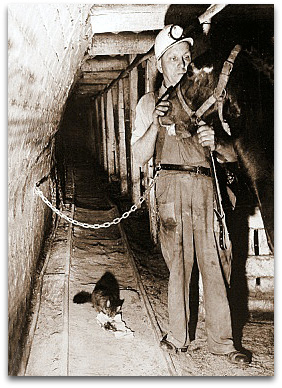
The average number of reported accidents was around 3,500 (How many weren’t?) Unfortunately vermin usually followed the food. Some pits were overrun with flies, cockroaches (e.g. Welbeck), others with mice (e.g. Silverhill), or with rats (e.g. Teversal and Pleasley). Sometimes a cat was ‘employed’ underground (e.g. Bentinck) to keep the rats and mice down. The stalls were cleaned out and the ponies were groomed daily by the ostler, and usually had their tails either docked or braided and had regular haircuts.
Several men and boys at Teversal used to have their hair cut with the horse shears. It was a swift over the top from back to front, just leaving a small tuft of hair at the front over the brow. Not uncommon these days, but in the 1950s everyone knew where they had been for a haircut! Farriers were generally on routine visiting arrangements to see to shoeing etc.
Most ponies were treated kindly by the gangers and many ponies would be treated to an apple or a carrot or slice of bread and a drink from a tin Dudley at snap time, however there were many instances of cruelty, particularly to make them go faster or pull a heavier than normal load. Sometimes whips were used or in some cases pieces of stone thrown at them. There were cases of handlers being caught in the act, who were fined heavily and in some cases sent to jail. Many ponies incidentally came from abroad such as Russia, Iceland (called horses there) etc and even America, and many others came from Wales, Dartmoor and the Shetland Isles.
Horse Dealer and Trainer

Some ponies had their own 'cap lamp'
A Tibshelf dealer in the trade was Jack Bamber. Of course it took several weeks sometimes to ‘break a pony in’. Some ponies were able to help their ‘leaders’ by pushing open air doors with their head or ‘leading them’ back to lit up gates when their lamps had gone out. It has been known for ponies to find their own way back from several miles inbye to the stables at the end of the shift, with no handler. Some ponies had their own ‘cap lamp’ as shown. Of course unfortunately the ponies suffered from other ailments, such as glanders, breathing problems, etc. Many unfortunately suffered from cuts and bruises generally caused by roofing that is, catching their back on low girders etc. Vets were on call for special cases, and routine visits by HM Pony Inspectors kept the ponies in reasonable fitness as any noticeable ailment would be reported and action taken to put the problem right. Dinting used to be carried out in some of the Dunsil seam gates at Teversal so that the pony had to step into a hole between the sleepers, the rails remaining at the original level. The dirt used to be packed in the side of the gate, thus narrowing the same
Not a solution really, as many a pony would stumble. Of course it was not at all good ‘walking’ for the men travelling the gate either. You had to negotiate the sleepers, and the cry from the from the front all way down a line of colliers walking up the gate would be ‘Hold up’,.. ‘hold up’.. ‘hold up’..to the last man, when a more severe obstacle or drop was in the way, or even low roof.
Rescue Regulations
The Coal Mines General Regulations (Rescue) came into force 10th December 1928.
Coal Faces
The greatest number of coalface workings was at depths of between 200 and 300 yards (183m and 274m) followed by many at between 300 and 400 yards (274m and 366m) deep. Next faces were 400 to 500 yards (367m to 457m), then 500 to 600 yards (457m to 549m), 600 to 700 yards (549m to 640m), 700 to 800 yards (640m to 731½m), 50 to 100 yards (47m to 91m), under 50 yards (46m) deep and finally one working at between 800 and 900 yards (731m and 823m) deep.
Output and Manpower
The North Derbyshire pits produced 10,093,259 tons with 41,917 men underground and 10,178 on the surface (plus 969 clerks and salaried persons) at an average selling price of almost 12s 5½d (62¼p) a ton, and the South Derbyshire pits produced 895,883 tons with 3,445 men underground and 845 on the surface (plus 114 clerks and salaried persons) at an average selling price of 12s 4d (61⅔p) a ton. The average yearly income of the miners for 1928 was £113 for Nottinghamshire and North Derbyshire and £110 2s 6d (£110.12½) for South Derbyshire.
Kiveton Park just over the North Derbyshire border into South Yorkshire had its maximum workforce ever at 2,244 men and boys.
Inrush at High Holborn
The Tupton dam at High Holborn failed and the mine flooded in 1928. Pumping had started in 1917. (see 1943)
Fatal Accidents 1928
- Blackwell B Winning, John Nuttall (72) crushed by tub 9 Sep 1928
- Brookhill, William Lindley (34) electrocuted 16 Jan 1928
- Brookhill, Henry Henstock (39) fall of roof 17 Aug 1928
- Coppice, James Harvey (48) fall of roof 28 Mar 1928
- Langwith, Frank Lucas (23) injured ankle on 24 Dec 1927, died of toxaemia 6 Jan 1928
- Langwith, Alf Brown (32) fall of roof 18 May 1928
- Manners, Arthur Daykin (63) caught in machinery on surface 2 Apr 1928
- Shipley, Allen Elliott (33) fall of roof on 13 Jan 1928, died 6 Feb 1928
- West Hallam, George T Robinson (31) fall of roof 24 Dec 1927, died 7 Jan 1928
- West Hallam, Sam Wingfield (27) fall of roof 18 Oct 1928
- Woodside, Walter Tatham (26) overcome by blackdamp, died 29 Mar 1928
- Woodside, Archer Beardsley (30) fall of roof on 8 Nov 1927, died 11 Jul 1928
- Woodside, Jesse Harrison (41) fall of roof 17 Dec 1928.
|