Bentley Colliery Paddy Train Disaster
Doncaster Area. 21st November 1978
The Accident
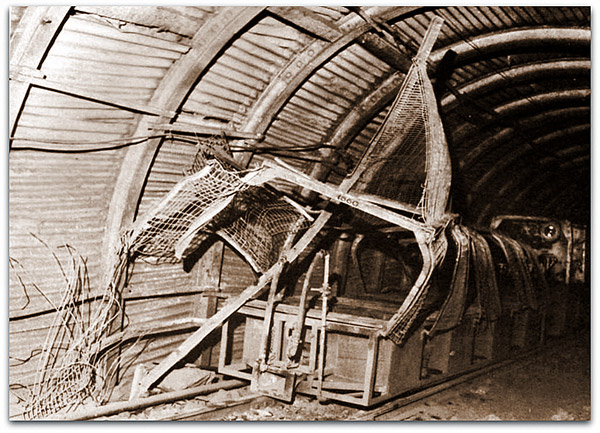
On the night shift of Monday 20th November, 1978, one hundred and fifty two men descended the mine at 10.15 p.m. to commence normal work. Some stayed at the pit bottom area but 42 boarded the D34 manriding train and were taken to the district and 87 boarded two trains and were taken up the D04 gate to 5's Paddy Station.
Drivers of the trains usually worked with their regular conductors. Of the two trains going to 5's Paddy Station, the first was hauled by No.13 Locomotive driven by R.L. Wade with his regular conductor, H.A. Wells. The train consisted of four carriages, the following train of two was hauled by No.18 Locomotive and was driven by G. Shone but his regular conductor did not come to work and his place for that shift was taken by S. Allott. The pit bottom deputy looked at the notice board in the diesel garage where there was a list of names posted of authorised conductors and nominated Allott as conductor. He confused Allott with another conductor named Aylott. Allott was not trained for the work.
These journeys were satisfactorily completed in a normal manner. For much of the remainder of the shift, the locomotives were used to transport materials up and down the D04's incline. At about 4 a.m., three locomotives left the diesel garage to go inbye ready for manriding at the end of the shift. No.13 was the first one driven by Wade; he hauled two carriages which had been repaired during the shift. Wells was his conductor. Repairs had been carried out to the left-hand brake on carriage No. 1660 and a new leaf spring had been fitted to carriage No. 1401. These two carriages were to become the first and second carriages in the accident train.
The first locomotive to go inbye stopped at the arrestor. Wells, the conductor, lowered the impact head and inserted a pin in the handle to hold it in the lowered position. He remounted the empty train and continued up the incline leaving the arrestor in the lowered position as he saw the headlight of a following locomotive, and assumed that this locomotive would follow him up the incline. In the event, this locomotive did not follow him but turned left to D43 District before reaching the arrestor.
Shone was driving No. 18 Locomotive inbye as a light engine approached the arrestor and on seeing it to be retracted, he drove over it without stopping. He decided to leave the arrestor in the pinned down position and continued to the top of the incline.
On reaching the top of the incline, Wade, driving No, 13 Locomotive and hauling the repaired carriages, stopped at No.5's Paddy Station and applied the parking brakes to the carriages which were boarded by workmen waiting to travel out. Shone arrived at the top of the incline where his locomotive was coupled to the two carriages already containing workmen. As it was the custom for the first train to consist of four carriages, he shunted these two carriages further up the incline to collect two of the four carriages which had been parked throughout the shift. These carriages also contained a number of workmen. Wade and his conductor, Wells, assisted in the coupling of these carriages and locomotive as they were aware that Allott, the substitute conductor, was not fully conversant with the operations.
It was intended to form a four carriage train leaving the spare locomotive, No. 13, to follow behind with the remaining two carriages with the remaining workmen, Allott was told by the regular drivers and conductor to sit at the rear of the last carriage which was the customary position for the conductor, so he went to the last carriage, No. 6, and was left behind.
When Wells had completed the coupling of the carriages to make a four carriage train, he signalled with his cap lamp to Shone, the driver of No. 18 Locomotive to pull the train a short distance forward so that No.13 Locomotive could be brought out of 5's cross slit and be coupled to the two remaining carriages to form the second train. According to the official timetable, manriding was not due to commence until 5.40 a.m. and as it was only 4.50 a.m. there was enough time to complete this operation. Shone said that he engaged second gear, released his brakes and started to move down the roadway. There had not been enough time to make a full completion of each specific joint.
The driver understood the signal and instead of setting off properly in first gear he set off in second with the intention of stopping after 30 feet. He tried to stop using the mechanical brake and went into a skid. He then used the service brake several times applying sand, which was the usual technique to get out of a skid. As he neared the Godwin Warren Retarder, he realised that he was not going to be able to stop and then decided to try to drive on and round the turn, hoping that there would not be a derailment. Meanwhile, nobody out of the 65 men on the train, had attempted to use the emergency brake system but two men had tried to wind on the hand parking brakes.
Most of the men on board ducked with their heads between their knees after they passed the Retarder. Locomotive No.18 and the first carriage passed round the curve but there was an impact at the connection between the first and second carriages which were pulled violently at the weld mesh canopy of the second carriage. The joint between the carriages was broken and carriage two, three and four were derailed and left behind. The locomotive and the first carriage came to rest 67 feet further on when the severely shocked driver managed to select neutral and apply the mechanical brake.
Deputies T. Rush, T. McAlister and A. Kenny were riding in the third carriage with overman W. Payne and apart from being shocked, they were unhurt and started emergency recovery operations. Other men on the train rendered first aid and gave comfort to the injured. Men who were waiting at 5's Paddy Station for the second train realised that an accident had occurred and ran down to help with the recovery operations. Soon afterwards a third manriding train returning with men from D34's arrived at the junction and these men also assisted. Deputy T. Rush ran back to the junction and alerted the controller that there had been a serious accident and medical assistance was required.
McAlister, the deputy, got off the train and ran back into the working district to collect supplies of morphia, in doing so he passed the arrestor and saw that the operating handle was pinned down by a bolt; shortly afterwards, N. Smithard, a fitter, also observed this.
At the scene of the accident men were pinned between the last there carriages and the roadside. Carriages 2, 3 and 4 were disconnected from each other and slided over in order to release the men.
Night shift senior overman, R. McGuire, who was already at the surface, went down accompanied by a doctor and a nursing sister. They travelled inbye on a quickly assembled manriding train who was later used to transport the stretcher cases while those who were able walked out to the pit bottom.
All the injured men were brought to the surface within two hours and 18 men sent to hospital for further medical treatment of whom four were temporarily detained. A further 40 were treated for shock at the colliery medical centre. The seven who died were brought to the surface by 9 a.m. |


