The Explosion
On the morning of 22 October nothing was thought to be amiss. The officials seemed to think that the workings were in their normal state. At 04:40 four firemen inspected number 2 pit. At 05:30 the regular workmen started to descend. The firemen assured the workers all was well and ascended to sign reports and have breakfast. Having received these assurances the workforce went about their various tasks.
At around 09:00 a blast was heard on the surface and flame and steam rushed up number 3 pit for a few minutes. Smoke was seen from the upcast pit and air came from number 2. Nothing was seen from number 1 pit, but below ground the miners felt the blast and at once ascended. The smoke was seen in the surrounding area so miners and managers hurried to the pithead. Shortly after 10:00 the Inspector of Mines, Mr Moore, and the Assistant Inspector, Mr Robson, were alerted by telegraph. They arrived at the colliery at noon.
Rescue Attempts
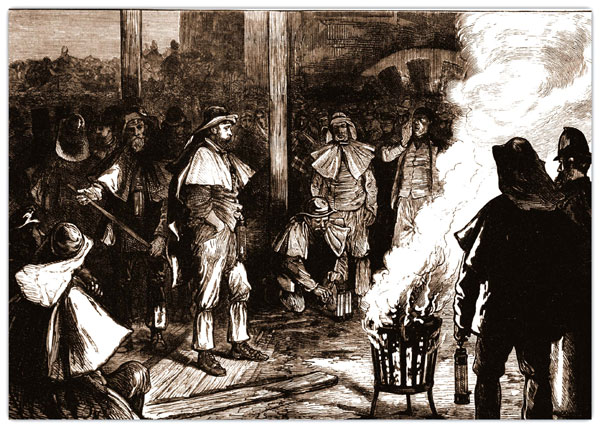
Volunteer Shankers Waiting Their Turn To Descend 23 Oct 1877
(Photo From Scottish Mining Website)
Number 3 pit was blocked by debris falling from the damaged shaft and by tubs and similar being blown up the shaft. The cages and ropes had been damaged, so an attempt at descending was made in a "kettle", basically a large bucket. Air was still travelling down the shaft and voices could be heard at the bottom, below the blockage. Number 2 pit was relatively undamaged, normal winding operations could continue. Moore, Robson and some engineers went down number 2 pit but were stopped by falls and afterdamp. The route to number 3 pit ("More's dook") appeared to be free of falls but was full of chokedamp.
A brattice was constructed to divert the air passing from number 3 pit directly to the upcast, and by this means More's dook became passable by 22:00. Four survivors were found, all badly injured. One of them, a boy, died shortly afterwards. The remaining three were brought to the surface through number 2 pit and sent to Glasgow Infirmary, but all died within the month. Rescue parties explored number 3 pit as far as they could, but were limited by chokedamp and firedamp. Seventeen bodies were found and brought to the foot of the blocked number 3 shaft for later retrieval. The shaft was unstable, and if it closed up the rescuers would be deprived of air so they retreated until the shaft could be secured from above. All hope of finding more survivors was abandoned.
Recovery Phase
The following day, Tuesday 23 October, an underground engine at the upcast was adapted to assist the ventilation. The slide valve was removed and steam sent down. The escaping hot steam rising up the upcast drew the air around the mine in the same way that the furnaces would. By this means 70% of the normal air supply was restored and recovery work could commence. All the men in the northern part of the colliery had left their work and headed for number 2 pit, only to be overcome by chokedamp before reaching safety. Ventilation continued until Saturday 27 when the debris at the foot of number 3 shaft could be cleared. By Sunday the first bodies could be brought up number 3 shaft, but it was not until Thursday 1 November that the mine was free of gas and recovery could be carried on from both downcast pits.
Investigation
The investigations commenced as soon as the air was safe. Significant damage had been done in both the number 2 and number 3 workings, though particularly in number 3 pit. Damage in number 2 pit was mainly in the south eastern part, that in communication with, and ventilated from, pit 3. This was the area where stooping was occurring, so that the place most likely to be liberating firedamp was being ventilated with firedamp laden air from number 3 pit. The official report notes that naked flames and blasting were allowed throughout the colliery, except in the area around the stooping. Near there no blasting was permitted and all lamps had to be "gauze lamps".
The report states: "These gauze or safety lamps were not Davy lamps, but of a kind in common use throughout Scotland. They are much larger that the Davy lamp and give a better light. Mr Moore [the lead inspector] has frequently tested them in gas, and on no occasion has the gas been exploded outside". It is interesting to note in this context that Lupton writing 15 year later inveigles against modifications to the Davy lamp including: "The larger the lamp the greater the force of the explosion, and if the lamp were too large, the explosion would force the flame through the gauze; for that reason the diameter of the gauze must never be larger than 1? inch". In addition, the Blantyre explosion was before Trimdon Grange (1882) and the Bedford Colliery Disaster of 1886 and so the shielding of gauzes from direct currents of air had not yet been introduced. Not withstanding Moore's claims for the Scottish safety lamp, the report's conclusions call for the banning of naked lights and the introduction of locked Davy lamps which "are better than the present safety lamps".
The report also roundly criticises poor discipline (including shots being fired by unauthorised workers), poor ventilation around old or incomplete stoops and the whole method of ventilating one pit from another. The report does not however come to a firm conclusion about how the explosion started.
Aftermath
It is reported that, six months after the accident, Dixon's raised summonses against 34 widows whose husbands had been killed and who had not left the tied cottages which they and their husbands had rented from the mining company. They were evicted two weeks later, on 28 May 1878.
|

 The Blantyre Mining Disaster -


