PARKHOUSE No.7
(Catty Pit as it was better known)
Clay Cross, Derbyshire. 7th November 1882.
An explosion of firedamp at this pit killed 45 men and boys. One of the countries worst disasters. At the inquest the 14 strong jury did not include a single miner, but comprised of gentlemen farmers, grocers and a couple of employed craftsmen.
Only the flunkies were working as the pit was on short time. Gaffer Dunn lost two sons and several relations. In 1893, a William Dunn was killed at work and the Clay Cross Company, "agreed to make a gratuity of £15 to his widow, he being an underviewer whilst on duty, but no precedent be thereby established"
About The Pit
The colliery was the property of the Clay Cross Iron and Coal Company which was founded in 1837 by George Stevenson when the colliery was operated under the name of George Stevenson and Company. In 1847 the Clay Cross Company took over the colliery. The total area of the coal of the Company amounted to 7,500 acres of which 2,050 had already been worked. To develop this large area sinkings had been put down at different places and the shafts were numbered starting at No.1.the accident took place at the No.7 Pit which was at Park House near Danesmore.
The pit was sunk in June 1868 to work 1,200 acres of coal with the objective of connecting with two other pits Nos. 2 and 4. a large portion of the coal that used to go up the No.2 shaft was then worked from the No.7. In sinking the Park House work was carried out on the upcast and then the downcast alternately. The diameter of the downcast was 13 feet and it was 179 feet deep to the Black Shale Coal. The upcast was 10 feet in diameter and 180 yards deep to the bottom coal.
A ventilating furnace, eight and a half feet wide and seven feet long was fixed near the bottom of the upcast shaft. The furnace on bars and a dead plate was put down in October 1868 and had been the means of ventilating the pit ever since.
The main roads north and south from the pit bottom, the cross cuts on the north side of the incline on the south side were worked by endless chain haulage. The engine plane was worked by a single rope driven from the chain gearing by a part of a horizontal steam engine which was driven by steam from surface boilers and taken down the downcast shaft. After 445 yards on the south side the chain incline connected with the south level of the No.7 pit which was the old south level of the No.2 pit. The workings to the rise of this were called the 'top pit' and those to the east and immediately west of the No.7 levels were called the 'bottom pit'.
As the workings in the top pit advanced to the rise in a westerly direction it was found necessary to sink a shaft near Clay Cross in order to facilitate the entrance to the exits in these parts of the workings. This shaft was the No.8 pit which was 9 feet in diameter and 120 yards deep with a ventilation furnace 7 feet square on bars and a dead plate at the bottom of this pit.
The water made in the No.7 pit and the workings was pumped to the surface by a direct acting pump fixed close to the bottom of the No.7 downcast shaft and the steam to drive this engine was taken from the steam pipes for the hauling engines. The north and south levels in the No.7 pit were driven in 1868, 1869 and 1870 and coal was first worked on the north side in 1869 and on the south side in 1870. The chain incline was driven in 1871 and 1872 and the 'straight up' incline driven between 1871 and 3. This formed the old part of No.2 and No.7 pit and connected with the No.8 shaft which ventilated the rise portion of the workings.
The dip workings in No.7 were started in 1869 and coal was first worked from there in 1876. The district was ventilated from the No.7 downcast and the air returned to the No.7 upcast shaft and crossed over the main chain level by an overcast. The north cross cut was driven between 1877 and 1879 and coal was first worked from there in 1879.
This was the district where the explosion took place. The level was driven for about 350 yards to the north east and the working were divided into three districts called Nos. 1, 2 and 3 flats. The ventilation to the first two flats went up the first gate, passed the workings of the first two flats and returned on the low side of the second flat by an overcast into the main return of the cross cuts. The third flat was ventilated by air passing above the afore mentioned overcast, from where it went through a head, round the faces and into the main return. The ventilation of the No.7 pit was separate from the others except on the north side where air was passed through to keep the old workings clean. The air passed down the No.7 and returned through No.2 upcast.
Mr. Crudace was the certificated manager of the colliery and the persons under him at the No.7 pit were, George Dunn, the underviewer who was assisted by the deputies and assistant deputies or corporals. James Parker, William Renshaw and Walter Cutts were the corporals in charge of the part of the pit where the bodies were found after the explosion. All the corporals and deputies also took orders from Mr. Dunn. James Parker, William Renshaw, Michael Parkin and Joseph Stone were among those killed in the disaster. George Dunn jnr. had charge of the blasting in the pit and naked lights were in use in the No.7 pit.
PARKHOUSE No.7
(Catty Pit as it was better known)
Clay Cross, Derbyshire. 7th November 1882.
Dreadful Colliery Explosion At The Parkhouse, or No. 7 Pit
Belonging To The Clay Cross Coal And Iron Company
George Dunn, the underviewer at the colliery, said that the workings were satisfactory and the ventilation good. He had been unwell for several days before the explosions and had not been down the pit for a week but while he was ill both the deputies called at the house to keep him informed of the state of the pit.
He lived close to the pit and heard the explosion from his bedroom. He jumped from his bed and could see smoke and fumes coming from the downcast shaft. He immediately dressed and went to the No.8 pit and was among the first to go down that shaft. When he got to the bottom he made his way with others to the No.7 shaft and they met gas along the incline and had to take another route. After several attempts they managed to get as far as the old junction and made their way to the engine house where they found three doors blown out. In the furnace there was a small fire and he believed that the blast had blown out the fire.
Joseph Philips was in charge of the furnace that day and his body was found to be badly burnt. He went along the intakes towards the cross cuts but he was overcome by the afterdamp and had to be brought to the surface and was not strong enough to go down the pit again.
Someone thought he heard voices from the Parkhouse Pit and shouted down,
"Hello. Are you all Right?"
"Yes, we have come from the workings but we have no lights."
It was considered too dangerous to send lights down the shaft and the men went to the No.8 Clay Cross shaft and came up safely.
After the blast, George Parker of Flax Place Road who was the underviewer at the No.2 Pit, went down the pit and found the bodies of John Buckberry and some others who he did not know, in the third flat. The day after he went up the north incline where he found several more bodies. George Hewitt and his two sons were found in the north incline and John Stanley was in No.82 stall and that of Richard Taylor in the wind-way.
Edward Reeves of Danesmore, a miner who went down with several of the exploring parties, discovered the bodies of Richard Dunn, Thomas Chappell and John Beeson at the bottom of the old junction, about 20 yards from the stalls in which they worked. In the enginehouse at the bottom of the north incline they found the bodies of Joseph Stone, Joseph Dunn, William Slinn and Berry and Michael Parkin outside the engine house. At the bottom of the pit they found James Parker, William Dunn and William Martin. The two Dunns were alive but the other two were dead.
On the third flat they found William Briggs, William Renshaw, George Michell, Thomas Goaler and William Vickers. In a stall to the north side they found Phineas Baker, the “Old Pensioner”. The bodies of Samuel and Edward Baker were found a little way down the gate from their stalls and that of William Squires was in a heading near the engine house. He also saw the bodies of Philip Scothern and John Holmes at the entrance to the first flat and those of Emmanuel and Edward Clarke in the first stall in the dip workings.
The Men Who Lost Their Lives Were:-
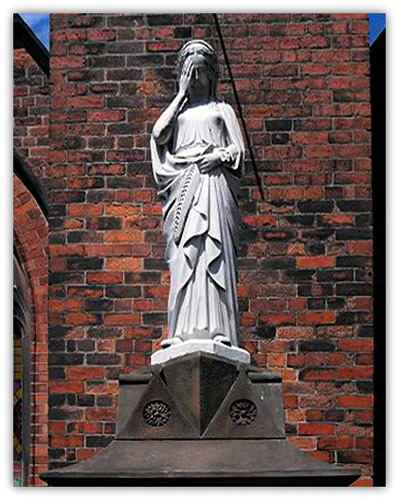 
Memorial Images From Midlands Heritage
Thanks to Simon Debell
For Point Out These Images

Click to Enlarge - Double Click to Reduce
 William Dunn aged 19 years, inclineman. William Dunn aged 19 years, inclineman.
Thomas Chappel aged 22 years, labourer.
Richard Dunn aged 37 years, dataller.
James Parker aged 25 years, corpral.
Joseph Stone aged 35 years, corpral.
Joseph Dunn aged 32 years, dataller.
Michael Parkin aged 47 years, corpral.
William Slinn aged 37 years, bricklayer.
Thomas Berry aged 34 years, bricklayer.
William Martin aged 21 years, engineman.
William Clark aged 20 years, loader.
Joseph Phipps aged 47 years, furnaceman.
William Martin aged 21 years, engineman.
William Clark aged 20 years,loader.
Joseph Phipps aged 47 years, furnaceman.
William Renshaw aged 36 years, corpral.
William Vickers aged 20 years, chainman.
Thomas Goaler aged 28 years, loader.
William Squires aged 35 years, labourer.
Edward ??? aged 15 years, loader.
Aaron Beeson aged 23 years, loader, of Danesmoor, son of Henry Beeson, who also died
John Beeson aged 15 years, driver, of Danesmoor, son of Henry Beeson, who also died
The Stallmen:-
Henry Beeson aged 44 years, of Danesmoor. Father of Aaron and John, who also died
 Joseph Walters aged 27 years. Joseph Walters aged 27 years.
James Edwards aged 32 years.
Phillip Scothern aged 47 years.
Emanuel Clark aged 43 years.
Richard Taylor aged 30 years.
John Holmes aged 50 years.
William Shelton aged 21 years.
Owen Richards aged 36 years.
James Smith aged 32 years.
John Fowler aged 52 years.
Joseph Stone aged 50 years.
James Simms aged 41 years.
Thomas Birkin aged 38 years.
Jacob Stone aged 35 years.
John Buckberry aged 37 years.
John Stanley aged 45 years.
Richard Taylor aged 25 years.
Elias Bowler aged 34 years.
George Mitchell aged 45 years.
William Briggs aged 28 years.
George Hewitt (46) Widower (daughter Hannah 19, George 11 (miner) and William (scholar)
Thomas Hewitt aged 22 years, single, son of George.
Joseph Hewitt aged 21 years, single, son of George. (Hewitt information from 1881 Census)
Phineas Baker, the “Old Pensioner” aged 53 years.
Samuel Barker aged 42 years.
The Inquest
 The inquest into the deaths of the men was opened at the Victoria Hotel, Clay Cross before Mr. C.G. Busby, Coroner for the Hundred of Scarsdale. All interested parties were represented and Marmaduke Lee, a miner of Danesmore, Thomas Downing, miner of Clay Cross and John Eaton of Staveley were several of the explorers who gave evidence of finding bodies in the mine. The inquest into the deaths of the men was opened at the Victoria Hotel, Clay Cross before Mr. C.G. Busby, Coroner for the Hundred of Scarsdale. All interested parties were represented and Marmaduke Lee, a miner of Danesmore, Thomas Downing, miner of Clay Cross and John Eaton of Staveley were several of the explorers who gave evidence of finding bodies in the mine.
Mr. Evans, the Inspector, examined the mine after the disaster and found that the effects of the explosion were mainly in the cross cuts in the Nos. 1 and 3 flats and he believed that there had been three explosions almost simultaneously. Up to then, he believed that safety lamps were not required in the collieries of the Midland counties but he recommended that safety lamps be used in future.
The Coroner summed up the evidence and the jury brought in the following verdict:-
- The jury agrees that the deaths of the 45 men seen by us were caused by an explosion in the Parkhouse or No.7 Pit on the 7th November last.
- We believe the explosion occurred in the cross-cuts in No.1 or No.3 flats and that the weight of evidence indicates it's origin in No.3.
- We are agreed that there has not been any negligence or carelessness on the part of the Clay Cross Company or their officials.
- We believe that proper precautions were taken for the ventilation of the pit.
- We are agreed that the explosion was caused by a sudden influx of gas, but no one was to blame for the same.
We also make the following recommendations:-
- That the night deputy should make his examination as late as possible previous to the men going down to work in the morning.
- That the day deputies should make more frequent examinations on the days when the pit is not at work.
- We are also of the opinion that safety lamps should be used in the deep part of the mine.
- We also appreciate the services of the explorers, who risked their own lives to save others, and to recover the bodies.
- And we also express our deep sympathy with all the bereaved ones who had suffered in this calamity.”
- Park House No4 Colliery Closed After 97 Years -
|

 Parkhouse Colliery, Known As Catty Pit - Page 1


