The Disaster
The Explosion
On the morning of the explosion and for some days previous to that Richard Wild and his two sons were working at a fall at the top of the intake to the No.2 face to make the inlet larger. The cutter had never cut across the face to the end.
Alfred Teasdale, a dataller who had been working in the place on the afternoon before the explosion said that the fall took place on the Sunday night of the week before the disaster. He had been working under it the night before and seen that the roof was very bad. In all probability there was gas coming off from this weighting.
The explosion occurred at 7.50 a.m. on Wednesday morning of the 21st. December Mr Alfred Tonge was the General Manager and he lived two miles away from the pit. He heard the explosion and went straight there arriving at 8.20 am along with Dr Hatton, the surgeon to the colliery.
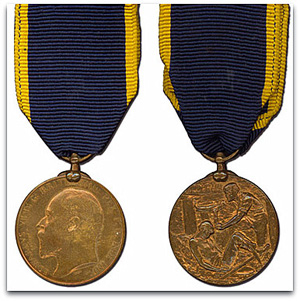 Repairs were made to the gearing of the downcast and at 9.00 am Mr Tonge led the first rescue party, entering the pit with eight other men: James Polley, James Moss, John Hilton, William Markland, John Hardman, Robert Roberts, John Herring and James Hartley. They did this at great risk to themselves as they were entering unknown and very dangerous conditions with every risk of further explosions. Repairs were made to the gearing of the downcast and at 9.00 am Mr Tonge led the first rescue party, entering the pit with eight other men: James Polley, James Moss, John Hilton, William Markland, John Hardman, Robert Roberts, John Herring and James Hartley. They did this at great risk to themselves as they were entering unknown and very dangerous conditions with every risk of further explosions.
They descended without breathing apparatus but with safety lamps, caged canaries and mice to test for after damp.
They each later received the King Edward Medal - the miners' VC.
Alfred Tonge handed a written account of his narrative to the inquiry as evidence. It read- "I was in my house and heard the report about ten minutes to eight and was informed shortly after that there had been an explosion. When I got to the pit, I found smoke coming from the upcast shaft. I saw that a portion of the casing of the upcast shaft had been wrecked. I went forward to the downcast shaft and was informed by the mechanical engineer that one of the cages was fast in the shaft as a result of the explosion. There was no damage to the engine and as the No. 3 shaft was out for the purpose for travelling, we set to work to liberate the cage in the downcast. Fortunately one of the cages appeared to be free, but it could not be brought up because the other cage was fast. We had to disconnect the rope from the cage that was fast from the drum and after that the free cage was brought to the surface. I got to the pit about ten minutes past eight and the cage was free about nine o'clock." When we got the cage working I took five men in the signal cage and went quietly down calling at the Trencherbone mine. Llewllyn Williams the undermanager of the Trencherbone mine was at the mouthing and I asked if all the men were all right there. He said, 'Yes'. They had suffered from fumes but everything was clear.
I took him with me in the cage and we went further down. On our way down we encountered obstacles in the shaft, broken signal wires and bearers, and we were in considerable alarm as to whether the cage was going to stick or not. But it kept freeing itself and broke through all the obstacles. We got to the Yard mouthing and, on going in, saw the underground fan blown inwards towards the downcast pit. Going forward through the electric haulage house, which was the main route to the upcast shaft bottom, we found great wreckage and got through into the No.3 pit bottom shunts where we found a boy. There was afterdamp and it was hot but we went forward. We picked up the boy and sent him back up the pit. Going forward we found Byres struggling, and we carried him to the cage. I looked about and found more dead bodies lying about, and then we decided to go down and see how the men in the Arley were.
We first took the injured men up to the top and then set out immediately to go to the Arley mine. Having passed the Yard mine, I heard a shout, 'Send the cage to the Yard mouthing' which was repeated mechanically over and over again. We had been at the Yard mouthing and I could not understand it, but I remembered that it would be the other Yard mouthing and we found the source of the noise. It was a lad from the workshops, Staveley. We got him out and lifted him up and asked him what he had been doing and were there any more. He said that there was a lad close to him, dead. We took him to the top and then went down into the Arley mine again having difficulty as the cage kept sticking and freeing itself. We called to the Three-Quarters mouthing in the shaft, which was not used, instead of going down the tunnel and getting to the Arley mouthing. We asked if they were all right and they replied that they were and wanted to go up. I said there were others in a worse position than they, and they must be patient.
When we got to the Arley, we found regular pandemonium. Men were crying to come up, they were ill with the fumes. Some were worse affected than others and the undermanager, John Bullough was amongst them calling upon them to be men and doing what he could. Do as we could we could not get quietness. I shouted to those round about, 'Put those men who are ill in the cage, and the strong keep back!'. I was afraid of a panic and that the men would rush the cage and seize ropes or anything, but fortunately they did not. The men who were ill were put in the cage and taken to the top. I went with them, came back to the Yard taking others with me and sent the cage to the Arley to fetch another load. The Arley and the Trencherbone men were all got out safely and we soon had a fair number of the men down in the Arley rescuing. Six of the Trencherbone men who had been in the cage at the Trencherbone mouthing when the explosion occurred, were raised to the surface after the suffering Arley men and the other Trencherbone men were all got out last. It was all done with one cage, signalling by knocking on the cage, as the proper signalling apparatus had broken down. There was no mishap whatsoever in getting the whole of the 545 men out and we had them all out in three and a half hours.
After getting down into the Arley Mine again, I took a few men and went on the East level, where we found a fire at an air crossing. I left instructions for the fire to be put out and went forward with two men to the down brow. I also instructed Turton and Scott, two reliable men, to proceed a short distance to the Plodder tunnel to see if there were any fires, and if so, to report. I then went forward down the down brow and at the bend of the brow, after calling out, heard a man respond. The man was able to give his name as Devonport. I gave him a drink and sent a man back for the doctor and a stretcher. Doctors Lee and Russell had come down with us in the cage. Devonport was carried out on the stretcher and taken to the surface. As the falls wee so bad further on in the down brow, I decided to return to the pit, and it was there reported to me by Messrs. Turton and Stott that they had found a fire but had not been able to put it out. I asked them to return to it to do so but to be very careful of the fumes.
I returned to the air crossing on the East level where the men were engaged in putting out a fire. By this time Mr. Gerrard, H.M. Inspector of Mines and several mining engineers had arrived at the spot. It was decided to restore the air crossing. At about this time news was brought to me that Turton, the fireman who had been sent to put out the fire had been overcome by fumes. We did what was possible for him and he was sent to the surface.
The next operation was the restoration of the air crossing over the No.1 East North Plodder, Top Yard, and Three-Quarters districts. After restoring this, the air crossing over the North Plodder Jig was restored. The only ventilation that was being effected in the mines was the natural ventilation combined with a little assisted ventilation, due to the continuous running of the Trencherbone fan, all the rest of the fans had been put out of action by the force of the explosion. The stand-by surface fan was intact, but the casing at the pit top was damaged and had to be put right. This was completed early and the surface fan was ready to run in nine and a half hours after the accident.
After restoring the air-crossing in the north Plodder Jig which gave the ventilation a chance to get into three important districts, I went along with the Inspectors and other engineers to consult with a Consultative Committee on the surface. It was decided not to put the fan into operation as there was still some doubt as to whether there was any fire in the mine. Returning down the mine, we again went into the down brow and fixed a tight cloth stopping in the brow with a view to forcing the air into the down brow workings. The finishing touches to this operation were affected by the men with 'rescue' apparatus. Shortly after this, Mr. Gerrard, himself, and a few others decided to make an inspection of the Three-Quarters mine thinking it possible that a few of these men, being near the shaft, might be still living, and that it was possible to bring them relief. We went in at the intake end and were able to get into the workings and out by the haulage road to the pit, having found a dozen bodies and having been convinced that there was no one left alive in the mine. |


