| Enoch Joined the North Staffs Miners Association
Enoch joined the Butt Lane branch of the North Staffs Miners’ Association. Then after his marriage, becoming lodge treasurer within a few months, and check weighman in 1875. Later in the same year he was made treasurer of the association, and two years later he was elected general secretary, a position he held until his death.
(Elected and paid by hewers, as a check-weighman he would be responsible for ensuring miners received the full amount due for the coal they dug and would act as their legal representative.)
Thanks to Bill Edwards For the above photos
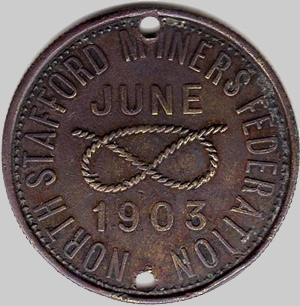
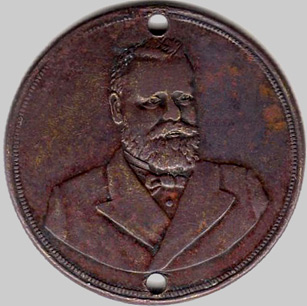
A brass miners' association badge, issued by the North Staffordshire Miners' Federation. Such badges signified that their wearers were paid up members of the Federation either up to or commencing from June of 1903. The Obverse of this badge bears an impression of a Staffordshire knot while the reverse depicts the full frontal portrait of what appears to be Enoch Edwards.
Edwards helped to establish the “Miners’ Federation of Great Britain” (MFGB)
In 1889, and became a leading figure in the new organisation. He was national treasurer from 1889 to 1904 and succeeded Ben Pickard as president from 1904 until his death in 1912.
In the eighteenth and early nineteenth century colliers in every coal-mining area attempted to form unions. Colliery owners refused to negotiate with these organizations and the colliers were invariably defeated. The 1830s saw a growing market for coal. This improved the bargaining position of the colliers and in 1831 and 1832 miners in Northumberland and Durham joined together to gain a reduction in hours and the abolition of the truck system. This encouraged miners from other parts of the country to form district associations.
In the summer of 1888 the price of coal began to rise. All over Britain miners began to talk about the need for a pay increase.
 |
When colliery owners rejected the claims of the Yorkshire Miners' Association, its leader, Ben Pickard, sent out a circular inviting all miners "to attend a conference for the purpose of considering the best means of securing a 10% advance in wages and of trying to find common ground for action." The Conference took place in Derby on 29th October, 1888 where the formation of a new national union was discussed but no agreement was reached.
Ben Pickard called another conference in Newport on 26th November 1889. |
Pickard selected Newport as it was the fiftieth anniversary of the Chartist Newport Uprising. Those attending included James Keir Hardie, Thomas Burt, Herbert Smith, Sam Woods, Thomas Ashton and Enoch Edwards. At the conference it was decided to form the Miners' Federation of Great Britain (MFGB). Officers elected included Pickard (president), Woods (vice-president), Edwards (treasurer) and Ashton (secretary).
Royal Commission in Mines
The unremitting attention paid by the Miners Federation of Great Britain (MFGB) to the need for increased safety in coal mines, carried on persistently for fifteen years and had a considerable effect on the Home Office. Not for a moment was the Home Secretary allowed to forget the demands of the MFGB, while Parliament more and more became a sounding board which roused echoes through the country. Pressure was building up and the great increase in January 1906 election in the number of mining MPs also had its effect, Enoch was elected at this time and was also appointed on 7th June 1906 to the Royal Commission in Mines.
But the accident rate in the UK was still much too high and the Commission conducted painstakingly and complicated investigation into all matters that seemed then to bear upon the health and safety of miners. |
|
The Coal Mines Act of 1911 which followed hard upon the final report of the Commission passed through Parliament with much less opposition than usual. Its provision with six parts and nearly a hundred sections made it at that time the most advanced mining law in Europe or America.
It was a far cry from the meagre provisions of the 1850 Act this most extensive detailed and technical state regulations of the daily working of a great industry.
Some of the new provisions are very far reaching in effect and of great importance for the workers in the mine and all those engaged in the coal industry.
They give increased power to the workmen, who, acting by a majority, can now demand more stringent inspection by elected fellow-workmen for the safety of all their fellows. This, plus all the other aspects of the Act, and the owners will obtain much greater security for the mines as a result of the Act.
The elaborate Act was in itself a magnificent tribute to the work of the Miners Federation and to the unity of the miners which made it possible for the leaders to carry on in the country and in the House of Commons the campaign that was responsible for bringing it into being. It was the reward of twenty years of mounting agitation and marked a great step forward and Enoch Edwards played his part in that.
|