| Enoch Edwards Death
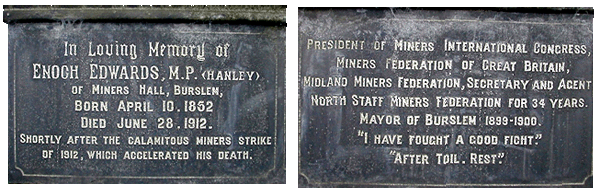
An announcement was made 28th June 1912 that stated; We deeply regret to announce the death of Mr. Enoch Edwards MP which took place at Southport at twelve minutes past two this morning in the presence of his son, councillor T.H. Edwards, Mr E. Edwards had a nervous breakdown after a prolonged strain of the recent national strike of miners. He had been in indifferent health for some time. Last Friday however he sustained a stroke and his condition was perceived to be very serious.

Consecration of Burslem Cemetery
"The Mayor then stood upon the steps and declared the cemetery open as a burial ground, and also as a recreation park, to be used for walking, riding and driving.
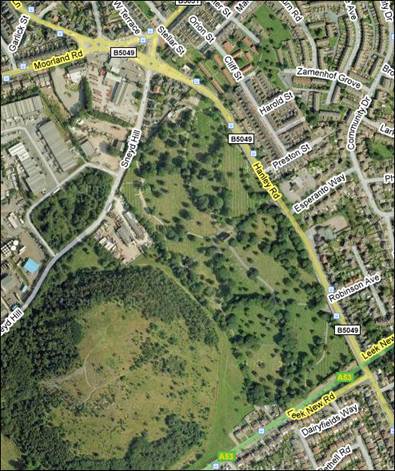
The cemetery is in a very suitable position, between the Leek New Road and Smallthorne. It rises slightly to the Smallthorne portion, and is about 28 acres in extent. A large portion has been tastefully laid out with plants and evergreens, by Mr Matthews, of Milton.
The whole has cost about £17,000, the plans being made by Mr Richards. The wall is a very handsome imitation of Kentish rag work, and is formed of local stone. There are three handsome gates, with palisades, from Messrs George Smith and Co of Glasgow. The contractor for the roads was Mr J Walker, of Crewe. Two handsome lodges in Gothic style have been erected by Mr J Bowden, of Burslem, and give a very pleasing aspect to the entrances.
It is only necessary to add that the greater portion of the cemetery forms a picturesque public park, and by the arrangements of the Council there will be nothing unseemly or thoughtless in its use as such. It is anticipated that the cemetery will be much patronised as a promenade. Its central situation has already caused a large attendance on Sundays, and this is expected shortly to extend to other days of the week."
Enoch Edwards Death
The Late Mr. Enoch Edwards M.P.
The Staffordshire Sentinel July 2nd 1912
The oldest inhabitant of North Staffordshire cannot call to mind such a scene as was witnessed on Monday afternoon at the funeral of the late Mr. Enoch Edwards, M.P., J.P., President of the Miners Federation of Great Britain. From all parts of the country delegates, representing various interests, came to attended the last solemn rites at Burslem, drawn thither by an absorbing desire to show honour and respect for the memory of a comrade high in their own and the world’s estimation, one who had fallen while furthering the interests of men in general, and of those of the mining fraternity in particular. The deceased fell asleep at Southport on the 28th day of June, where he had gone to recuperate after a protracted period of anxiety. The body was brought home on Saturday, and was laid to its long rest in the Burslem Borough Cemetery on Monday afternoon in the presence of an immense concourse of people, whose number it would be difficult to compute. Considering the short notice for completing arrangements, the number of interests represented was amazing. The procession was one of the largest, if not actually the longest, that the district has so far seen, and as may be gathered from the lists given below including representatives of almost every class of industry throughout a very wide area.
It has been arranged that the various deputations and representative public bodies, and those unattached, who wished to show their respect by attending the funeral of the deceased gentleman, should assemble at the Old Town Hall, to await the cortege which started from the Miner’s Hall in Moorland Road, and accompanied it to the Clowes Memorial chapel in Church Street. Long before the time due for the procession to move a large number of people assembled at all favourable points of vantage on the route to be taken. The road way was exceedingly well kept by a large force of the County Borough Police (numbering 137). The cortege was headed by a couple of mounted police. The hearse, with coffin almost buried in floral tributes, was followed by two open landaus filled with beautiful floral tributes, wreaths, also hung on each side of the six coaches containing the mourners, family and immediate friends.
At the Town Hall an immense procession was already waiting to join the cortege and with it walked to the Clowes Memorial Chapel by way of Market Street, St. John Street, Market Square and Church Street. It was not an easy matter to find accommodation for all who walked in the procession. The mourners and immediate friends were seated in the body of the chapel, and every seat in other parts of the building from floor to ceiling was occupied. Even thus, a considerable number of people who desired to be present were disappointed.
The service was conducted by the Rev. J. Teece, address by the Rev. J. Griffin, a former minister of the church. The Rev. T. Jackson, President of the Methodist Conference, also addressed the congregation.
The procession from the church to the cemetery included the hearse and mourners, choir and members of the Clowes Memorial Church, friends, representatives of 42 lodges in North Staffordshire, Midland Miners Federation, Miners Federation of Great Britain, TUC, National Labour Party, Scottish Miners Federation, and other regional federations, Coal Owners Association, Corporation of Stoke-on-Trent, Stoke Board of Guardians, Magistrates Associations, North Staffordshire Trades & Labour Council, Local Liberal Associations, the Burslem Conservative Club. North Staffs Symphony Orchestra, North Staffs District Choral Society, the Salvation Army, and the Stoke-on-Trent Fire Brigade etc.
Excellent order prevailed, despite the immense crowds which quietly awaited the mournful procession on its way from the chapel to the cemetery, the route taken being by way of Church Street, St. John’s Square, Market Street and Moorland Road. The police arrangements which had worked so well in the public thoroughfares were seen to even better effect in the cemetery itself. A large circle was formed around the grave, leaving room for the mourners and preventing congestion. The concluding sentences of the funeral service were said by the Rev. J. Teece, and then Mr. Albert Stanley M.P. Secretary of the Midlands miners Federation, delivered an oration, a hymn was sung by the church choir, and the mourners and friends having retired, a very large number of people filed quietly past the grave. Casting a last found look upon the coffin containing the remains of a worker who had laboured so long in the public weal. The crowd quietly dispersed.
The Staffordshire Sentinel, 17 September 1879
Conclusion
Enoch Edwards was emphatically one of the men of his time, he laboured for better working hours and pay and conditions for the miners both locally and nationally and by means of the International Congress which he assisted to promote. He was president of the International Miners Congress and frequently attended the meetings on the continent and went to the United States as a trade union representative and was received by president Roosevelt. He hoped to further improve industrial conditions both abroad and at home and to stimulate the causes of international understanding and good will into the bargain. In one way and another Mr. Edwards was an enormous force for material, morel, social, political and international progress, and his success was all the greater because he adopted conciliatory methods while pursuing his purposes resolutely.
The local miners’ and miners everywhere have lost a leader who not only fought their battles resolutely, but had the good sense to perceive that moderate courses sometimes succeed best.
The fact that he was held in high regard by the coal owners, that they seldom hesitated to submit confidential information to his inspection when controversy arose, was an asset of immense value to interests committed to his care, even though it was not always appreciated by others as it might have been.
|
The Miners' Federation of Great Britain became the National Union of Mineworkers (NUM)
on 1st January 1945. |
|
|