There were two
broad types of breathing apparatus in general use for the purpose of affording
respiratory protection against poisonous or irrespirable atmospheres. These were:
-
(1) Tube Breathing Apparatus;
(2) Self-contained
Breathing Apparatus.
(3) Escape Apparatus. recommendations
were made by the Chief Inspector of Mines that simple and suitable self-rescuers
should be provided for men working underground
Tube
Breathing Apparatus.
The
Fourth Schedule to the General Regulations (Rescue) 1928 required each Central
Rescue Station to maintain 4 sets, and each colliery employing 100 or more persons
underground one set, of tube breathing apparatus. The eighth Schedule to the regulations
required the official calling assistance in case of emergency to requisition the
"smoke helmet" or other apparatus serving the same purpose.
 1.- Helmet
Type. This type
of apparatus allowed the wearer to go a limited distance into a dangerous
atmosphere by obtaining fresh air, forced through a tube, from a point beyond
poisonous area. 1.- Helmet
Type. This type
of apparatus allowed the wearer to go a limited distance into a dangerous
atmosphere by obtaining fresh air, forced through a tube, from a point beyond
poisonous area.
The Spirelmo type comprised
a leather helmet with an apron which completely enveloped the head of the
wearer; the fresh air being delivered to him, through an air tube of two-ply canvas
insertion rubber with an internally embedded wire armour and an external canvas
fabric covering. The air was pumped into the helmet by means of a hand or foot
operated bellows worked by another person. The air tube is 3/4"diameter, usually
in 2-60ft. lengths, and fitted with screwed unions.
Ivan
Briggs wearing smoke helmet and Asst Superintendent Radford on bellows.
When in
use it was vital for the bellows to be operated continuously, to supply a
continuous flow of fresh air to the wearer, and to maintain a pressure above that
of the atmosphere, in the helmet.
2.-
Equaliser Types.
In
these types of apparatus bellows were not used, but a rotary blower might
or might not be used.
All these apparatus were fitted with an air flow equalising
device which had the function of converting the intermittent flow of air to a
very nearly uniform flow, thereby reducing the air flow resistance of the tubing
to a minimum. This was important since a high resistance induced lung fatigue
in the wearer.
The air flow equalising device was either of the Briggs
pattern, a box shaped bellows carried on the back of the wearer, or a corrugated
tubular shaped bellows, the Haldane pattern, which connected the mouthpiece to
the air tube. On inspiration the bellows contract as air was drawn from them,
and air began to flow along the tube, whilst during exhalation the bellows expanded
to their normal size and kept the air flowing steadily along the air tube. In
this way the air resistance was kept down to about l-l/2" of water gauge, whereas
if the air flowed intermittently, at a high rate during inspiration, and then
stopped altogether during expiration, the resistance would build up to as much
as 10"- ll" of water gauge.
 The Antipoys
Apparatus. (1) This apparatus comprised head harness, nose clip, vulcanised rubber mouthpiece, rubber disc type inhalation
valve, Tissot type exhalation valve, Haldane equaliser device, body belt and air
tube with strainer. The Antipoys
Apparatus. (1) This apparatus comprised head harness, nose clip, vulcanised rubber mouthpiece, rubber disc type inhalation
valve, Tissot type exhalation valve, Haldane equaliser device, body belt and air
tube with strainer.
The
Bloman Apparatus. (ii) Was similar to the Antipoys but had, in addition a hand operated rotary blower mounted on a japanned
steel case designed to contain the whole apparatus when not in use. See picture
The
Briggs Apparatus. (iii) Comprised a Briggs equalising device, with mouthpiece and breathing tubes, inlet valves
were mica discs, the outlet valve was of the Tissot types. Air flow depended entirely
on the equaliser device as bellows were not permitted for use with this Apparatus.
Tube breathing apparatus-made by Siebe, Gorman, Ltd.
Precautions
when using short distance tube breathing apparatus.
The
approved types were for use over a limited range of forty yards, and this
distance was not to be exceeded. Care had to be taken to avoid damaging the breathing
tubes, and air supply tube. Bellows had to be operated continuously on the helmet
types when in use.
A small bird and a flame safety lamp had to be
used and observed continuously at the fresh air end of the tube.
The air
supply tubes should be underwater tested at least at six monthly intervals.
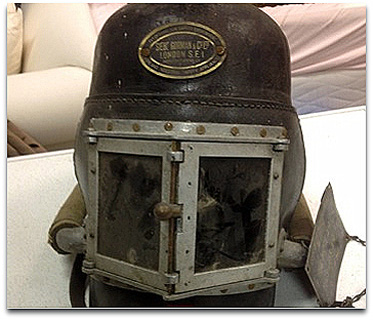
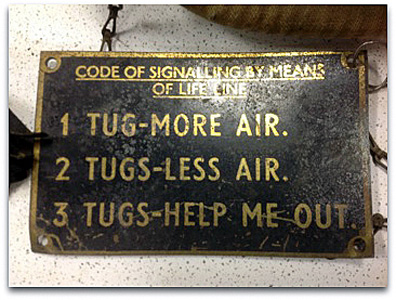
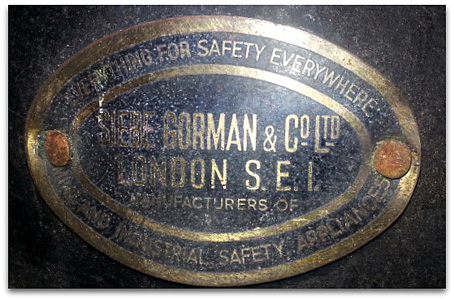
RARE SIEBE GORMAN AND CO FIREMAN'S AND MINER'S FIRE SAFETY HELMET

From: Les McClelland
Sent: 24 Nov 2013
Subject: Siebe Gorman
I have recently listed a Siebe Gorman mining smoke helmet from the 1930's I bought in Nottingham.
The listing is coded 161158680586. If you click on the number or put it into an eBay search the item will appear.
The price is modest and the item very much a part of mining history. I thought you may be interested.
.jpg) .jpg) .jpg)
.jpg) .jpg) .jpg)
|


 Two Systems of Rescue Brigades