Life On The Station
All men working in or under the Brigade are to conform Strictly to the Rules and Regulations which may from time to time be issued by the General Manager.
A member of the Brigade is always on duty, night and day, at each of the Central Stations.
A turn out switch is fitted in the Watch Room at each Central Station which when in closed position rings all fire bells throughout the stations.
Call bells are fitted to all the men's quarters.
An occurrence book is kept at all stations in which all duties and all information relating to the work of the stations are entered. All calls to fires are entered in red ink.
A board is fitted in the Duty Room on which is shown the names of the men attached to the Station, and any man entering or leaving file station is able by moving a slide opposite his name to indicate whether he is in, out, on duty, on leave, or sick. The duty man is able there- fore at a glance to see how many men he has in the station, and where the others can be found.
At 7 a.m., 2 p.m., 6 p.m., and 10 p.m. the duty man will ring up the public telephone exchange, to see that the telephones are in order. The result must be entered in the occurrence book together with any observations thereon.
When receiving a call by telephone it is essential that the clearest possible information be obtained as to the name of the Colliery, the name of the resident manager, and as to whether the fire is above or below ground. To ensure that the message has been properly received, it should be repeated to the sender.
All bells are fitted to all the mens quarters.
Charlie Snarki Shoveling Coal
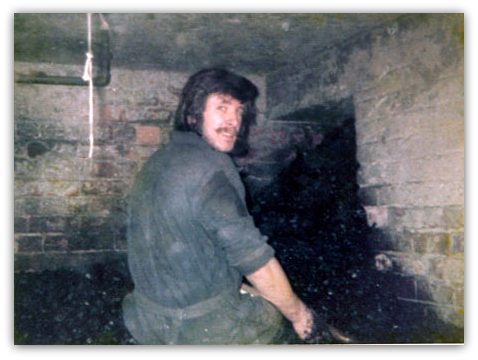 It had to be done. 12 Tons of coal would slide off the lorry ready for a Mines Rescue Officer to shovel into the boiler room. It had to be done. 12 Tons of coal would slide off the lorry ready for a Mines Rescue Officer to shovel into the boiler room.
Alternatively the Station Superintendent could pay to have the driver blow the coal in to the bunker, that was a non starter. If, on the other hand, the Superintendent was away they could ask the driver to blow it in, out of the goodness of his heart, and he usually did.
Volley Ball

Volley ball was played 3:30 to 4pm every day for team building and fitness.
When the station first opened it was not wired into the mains.
A network of tunnels were dug under the station so that the men could practicing rescues under ground. The tunnel under the volleyball court had a huge store of batteries which were used to power the station in those early days.
Fire Fighting Competitions

Fire fighting competitions between pits was not only popular and competitive but it was good training and practice.
Shef, who was judging the competition, can be seen standing in the background.
Five-A-Side Football
Five-a-side football was taken very seriously and was played everyday. It built up team spirit and was supposed to help the men keep fit, however everyone of them ended up in hospital at one stage or another. After Philip tore a cartilage in his knee they were told to play the game without their pit boots, plimsolls became the order of the day.

Five-a-side football was taken very seriously
and was played everyday. It built up team spirit and was supposed to help the men keep fit, however everyone of them ended up in hospital at one stage or another. After Philip tore a cartilage in his knee they were told to play the game without their pit boots, plimsolls became the order of the day.
|

1959, the 'YOUNG ONES'
Back, Ray Davis
Left to Right, John Dixon, Harry Meakin,
Terry Astle
|
|


