1924 - Page 1
Parliament
 Ramsay Macdonald
 |
The first Labour Government took office from January 1924 with Ramsay Macdonald as Prime Minister until November 1924, when the Conservatives were returned to power until May 1929 with Stanley Baldwin as Prime Minister once more.
President of Board of Trade, Sidney Webb (Lib) 22nd Jan 1924-Nov 1924.
Secretary for Mines Emmanuel (Manny) Shinwell MP (Lab) 1924.
Secretary for Mines GR Lane Fox MP (Con) 1924-1926. |
 Stanley Baldwin Stanley Baldwin |
Rail Strike
There was concern from Nottinghamshire miners regarding the potentially crippling rail strike by workers of LMS and LNER, because members of the NUR in Nottingham had agreed to join the strike.
Union
Enoch Overton was elected President of the Derbyshire Miners’ Association 1924-1938.
Chimney Was Felled
At the closed Green pit, Pinxton colliery the chimney was felled on 6th February 1924.
Shotfiring Accident
On 23rd February 1924 there was a shotfiring accident at Birley East pit (South Yorkshire) and 4 men were killed and a further 4 injured. A Public Inquiry was called. This pit would be used as a Training Centre in the 1940s for new entrants and Bevin boys and Poles some of whom were sent to Nottinghamshire and Derbyshire pits as well as Yorkshire pits.
Collieries Sunk or Opened in 1924
- Birchwood Vale (Birch Vale Colliery Co), 2 adits to Blackshale Dec 1924
- Bolsover (Derbyshire) (Bolsover Colliery Co). A new No3 shaft at 21 feet (6.4m) diameter was commenced. The No1 shaft was deepened from the Top Hard to the Waterloo seam at 402 yards (367m). No2 shaft was deepened to the Blackshale at 757 yards (692m).
- Sinking was commenced at Blidworth (Nottinghamshire) on 1st August 1923 to excavate the pit top and sinking proper began on 15th October 1924. It was sunk by the Newstead Colliery Co and was originally called Newstead No2 colliery. Height above sea level was 397 feet (121m). A huge winding-engine and powerhouse combined, was built for both shafts. It was 248 feet (75m) long by 46 feet (14m) wide. No other of this magnitude is known in the region. Markham’s of Chesterfield manufactured the winding engines. The Company built a model village for the workforce to house 1,200
- Dent Main (Dent Main Colliery (1924) Ltd), Birley Wood, 28 Parkgate, 10 on s/f, Manager, R Rolfe (2382)
- Harworth colliery had electric winders from the start. The shafts were completed to 894 yards (817m) deep to the Barnsley Bed or Top Hard in 1924. The Manager was William Wright (271), Undermanager Thos Jones (2nd) and Agent Donald McGregor for the Barber Walker Co
- Hill (Bagshawe and Mills) Bagsworth near Chinley, Day eyes, Yard
- Littlemoor (Henry Blair and Sons) Newbold, Deep Soft, Undermanager Henry Blair (2nd class cert)
- Newbold High Main (Henry Blair and Sons) Newbold, Piper and Whitehouse (Boythorpe Co Ltd) Chesterfield, to Piper seam
- Ollerton (Butterley Co). Sinking continued.
- Wallsend (Wallsend Collieries Ltd) adits to Silkstone, mm 1924
- Whitwell (Shireoaks Colliery Co) was deepened to 698 yards (638m) at the No2 shaft. The pit was sunk in 1890
In October 1924 Staveley Coal and Iron Co completed Do Well colliery sinking, E441866, N374687, Manager H Kirk (1511). The Company wanted to make it a non-union pit. The same company deepened Warsop from 560 to 920 yards (512 to 841m).
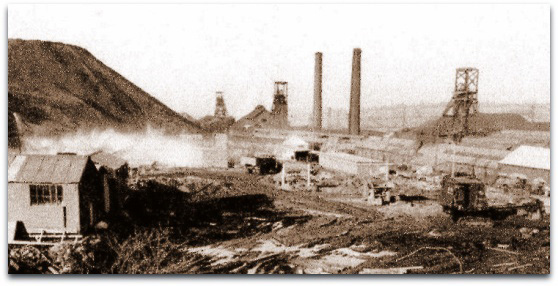 Sinking continued at Glapwell (Derbyshire) (Sheepbridge Coal and Iron Co Ltd) with a third shaft at 18 feet (5.5m) diameter down to the Blackshale seam, at 636 yards (581m). No2 shaft was deepened to 669 yards (611m), manpower increased to 1,708 u/g / 422 s/f. There was an inset at 290 yards (265m) for the Waterloo and another at 603 yards (551m) for the Low Main. In 1921 the manpower was 1,432 underground with 348 on the surface; New Lount (Leicestershire ) (Leicestershire Colliery and Pipe Co Ltd), Middle Lount, Nether Lount, Roaster 96 u/g and 77s/f. Sinking continued at Glapwell (Derbyshire) (Sheepbridge Coal and Iron Co Ltd) with a third shaft at 18 feet (5.5m) diameter down to the Blackshale seam, at 636 yards (581m). No2 shaft was deepened to 669 yards (611m), manpower increased to 1,708 u/g / 422 s/f. There was an inset at 290 yards (265m) for the Waterloo and another at 603 yards (551m) for the Low Main. In 1921 the manpower was 1,432 underground with 348 on the surface; New Lount (Leicestershire ) (Leicestershire Colliery and Pipe Co Ltd), Middle Lount, Nether Lount, Roaster 96 u/g and 77s/f.
Hardstoft No2 Oil Bore
A further drilling for oil, No2 bore, some 200 yards (183m) west of Hardstoft oil well (Derbyshire) on the other side of Chesterfield Road was commenced in May 1924 and at 760 feet (231.5m) a small amount of crude oil was encountered. However the hole was continued down but only yielded gas at a depth of 1620 feet (494m). This gas was used to fire the boilers. The hole was further continued down to 3,125 feet (952.5m) where a flow of salt water was encountered which hampered drilling for a time. After reaching 3,130 feet (954m) drilling was abandoned by May 1925; however the gas was used for quite some time afterwards as fuel and lighting for the wooden huts which had been let out to some local people. A further hole was planned nearby – see 1925.
Annesley Purchased and Hardwick Leased
The New Hucknall Colliery Co purchased Annesley (Nottinghamshire) in July 1924 from the Annesley Colliery Co. The Hardwick Colliery Co had leased it from Worsick and Co in 1904. The General Manager of the Company was still Capt Percy Muschamp.
Tug o’ War Team
The New Hucknall colliery tug o’ war team won several trophies that year competing against other local pit teams.
Butterley Company
The Butterley Co set on a full-time Welfare Officer. The company also introduced face conveyors at Kirkby Summit (Nottinghamshire).
Arthur J Cook

Arthur J Cook
Arthur J Cook the Miners’ Leader from South Wales travelled the coalfields and gave speeches to thousands at the weekends. He had great influence over the miners and their families. The coal owners did not welcome him. The Lammas in Sutton-in-Ashfield was one such venue. Others were Bulwell Common, Hucknall Park, Kirkby Oaks and the Ruffs. My Grandfather Eli White was a great believer in his ways and was an orator in his own right, speaking to huge crowds of miners on Sutton Lammas. Unfortunately it was to be his undoing later, in 1926. The unions also had Members of Parliament who seemed to be bringing hope to the masses. This of course was false hope. Miners who had suffered poverty listened intently, but the truth was that when there was no work, they joined the dole queue and accepted handouts to keep them and their families alive.
Joseph Jones was General Secretary of the Miners’ Federation of Great Britain in 1924.
No Evidence Of Lung Disease
At the 1924 Empire Mining Congress Dr Haldene stated “To my mind there is as yet no evidence that coal miners as a class suffer in any way whatever from the inhalation of dust”!!!! How wrong he was. Many miners would suffer a long and painful death by being unable to breathe due to the air sacs in the lungs being choked with fine dust less than 5 microns in size.
Miners’ Colic
Miners’ colic was caused by lack of salt. Advised to take salt water, salt bacon. Even in the late 20th Century miners were given salt tablets to put in their 8 pint water dudleys by the NCB to replace that lost through sweat in the very hot deep mines.
Wage Offer
The Nottinghamshire miners were offered an increase of 3¾d (app 1½p) per shift which they accepted although other poorer areas rejected the offer. Now though, competition from other fuels was weakening the miners’ position.
Mansfield Wooden Headstocks Condemned
On 1st September JR Felton (1924-1937) replaced FH Wynne (since 1921) who had been promoted to Deputy Chief Inspector on 24th August and one of his first jobs as Mines Inspector for the district was to condemn the wooden headstock at the No2 shaft at Mansfield colliery (Nottinghamshire) (Bolsover Colliery Co). This had to be replaced by steel lattice and was made by Plowrights of Chesterfield. Almost normal operations were able to carry on by the erection of a temporary winding structure with a single pulley and single deck cage was installed beneath the existing headgear, whilst the new headgear was constructed. Coal production shifts at the time were two shifts, 7am to 2pm and 10.45pm to 5.45am, Monday to Friday and on Saturdays a short dayshift 7am to 10.30am.
Bond's Main
Bond's Main (Derbyshire) had been put up for sale in 1923 and the Clay Cross Co purchased it and redeveloped the pit in 1924.
Aerial Ropeway
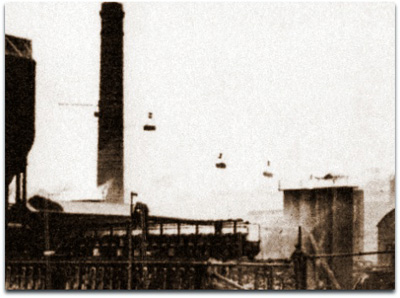 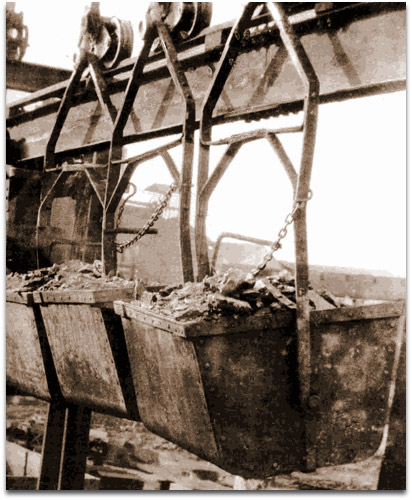
R White and Sons of Widnes erected an aerial ropeway for dirt disposal with 30 buckets an hour capacity at Bestwood (Bestwood Coal and Iron Co) in 1924. Many other companies would install this system of dirt disposal.
Butterley Company Headquarters
The Butterley Co moved their HQ from Codnor to the Colliery Offices at Ironville.
Non-Unionist Pit
In October, the Staveley Colliery Co wanted to make their Do-Well pit non-unionist.
British Coal Was Needed
Higher wage rates were granted and National agreements made because British coal was needed and in demand due to the French occupation of the Ruhr.
Butterley Company Pits
It was noted that at Little Hartshay colliery (Derbyshire) UC pit 20 yards (18.25m) deep to Blackshale, no water, Basset pit 55 yards (50m) away 42 yards (38m) to Blackshale, 20 yards (18m) to water and at Deep Pit, a further 154 yards (140m) away it was 60 yards (55m) to Blackshale, 24 yards (22m) to water. At New Langley (Butterley Co Ltd) Soft coal 3’ 5” (1.04m), batts 2’ 0” (0.61m), Roof coal 10” (0.25m), batts/clod 9” (0.23m), coal 2’ 5” (0.74m) and Deep Hard seam, Jays 1’ 3” (0.38m), scuds 5” (0.13m), hard coal 2’ 8” (0.81m) all abandoned 1st March. The pit was coupled through to Bailey Brook as an emergency exit. Do-Well pit, 93 yards (85m) to Waterloo was nearby (later Marlpool pit?).
Peak Manpower
In 1924 in Derbyshire there were now 49,879 underground miners out of the peak manpower of 1,213,724 men on books throughout the country.
The Following Pits Were Closed in 1924
- Allpits New (SE Redfern Ltd), Chesterfield, Blackshale abandoned, Manager: Jack A Tankard (3946), Undermanager: J Fox (no cert) stopped
- Ballarat (G Dunlop) New Whittington, Tupton Threequarters and fireclay, discontinued
- Birchwood Vale (Birch Vale Colliery Co) adits to Blackshale begun in 1923, abandoned 1924
- Brimington Chesterfield, coal abandoned
- Calow (Calow Colliery Co), Blackshale, 4/4
- Frith Wood (Thos A May) Dronfield, Silkstone discontinued Dec 1922
- Grassmoor No11 2nd Waterloo discontinued 12 Dec 1924
- Gun Lane (JT Bollington) Heage, Footrill, dip 1in2½, advancing face in Alton? (coal 11” (0.28m), dirt 3” (0.05m), coal 1’ 6” (0.46m) more than likely Belper Lawn seam), stopped Sep 1923 and pillars robbed near pit bottom, old hollows met to west by 1924. A new adit driven into old workings was abandoned, Surveyor Steve G Lee
- Hady Farm (GE Clark), Chesterfield, Yard and Kilburn 2 u/g/ 2 s/f, 17th Oct, Surveyor Hubert Blackshaw
- High Field (Sharpe) Piper, info from Mr J Sharpe one of late owners, DC to UC shaft driven Feb/Mar 1921, head cont'd, William Henry Burgin 20 Feb 24
- Holmley Lane (JB Dawson), Coal Aston, Silkstone
- Lark Hill (GS Aitken) Yard, day eyes March 1923 abandoned, Surveyor GT Ingham (1038), then later owners (Burton, Oldfield and Sheldon), New Mills, Yard abandoned, worked old pillars 1926, see 1928
- Littlemoor (Henry Blair and Sons), Newbold, 5/3, Deep Soft 3’ 8” (1.12m) extracted and 8” (0.20m) left up because of weak bind roof, 4 adits, 4 air shafts, 1 trial shaft, met old works, abandoned 30 Jun 1924, Surveyor Leonard Kelsall (773)
- Lount (Leicestershire), Middle Lount seam, 3 mine mouths, old works met, cert Surveyor DM Harley?
- Moor Edge (Pickford, Holland and Co) Ganister and Halifax Hard standing
- Nab Wood (Gregory, Reddish and Co Ltd) Holymoorside, Ganister, fireclay and Halifax Hard, discontinued Feb 1921
- Ollersett Hall (Ollersett Collieries Co Ltd), New Mills, Glossop, sunk by Messrs Brocklehurst in 1854, 30/5, Big or Yard mine, worked Sep 1913 to Dec 1924, 68 yards (62m) deep, and intake adit and water loose, pumps broke down and workings completely flooded, old workings previously to 1888, abandoned 27 Dec 1924, Surveyor John Mort (187) c/o George Eagle, Surveyors
- Starveham or Starvehim Valley (Edwin Glossop), Hartshay, Mickley 2’ 6” (0.76m) or Norton worked, 6 adits, one shaft, heads and benk work, Ashgate 1’ 6” (0.46m), grey fireclay 5’ 6” (1.68m), dip 1in3, not profitable due to water, Surveyor: JG Lander (308), position E437450 N351 330, E437370 N351300
- Upper Birchwood (Butterley Co Ltd) Yard abandoned
- Wallsend (G Orwin and Sons), Newbold, 15/4 Tupton abandoned 39th Sep
- Whitemoor (Greenwood and Jackson), Belper, Alton or Holten seam 2’ 10” (0.86m), Naughton abandoned 18th Jan unprofitable, Apr
- Woodhouse (G and W Woodhouse), Heanor, Coombe, 2/1, abandoned 17 May 1924, bad roof and water trouble, Surveyor JG Lander, Owner GW Woodhouse
- Upper or Old Birchwood (Butterley Co Ltd)
(19).
|