1925 - Page 1
Sherwood Forest Under Threat From Railways
In early February it was stated that Sherwood Forest was under threat from devastation by railways. The new pits in the Dukeries needed to be served by rail to take away the vast production expected from the new sinkings in the area, and the land owners Lord Savile and Earl Manvers although concerned about the LMS proposals to build lines through the forest, realised that although a petition had been presented to Parliament the result would be inevitable they had told the Nottinghamshire County Council.
Samuel Commission Inquiry
On 25th June 1925, Charles Markham was asked a question at the Samuel Commission Inquiry regarding manpower at the pits. He was asked if he was aware that ⅔ of the mines in the country employed less than 500 men in each and produced only 18% of the total output? He replied ‘That is so. They want shutting up. Today a colliery is no good at all unless it raises 20,000 tons a week!’
A dispute regarding pay and conditions was bubbling in July 1925 when a stoppage at that time had been averted with the promise that a Royal Commission would be set up to investigate the miners’ claims.

Slump In The Mining Industry
There was a slump in the mining industry, and the end of the Ruhr occupation on the Continent. The British mines were now running at a loss in the face of European competition. 31st July 1925 was hailed as Red Friday. The PM Stanley Baldwin provided £23m total subsidy for the industry. Winston Churchill Chancellor of the Exchequer had restored the £ (pound) to parity with the US $ (dollar). Immediately the price of British coal exported abroad went up (particularly to South America, Canada and the European market) and cheap foreign coal came pouring in, and the industry faced bankruptcy unless prices were slashed. However Stanley Baldwin the PM had awarded the coal bosses a subsidy for 9 months so that they could continue to pay existing wage rates.
Gedling
There were 70 horses employed at Gedling (Nottinghamshire) (Digby Colliery Co) and underground were 2 sets of stables, one that could accommodate 75 horses. The High Hazles seam has been worked extensively but at present the only seam worked was the Top Hard where there was a washout present in the workings. The cage had 3 decks for simultaneous decking.
Change Of Name
J Oakes and Co became Jas Oakes and Co (Riddings Collieries) Ltd.

|
Teversal
Up to now large quantities of Teversal Top Hard coal had been used in the blast furnaces at Stanton Iron Works. The cage in the Shonkey upcast shaft at Teversal only held 4 or 5 men at a time and due to the slow speed, to wind out a full shift of men could take a couple of hours. It was a wet shaft also and the men were soaked by the time they reached the surface.
Coal Cutters At Pinxton
Chain coal cutters were installed at the Pinxton pits (Pinxton Collieries Ltd), replacing 3 old bar cutters. Pinxton Welfare was opened during the year.
|
Ollerton
Collieries Sunk or Opened in 1925
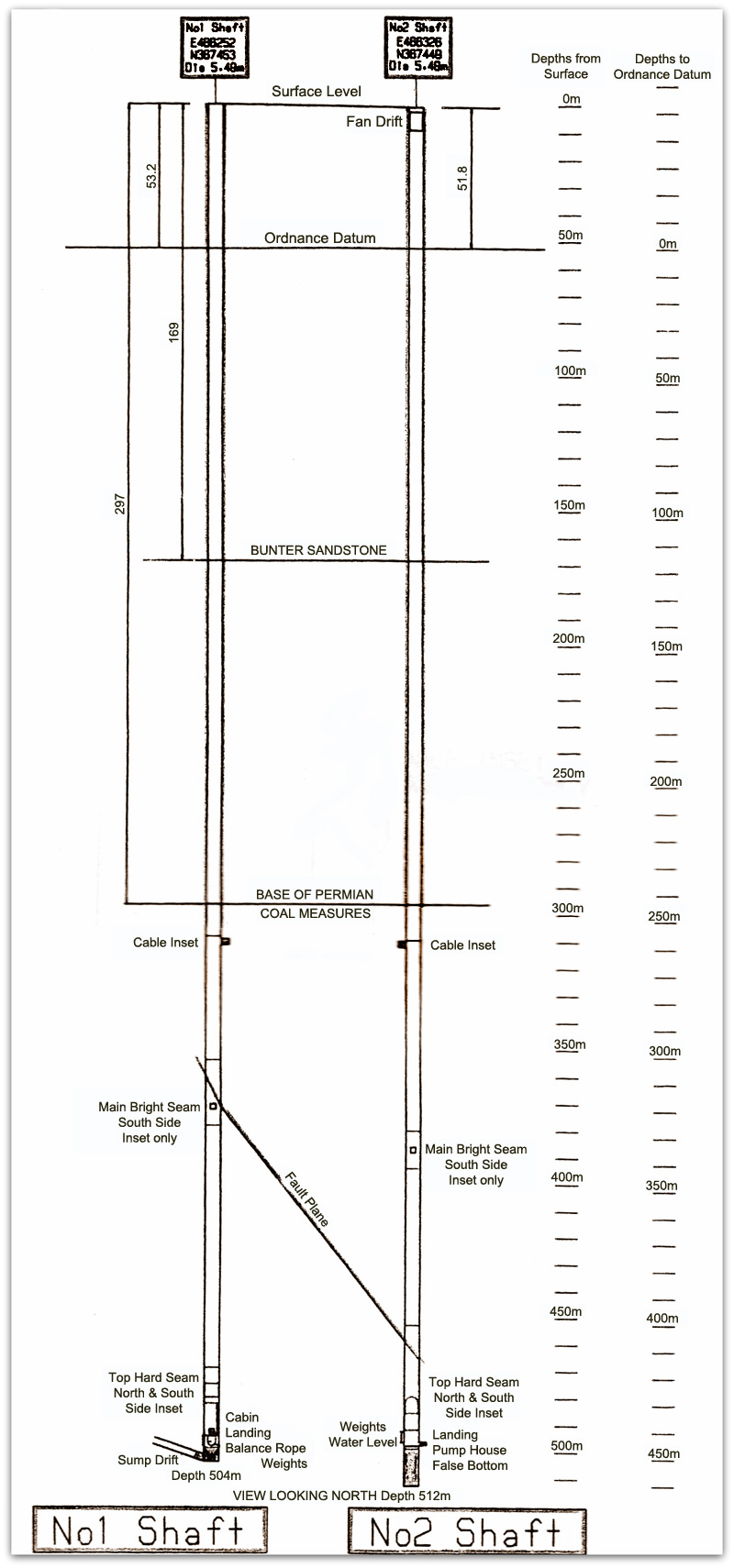
Shaft sinking was completed at Ollerton on 25th October 1925. It was the last mine to be sunk by the Butterley Co, who had leased 7,000 acres of mining rights, 5,000 of which were from Lord Savile of Rufford Abbey. The sinking cost £850,000. The total cost with all the surface buildings, village etc came to £1.5m. See shaft section. Note the No1 Shaft was deepened by 5 Yards (4.5 m) in 1970 and a sump drift driven.
- Ashgate ( William Morris) Chesterfield, Silkstone the sinking of two 20 feet 2 inches (6.14m) diameter shafts was commenced at Bilsthorpe (Stanton Ironworks Co) on 2nd July 1925. The site clearance had commenced on 14th Jan
- Bond Lane (Butterley Co Ltd) Heage, sinking
- Coppice No3 shaft sinking (Shipley Colliery Co)
- Dore Ganister (Webster and Co (Sheffield) Ltd) Dore, Halifax and ganister
- Firbeck Main (Firbeck Main Collieries Ltd) Barnsley Bed opened, 651/273 – this colliery near Worksop was always classed as a Yorkshire pit although the shafts are in Nottinghamshire, E458215, N386015
- New Mickley or Mickley New closed in 1917 re-opened (GH Booker)
- Derbyshire miners were offered employment at Ollerton in preference to Nottinghamshire men. Why? It was because Derbyshire miners probably had over 900 years of mining blood in their veins, but mainly it was to transfer men from their local pits that were to close in the near future. Men from the Heanor area in particular were offered jobs as Butties or chargemen
- Owler Bar mine (Pickford, Holland and Co Ltd) Totley, Coal
- Pingot Clough (Jas Morton) New Mills, Little Mine; Vale (Thos A May) Birley Vale, Parkgate
- Thoresby (Bolsover Colliery Co) began sinking at Edwinstowe on the edge of Sherwood Forest.
Royalty Payments
Mining royalty payments per ton of coal raised varied from 1.47d (0.6p) to 6.0d (2½p) ave 4.07d (1.7p) in Nottinghamshire, between 1.2d (½p) and 10.05d (4¼p) ave 3.74d (1½p) in North Derbyshire and between 1.98d (0.82p) to 5.0d (2p) ave 3.73d (1½p) in South Derbyshire.
Oil Boring And Tibshelf Top Pit
No3 oil boring at Hardstoft was begun in August 1925, some 200 yards (183m) north east of the No1 oil well at Biggin (Derbyshire). At 60 feet (18m) down old mine workings were found, thought to be in the Deep Soft coal, but unknown, and then at 470 feet (143m) the hole encountered old Blackshale workings from Tibshelf Top Pit (Derbyshire) and the Manager of the mine and the Drillmaster went underground to search for the hole in an old disused roadway. The hole was continued down and volcanic ash was found at a depth of 3,420 feet (1,042.5m) and a lava bed at 3,640 feet (1,109.5m). After drilling 3,825 feet (1,166m) and finding no oil, the well was abandoned in June 1926. One might say that this was fortuitous, because if oil had been found in quantity in the area, the local collieries of Tibshelf, Holmewood, Williamthorpe and Grassmoor etc may have been closed much earlier.
Oil At Shirebrook And Warsop
A small amount of crude oil seeped into the workings at Shirebrook during the year causing great upset, but fortunately it was only a small amount. Oil would seep into neighbouring Warsop (Nottinghamshire) and other pits in North Derbyshire also.
Pumping At Marehay
At Marehay (Butterley Co Ltd) pumping was commenced to protect the surrounding mines.
Record Output At Gedling
During 1925 a record 4,300 tons was produced in a day at Gedling, (Nottinghamshire) (Digby Colliery Co) in two shifts from the Top Hard seam. |