1962 - Page 4
Coke Ovens Closed
In June Hardwick Coke ovens in Derbyshire were finally closed.
Inter-Coalfield Transfer Scheme
Inter-Coalfield Transfer scheme was started in 1962 due to the closure of many mines, particularly in the North and North East and many Scots and Geordies came to work in the ‘long life pits’ in Derbyshire and Nottinghamshire.
A comprehensive transfer scheme providing allowances to cover the costs of moving from one Area to another was introduced in April and hundreds from the North East Coalfield took advantage of this.
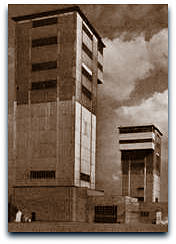 In October there was an urgent need for more living accommodation to be found for the hundreds of miners due to be transferred from Scotland and the North. Hundreds of men had arrived in Nottinghamshire and Derbyshire from Durham during the year and a few from Scotland to work at the large collieries in the district. However hundreds more were expected and the word was out for temporary accommodation in lodgings to be found for them until permanent homes could be built for them and their families. Housing and jobs were offered at the longer life collieries. The scheme covered the cost of moving homes and families and the Coal Industry Housing Association (CIHA) in co-operation with the local authority built and allocated homes to these miners. Ollerton/Boughton for Bevercotes and Cotgrave village for the new Cotgrave mines are such examples. In October there was an urgent need for more living accommodation to be found for the hundreds of miners due to be transferred from Scotland and the North. Hundreds of men had arrived in Nottinghamshire and Derbyshire from Durham during the year and a few from Scotland to work at the large collieries in the district. However hundreds more were expected and the word was out for temporary accommodation in lodgings to be found for them until permanent homes could be built for them and their families. Housing and jobs were offered at the longer life collieries. The scheme covered the cost of moving homes and families and the Coal Industry Housing Association (CIHA) in co-operation with the local authority built and allocated homes to these miners. Ollerton/Boughton for Bevercotes and Cotgrave village for the new Cotgrave mines are such examples.
Water Broke In At Cotgrave Shaft
Water broke in during the sinking of Cotgrave (Nottinghamshire) in 1962 and the shaft almost had to be abandoned.
Harper Hill Drift Mine
At Harper Hill drift mine (Nottinghamshire) (Horace Taylor) the Dunsil seam was abandoned in 1962 after 20 years, and two new adits were driven to the 2nd Waterloo seam. The heads were to the dip at about 1in5 and the room and pillar system employed.

Adit access showing the Official in charge and the rope hauled 25 cwt tubs,
which were also used to ride out of the mine at end of shift.
A Siskol cutter on a wheel base purchased second-hand from Pinxton colliery was transported or flitted in turn to each room. The coal was undercut and then blasted down and loaded into trams or tubs carrying about 3 to 4 cwt by hand which were then manhandled down the stall. The tubs 3 ft x 2 ft x 1’ 6” deep (0.90 x 0.60 x 0.45m) originally made of wood on a steel base were replaced by steel ones about 1/8th inch thick body and were spun at the gate end on a steel plate and when about 20-25 tubs were full the run was hauled up the incline to the surface on rails at 1’ 6” (0.45m) gauge, by an electrically operated haulage engine. The second engine used till abandonment of the site was a second hand 40hp engine purchased from Renishaw pit owned by the NCB. The tubs then had to be tipped on their side to empty them into bins at the screening plant where lumps were sorted from the slack and less than 2 inch (0.05m) size.
The rooms about 6 yards (5.5m) wide were worked forward for about 50-60 yards (46–55m) depending upon conditions and then a small roadway was driven in the pillar between that and the latest room to form a ventilation circuit. The main dip head 1in4 to 1in5 was driven on 6 feet (1.98m) high by 8 feet (2.74m) wide arches and bored and fired.
The mine was quite cold and damp and very low and steep and rainwater constantly ran down to the front head and needed to be pumped out. A small shaft and fan were added later to assist ventilation.
The drift mine was situated off Chesterfield Road from Huthwaite to Tibshelf Ramper close to the junction with Newton Wood Lane. The miners there were quite content working there and although having progressed from deep mines in the past vowed never to return.
Transportation from home to work and return was by lorry at reasonable times on regular days. The mine was licensed by the NCB and as such the manpower underground was limited to 30. However this figure was never achieved, only averaging around 13 men underground and 3 on the surface.
Occasionally I, along with other NCB surveying staff from the nearby Teversal colliery or other mines went periodically to do check surveys of the mine and coal thickness measurements, to verify surveys for royalty payments. During one visit on my own I wished to enter a particular room to check distance and height. However there was a crossed board at the entrance denoting no access. The Undermanager Arnold Heappey said there was no need to check the measurement as it had just finished and he proceeded to give me his measurement of distance worked. In the next room near to the head end there was a snicket back up to the other closed off room. These snickets were driven as an airway. I nipped through into the other room and measured up to the finishing point having been assured there was no gas. My measurement was far more than his! It showed how they were 'pinching the odd ton of coal so that a royalty of about 6d (2 1/2 p) a ton was not paid on all the output'. From a safety point of view it is evident to me that on the plan of the working there were some rooms from one side of the drift mine breaking into old rooms on the other side of the mine by mistake, as some of the workings were not plotted to the correct final position, due to this practice. Fortunately there was no gas or water problems on those occasions.
On one occasion Bernard Bailey (2728) and me did a complete correlation of the main adit in relation to the surface features in order to satisfy ourselves that what we were checking was correct in the first place.
It was possible to buy screened coal direct at the pithead providing one took a lorry.
It was thought at one time that due to the sludge and smell of the water that it was draining from old workings overhead in the Top Hard seam worked from one of the Old Skegby Colliery pits abandoned in the 1800s.
In 1947 due to the heavy snow falls the road was blocked across from the Woodend pub, the Railway Inn across to Newton Wood Lane for 6 weeks but the mine was kept open and the men had to walk through the deep snow to the office / lamp cabin before proceeding down the drift. On one occasion the mine was flooded in the first drift and had to be pumped out using a borrowed 5hp pump to work in conjunction with the one used daily to keep the surface water down. The main roadway had collapsed due to the water damming up cutting off the ventilation and had to be re-timbered when the water was lowered, following emergency oxyacetylene cutting and welding operations by Mr Frank Smith, electrical engineer of Pinxton to join pipes together to allow pumping to re-start. Arnold Heappey was the Undermanager.
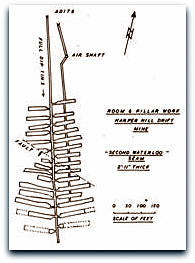 The plan shows the first area worked in Dunsil seam. A new drift higher up the field nearer to Tibshelf Ramper was driven to access the Waterloo seam and water was constantly a problem and up to 600 gallons a minute had to be pumped using 2 Mono D6D pumps in tandem. The plan shows the first area worked in Dunsil seam. A new drift higher up the field nearer to Tibshelf Ramper was driven to access the Waterloo seam and water was constantly a problem and up to 600 gallons a minute had to be pumped using 2 Mono D6D pumps in tandem.
Owner Of Doe Lea Mine Died
Dominic Lavin (385), the Manager and owner of Doe Lea drift mine at Heath, Derbyshire, died. He had opened the mine in 1930 after leaving his post as Manager at nearby Ramcroft, which had closed temporarily at the time due to water problems. He had made provisions for the future by stacking material in the workings at Ramcroft then later breaking into the workings from his drift mine to salvage it. The mine locally known as Dominic’s thrived under his management, albeit that he had a stutter and was small and hump backed. An Australian company took over, 33 men employed u/g and s/f.
Group Surveyors Moved Into Area HQ
Group Surveyors in No4 Area, Jack Brown, No1 at Newstead, Ian McCraight No2 at Brookhill, Jerry Hancock No3 at Blackwell and Clarence Skeavington No4 at Teversal, were moved away from separate Group offices in September 1962 into one office at No4 Area HQ based adjacent to New Hucknall colliery, Huthwaite. Not a move that they relished, because they were now all in one office, under the watchful eye of Les Watson Area Surveyor, whereby previously they had a private office of their own at a pit outstation. Clem Jackson had retired.
Firedamp Outburst
There was an outburst of firedamp at Welbeck (Nottinghamshire) Top Hard at 710 yards (650m) deep and also at Sherwood (Nottinghamshire) from the Deep Soft seam at 720 yards (658m) deep. These outbursts were very dangerous and frightening and all men had to leave the area quickly and stay away until the gas dispersed safely. On occasion this could be days and therefore the mine was not open for work and the men were laid off.
Outputs
At Brookhill (Derbyshire) the maximum ever output was 642,000 tons in 1962. Maximum manpower was 1,041 in 1959
Highest ever output at Langton (Nottinghamshire) the neighbouring pit, was in 1962 with 641,866 tons produced by 1,011 men.
Clipstone (Nottinghamshire) produced its second one million tons for the year with 1,025,512 tons and the highest ever manpower of 1,677.
Moorgreen (Nottinghamshire) produced its first million tons in the year with 1,009,746 tons and a manpower of 1,579.
Severe Winter Weather
The winter of 1962-1963 was extremely severe and harsh frosts and snowfalls lasted through to March. Most pits experienced some problems with pit top operations.
I remember it well as our incoming water pipe at home was frozen solid and for 6 weeks from a good neighbour down the Avenue I used to fetch 20 buckets of water each day before I went to work and another 20 when I came home to pour into our water tank upstairs so that we could have a coal fire and that my wife Mary could do the washing daily for our two girls Karen aged 4 months and Jane aged 2½. What a winter, and on many days I walked it to work to Teversal through Skegby and over the fields and up the pit sidings because it was too icy to use my bike on the roads.
Number of Collieries
There were 83 deep mines in the 3 counties with a total of 353 power loaders. Unfortunately there was 29 fatal accidents during the year. The 39 collieries in Nottinghamshire were making large profits overall.
Opencast Sites
- The Cottage First Piper seam Eckington Flockton seam
- Errigal SK 440400, 375600
- Corfield Roof Soft, Deep Soft fin 24th Oct 1962
- Calow Brook Yard and Thin coal fin 6th July 1962
- Loscoe Playing Fields 1st Ell, Apr.
Inspector's Report 1962
HM Inspectors:
- JW Calder OBE replaced G Miller who was promoted to HM Divisional Inspector.
- GW Taylor transferred to South Wales
- JS Marshall to Divisional HQ from London.
13 men were prosecuted and charged with 37 offences.
There were 83 mines plus 13 small licensed mines with an output of 49,911,854 tons plus 4 Nottinghamshire pits administrated by Yorkshire with an output of 1,511,756 tons.
There were 84,420 men on books.
29 men were killed and there were 193 serious accidents in 1962, as against 45 killed and 201 serious accidents in 1961.
There were only 4 mines in Nottinghamshire practicing firedamp drainage.
New medical centres were opened at Hucknall and Cadley Hill.
Mobile X-ray unit visited 16 collieries where 15,751 plus 4,882 new entrants and re-entrants were examined.
925 horses with 908 at 66 pits in the NCB Division plus 10 at 2 licensed mines and 7 at one ironstone mine.
An automatic cable handler for the coal face was developed.
Chain haulage for shearers to replace rope haulage on Shearers and Trepanners because of breakages.
A Collins Miner with nucleonic coal-sensing device for seam horizon was being developed.
Large air-cooled flame-proof transformers in use.
At the 4 Central Rescue Stations 618 fully trained men. Percy Blunt was awarded the BEM for gallantry for rescuing and recovering a workman buried under debris at Whitwell. |


