1963 - Page 4
Fatal Accidents at South Wingfield:
- Joseph Turner (38) hit by a piece of wood on the surface 23/12/1898, died 24/12/1898
- John Fining (37) shotfiring accident 4/5/1900, died 5/5/1900
- George Wildgoose (35) fall in a roadway 30/8/1900, died 31/8/1900
- William Bousall (59) fall of roof 28/9/1901
- Ben Radford (33) fall of coal 31/1/1902
- Charles Gration (60) crushed by wagons on the surface 9/8/1905
- George Arthur Briddon (63) fall of roof 28/12/1940.
Fatal Accidents at Wingfield Manor:
- Henry T Calladine (27) electrocuted 20/4/1910
- Harry Booth (16) fall in a roadway 22/8/1910
- Frederick Vann (31) crushed by tubs 16/3/1911
- Aaron Greenhough (35) fall of roof 14/10/1912
- Thomas Wragge (14) run over by tubs 28/2/1914
- John Pugh (39) fall of roof 20/3/1916, died 16/4/1916
- Lawrence Edward Moore (18) fall of roof 28/2/1918
- Albert White (39) fall of roof 9/3/1818, died 23/3/1918
- Benjamin Pugh (37) fall of roof 10/12/1918, died 16/2/1919
- James Riley (47) fall of roof 15/12/1921, died ?/1/1922
- Walter Booth (57) run over by tubs 2/1/1926
- Reginald Hambleton (19) crushed by tubs 19/11/1926
- John Osborne (48) run over by wagons on the surface 10/5/1929
- Jesse Booth (34) fall of roof 27/1/1934
- Reginald Hambleton (55) fall of roof 25/2/1937
- George Edgar Walmsley (52) fall of roof 25/6/1937
- Walter Timms (60) fall of roof 15/2/1940.
Old mines closed previously in the South Wingfield area included:
- Shaw Wood
- Shaw Wood Old
- Waterloo
- Morley Hill
- Highfield Lane (Boden’s)
- Furnace Hill
- South Wingfield
- Oakerthorpe
- Highfields
- Peacock.
At neighbouring Oakerthorpe area there were:
- Speedwell
- Furlongs
- Jerusalem
- Highfield
- Lily Street
- old Oakerthorpe pits.
At Crich Cliff (Derbyshire) around 8 shafts (lead), mainly to the south of Crich Stand: including
- Church Rake
- Red Rake
- Glory shaft
- Old Coco Stead
- Graham’s shaft
- Rolley shaft
- Wakebridge mine.
There was a sough running South East from above Oxley Wood with the sough tail ending in the River Derwent after the sough had passed beneath the Canal.
Linby The Most Efficient Pit
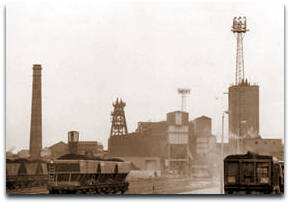 On 18th December 1963 the miners at Linby (Nottinghamshire), stated to be the most efficient pit in Britain and even Europe, agreed that the NCB should accept the approved miners’ charter before the ban on further mechanisation by the 40,000 Nottinghamshire miners was lifted. This had been imposed earlier in the summer because the piece-rate workers were not guaranteed new jobs if displaced by new methods i.e. mechanised mining. Linby was one of 14 pits where new cutting machines were lying idle because of industrial action. On 18th December 1963 the miners at Linby (Nottinghamshire), stated to be the most efficient pit in Britain and even Europe, agreed that the NCB should accept the approved miners’ charter before the ban on further mechanisation by the 40,000 Nottinghamshire miners was lifted. This had been imposed earlier in the summer because the piece-rate workers were not guaranteed new jobs if displaced by new methods i.e. mechanised mining. Linby was one of 14 pits where new cutting machines were lying idle because of industrial action.
Millionaires
- Welbeck (Nottinghamshire) produced its first million tons, just, with 1,003,456 tons and a manpower of 1,534 in 1963
- Clipstone produced its third one million tons with 1,261,566 tons and an OMS of 69.3 cwts
- Gedling produced its 12th million with highest ever of 1,156,756 tons with 2,295 men.
- Calverton
- Linby
- Moorgreen
- Newstead
- Thoresby (Nottinghamshire pits)
Output
Moorgreen the highest ever output of 1,058,420 tons, was produced by 1,505 men. Around 40m tons were mined from the 70 pits of the North Derbyshire and Nottinghamshire Coalfield in 1963. Two new collieries were under construction and 10 older collieries were undergoing reconstruction work, whilst 23 had already had major reconstruction works completed. Further projects were envisaged at a few of the older mines to make them more efficient.
Where The Coal Was Used
The electricity industry purchased around 28%, gas 12%, coke ovens 9%, other industries 19%, domestic 19%, railways 3%, collieries 3%, miners’ coal 2% and the other 5% miscellaneous, whereas in the South Derbyshire Coalfield, 39% was used for electricity generation, hardly any for gas and railways, domestic 22% and industry 39% with 6% miscellaneous.
Tools Provided At Cost Price
It was agreed by the Board that workmen’s tools be provided at cost price plus administrative charge although the NUM had suggested that they be provided free.
Local Coal Used In Royal Palaces
Cossall or Coppice or Woodside cobbles coal in 6” (0.15m) cubes, from Derbyshire was handpicked, hand loaded and supplied to Charringtons, Coal Merchants to Her Majesty the Queen under the Royal Seal, for use at the Royal Palaces.
The One And Only Pony At Bilsthorpe
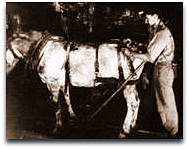 At Bilsthorpe (Nottinghamshire) a pony (Prince) the one and only ever was introduced underground to assist in moving supplies etc in the pit bottom area and on some salvage work in the Top Hard seam for a short period by John H Otter (5592), Manager 1963-1965. This was an unusual move as at many other collieries ponies were being dispensed with when small hp haulage engines (putters) were introduced, and by the mid 1970s none existed in the Nottinghamshire and Derbyshire Coalfield. At Bilsthorpe (Nottinghamshire) a pony (Prince) the one and only ever was introduced underground to assist in moving supplies etc in the pit bottom area and on some salvage work in the Top Hard seam for a short period by John H Otter (5592), Manager 1963-1965. This was an unusual move as at many other collieries ponies were being dispensed with when small hp haulage engines (putters) were introduced, and by the mid 1970s none existed in the Nottinghamshire and Derbyshire Coalfield.
Opencast Sites
- Agnes, Deep Soft, Low Main and Threequarter, abandoned May 1963
- Belfitt Hill Blackshale seam
- Woodthorpe Farm Blackshale
Inspector's Report 1963
HM Inspectors:
- W Freddie Gill transferred to Senior District North Nottinghamshire. He replaced Frank Bishop (since 1947) who had died suddenly.
- Guy DR Adamson and John Bennington were appointed to North Derbyshire and replaced PB Taylor and John W Jones who was promoted.
7 men were prosecuted for breaches of Regulations.
There were 85 pits (inc 4 in Yorkshire area) plus 12 small mines.
Total output was 48,079,929 tons with 47,405,246 tons from Nottinghamshire and 1,674,683 Yorkshire. 87,213 men on books.
During 1963, 35 men (inc 7 on the surface) were killed and there were 192 serious accidents.
During the year 30 underground and 19 surface boreholes were drilled for exploration.
Manton No4 shaft was sunk to Parkgate and a tower mounted multi-rope friction winder installed.
At Shirebrook preparatory work commenced for deepening No2 shaft to Deep Soft seam 240 yards (220m) below Top Hard.
A new pit bottom 90 feet (27.4m) above the previous decking level plus introduction of 7 ton capacity mine cars at Blidworth.
New surface fans were installed at Ollerton, Cotgrave, Langwith and Linby.
At Bevercotes both shafts were being repaired due to water ingress. Workforce sent to other pits.
New coal prep plant at Cotgrave and installation of skips at shaft.
There was a new European record at Donisthorpe when a face oms of 45.5 tons was reached. At New Lount a Collins Miner plus a modified Russian PK3 heading machine did 150 yards (137m) of heading in a week.
ROLF faces were equipped at Ormonde and Newstead, 125hp Shearer.
Advance headings were introduced at Bramley Vale and Hucknall where at Hucknall the heading material was crushed and stowed pneumatically.
Many faces now with sensitive earth leakage equipment.
346 power loaders. Trials with bi-directional Shearers, bi-di Trepanners and Stable hole machines.
Coupling chains of AFC using hydraulic ram at Bolsover.
To prevent ice forming in winter in DC shafts and Intake drifts heating units were installed.
Rescue personnel, 12 Officers in 4 Central Rescue Stations and 39 permanent corps members and 596 trained mmen at pits.
8 Preliminary Training Centres operated by the NCB 1,499 juveniles and 208 adults passed out. 747 men were on coal face training. 1,992 craft apprentices and 29 foreign students.
There were now 775 horses working underground. |


