1964 - Page 2
Teversal
A new one-sided shaft inset had been made in the Shonkey shaft at Teversal (Nottinghamshire) and the ropes were shortened, the weights lifted, and manriding was commenced from the new level on 25th July 1964 with a 1 in 8 stone drift down to the Top Hard horizon. The single deck chair with a counterweight was continued as before. The old Top Hard pit bottom below was always wet and the guide rope weights were constantly under water a situation frowned upon by the Mines Inspectorate. Because of the foggy atmosphere antiquated mechanical shaft signals were used at the old level because electrical equipment quickly corroded.
A new Deployment Centre was opened at the entrance to the pithead baths. For the first time men were registered and assigned work at the surface before having to go down the pit, whereas previously they had been ‘set out’ or deployed to jobs by the Undermanager and Overmen in the pit bottom, who stood on a box and pointed or shouted to each man in turn to make up numbers for various face teams from ‘market men’ – not unlike an auction!
A covered overhead gantry with steps at either end led from the pithead baths and lamp room over the sidings to the pit yard.
A Euclid machine that transported and layered and compacted spoil was introduced for dirt tip operations, replacing the bulldozer and conveyor system, which in the 1950s had replaced in turn the overhead ropeway with tipper buckets and a foreign coal / dirt bunker was commissioned.
Bentinck Surface Drift
A new surface drift dipping at 1in4.2 was started at Bentinck (Nottinghamshire) in June 1964, and in September 1964, Brookhill sunk in 1910 was closed and merged with Bentinck in an efficiency scheme. A Project team was set for the reorganisations headed by Jack Frith (3831) ex Production Manager. Ray Greasley was the Planner. A team of Hungarians were employed by the contractors Cementation Co.
I met 6 feet 4 inches (1.93m) tall Highlander Andy Steven from Scotland by chance on holiday in Bavaria in August 2013 he worked on the project in the late 1960s and lodged in Mansfield with others in the team. He vividly recalled the drift project and told me that one Hungarian called ‘Dirty Dick’ Digman, who hardly ever washed and walked through the showers in his pit muck and clothes, bought a suit from Jelonek the bespoke tailor in Mansfield every 6 weeks and wore it until it was not fit to wear, threw it away then bought another and carried on. Micky Magner was the Irish shift boss. Another of the team was John Scotland the electrician and nicknamed ‘Banana fingers’. ‘Monkey hanger’ Bob Malcolm was from Hartlepool. Foreman was Bob Morris another Scot. Others in the team were Zoltan Arkovitch, Charlie Dasas, and ‘Spanner’ the mechanic Louis Kovaks who was 70 but did not want to retire. The teams of 6 each had 4 headers, a leading header and a shift boss and aimed for two 6 feet (1.8m) pulls in a shift. It was very hard work and punishing at times but rewarding earning £120 per week when the wage for headers at the pit was less than £30. The local branch of the NUM was very upset over the wage issue as all the arches and other supplies to the drift were delivered by pit haulage personnel who were on the lowest basic wage, however as the contractor was a private firm employed by the NCB nothing could be done. Of course it did nothing to foster good relations. All the surface drifts and shaft sinkings were constructed by experienced contractors such as Cementation Co, Thyssens, AMCO, Blandford and Gee etc.
Andy explained to me that the men earned high wages but these firms were ruthless and to finish a contract earlier meant more money for the firm therefore these men were worked under great pressure 7 days a week and at least 8 hours on the job taking one another off or stopping longer without overtime so that the job did not stop. NUM men would not do this. Of course anyone not pulling their weight was sacked with no come back as there was no union to turn to. If a man was not prepared to do this then there was no job. There was sometimes a big turn over of men who were attracted by the promise of high wages and set on by these companies but many left after a short time as they were unused to such conditions of work.
Mine Cars Or Skips
 Mine cars were introduced at several mines in the area replacing the old tubs. At other pits skip winding was employed. Mine cars were introduced at several mines in the area replacing the old tubs. At other pits skip winding was employed.
Shirebrook Shaft Deepened
At Shirebrook (North Derbyshire) the No2 shaft was deepened from Top Hard at 542 yards (496m) to the Deep Soft horizon at 756 yards (691m). No1 shaft had 2 double deck cages each carrying 2 x 5 ton mine cars, with 34 winds per hour. No2 shaft had 1,650 hp electric motor and a twin-rope winder cage and balance weight for manriding and materials. Cross-measures drivages were made from the Top Hard pit bottom. No2 shaft cage was capable of transporting 120 men at a time.
Record Installation Of Chocks At Ollerton
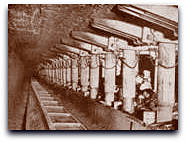 A full face of Wild 3 leg goal post chocks was installed in a record 25 hours at Ollerton (Nottinghamshire) in the thick South side Top Hard seam. A full face of Wild 3 leg goal post chocks was installed in a record 25 hours at Ollerton (Nottinghamshire) in the thick South side Top Hard seam.
Colliery General Managers
Colliery General Manager posts were created at some of the very large collieries, reporting direct to the Area General Manager, and not via the Production Manager posts.
Manton
The Top Hard seam was abandoned at Manton (Nottinghamshire) in July 1964.
Remote Control Of Conveyors
In 1964 the trunk conveyors at Whitwell (North Derbyshire) began to be controlled from the surface using direct wire control and Sargrove monitoring system. This was a ‘never-to-be-thought of system’ that showed up stoppages, previously not reported.
Parliament
 A Labour Government was returned to power from 16th October 1964 until 19th June 1970 with Harold Wilson as Prime Minister. President of Board of Trade, Douglas Jay (Lab), 18th Oct 1964-1967. 254 pits were closed during Conservative government period 1957-1964 when Harold McMillan was PM. In 13 years from 1951 to 1964 a total of 455 pits were closed. The number of miners dropped by one third and wages dropped below inflation. However 300 more pits would be closed under Labour and the workforce reduced from 750,000 to 320,000 by 1968. A Labour Government was returned to power from 16th October 1964 until 19th June 1970 with Harold Wilson as Prime Minister. President of Board of Trade, Douglas Jay (Lab), 18th Oct 1964-1967. 254 pits were closed during Conservative government period 1957-1964 when Harold McMillan was PM. In 13 years from 1951 to 1964 a total of 455 pits were closed. The number of miners dropped by one third and wages dropped below inflation. However 300 more pits would be closed under Labour and the workforce reduced from 750,000 to 320,000 by 1968.
As competition from oil increased, the Government stopped subsidising the industry and pits were closed as uneconomic.
Alf Robens the NCB Chairman had decreed from 1960 that the output in future was to be from the best and most productive pits. It was then realised that these pits would be the only ones that would survive and many of these were in the Midlands.
Serious Fire At Glapwell
On 16th October 1964 a surface fire got out of hand at Glapwell No3 shaft top, and burned through the shaft ropes and the guide ropes fell down the shaft. The pit was closed temporarily for some months whilst repairs and rebuilding took place. Major investigations were carried out by NCB officials and HM Inspectors. Men were transferred to neighbouring Bramley Drift mine (Derbyshire).
Overman's Pay
Grade 1 Overman rate was increased to £24.7s.0d (£24.35) per week around this time.
Ollerton Bingo Hall Opened
Elsie Tanner, the popular star of TV’s Coronation Street opened the Ollerton Bingo Hall in 1964 and was shrouded by the local police force as the villagers clambered to get a better view of her.
Seam Re-Opened At Silverhill
At Silverhill (Nottinghamshire) the Low Main seam working was recommenced with a modern mechanised panel system, the old stall method of working having been abandoned in 1923, and handfilling system in the 1950s.
Old Whim Gin
 At Pinxton Green pit (Derbyshire) the original wooden Whim gin was removed. It was preserved at Wollaton Hall Museum. The shaft bottom was then plugged and the shaft was filled in March 1965, in preparation for the new M1 Motorway, which would pass over it. Position: SK45NE 446444, 355212. Several other old shafts at 7 feet (2.13m) diameter were located and filled also. Another shaft at only 3 feet 6 inches (1.07m) diameter lay 100 yards (91m) South East of Green shaft and a culvert led to some brickwork and fire bars indicating that this shaft used to be a cupola. At Pinxton Green pit (Derbyshire) the original wooden Whim gin was removed. It was preserved at Wollaton Hall Museum. The shaft bottom was then plugged and the shaft was filled in March 1965, in preparation for the new M1 Motorway, which would pass over it. Position: SK45NE 446444, 355212. Several other old shafts at 7 feet (2.13m) diameter were located and filled also. Another shaft at only 3 feet 6 inches (1.07m) diameter lay 100 yards (91m) South East of Green shaft and a culvert led to some brickwork and fire bars indicating that this shaft used to be a cupola.
Arkwright Output
Arkwright (North Derbyshire) output reached 1,500 tons a day and a plate conveyor up the drift transported the coal to the surface.
Bagworth
Bagworth (Leicestershire) 43/4408/408655, 43/4408/399634, Lower Main abandoned 7/10/1964. Surveyor J Alan Ratcliffe (3296) (later Area Chief Surveyor). Manager John CB Bond (4780).
Parliament
Minister of Power, Fred Lee (Lab), 18th Oct 1964-1966.
HM Inspectorate
HM Inspectorate of Mines:
- Divisional Inspector Jim W Calder OBE
- Senior District Inspector Joe S Marshall
- District Inspector R (Bob) A Ridsdale MBE.
- North Nottinghamshire Senior Inspector: W Freddie Gill
- District Inspectors Arthur Chaplin and Dilwyn Richards
- Inspectors Harry Jones.
- South Nottinghamshire Senior Inspector: George Jenkins
- District Inspector C William Percival
- Inspectors HJ Dennis and Frank Stephens.
- North Derbyshire Senior Inspector: William (Willy) Whitehouse
- District Inspector FC Mackie
- Inspectors Guy DR Adamson (5391), (ex Manager Giant’s Hall, NW), John Bennington and Andrew McMurray.
- Leicestershire/South Derbyshire Senior Inspector: Ben Duckworth
- Inspectors Arthur H Barker and Alan Monks.
Dent Main Closed
Dent Main (Derbyshire) (Dent Main Colliery (1924) Ltd), closed Oct 1964, Parkgate.
Manager: B Hutchinson.
Surveyor: B Skeith (4292).
This pit was situated at Birley Wood, Mosborough (Derbyshire) and surrounded by old mines named Moorhole, West Wells Prince Albert, Victoria, Moorside, Birley Moor, Mosboro Moor, Mosbro Hall, Haven Farm, High Lane, High Lane, Vardy’s, Phoenix, Quarry, Birley Wood and Wiggin Tree, Holbrook, Streetfield, Swallow’s, Swallow’s sough, Westwell, Plumbley Lane, Gally’s and Bishop’s. |


