1977 - Page 2
North East Leicestershire Prospect
The North East Leicestershire Prospect:
- Deputy Director Jack J Lewis (5459)
- Surveyor Jack Brown (2414)
- Project Geologist (Belvoir) E Lloyd Boardman
- Assistant Geologists, Cliff Beal (Surveyors cert, an ex Assistant at Pleasley and Kirkby)
- David A Inkley
- DW Turner
- Regional Geologist Richard (Dick) Elliott (ex Surveyor)
- Deputy: Maurice Lock.
Coal Industry Act 1977
The Coal Industry Act 1977 was passed. Also the Town and Country Planning General Development Order 1977 which confirmed that the working of coal by the NCB at a mine commenced before 1st July 1948 is permitted development. However if the Local Planning Authority and the Secretary of State are convinced that coal should not be worked in that particular area unless permission is granted on application, then a direction to that effect may be made.
Pay Settlements Restricted to a Maximum of £4 a week or 5%
From 1st March 1977 in line with the Government’s policy, pay settlements were restricted to a maximum of £4 a week or 5%. Average weekly wage underground was £77.63 (£16.95 per shift).
NACODS Restrictions
NACODS union for Deputies and Overmen applied restrictions to work following the Health and Safety Executive (HSE) prosecutions of some of their members following the Houghton Main explosion in Lancashire.
RMPS
The Redundant Mineworkers’ Payment Scheme was operative from 27th March 1977, also the Retired Mineworkers and Concessionary Coal (Payments Scheme) (Amendment) Order 1977. Included in unemployment benefit from November 1976. Since 1974 the basic miners’ pension had been increased twice for inflation, and now stood at £5.23 per week, for over 65 and 10 years plus working in the industry.
NCB HQ Hobart House Computer
Sir Derek Ezra MBE ‘operated a computer’ installed at NCB HQ Hobart House, London. A programme for outputs showed the first three pits to exceed 1 million tons in the year 1976/77, which included Markham, North Derbys, being second, with 1,515,561 tons.
Third Week’s Holiday
In May 1977 a third week’s holiday was granted to the workforce.
Surface Fire Certificates
Surface Fire Certificates were issued to collieries where the Inspector was satisfied and had agreed on the equipment necessary should an emergency arise. I remember Ken Couldwell (5064) HMI as ever being keen on his visits to Ollerton, asking me to accompany him on several occasions to answer questions. He eventually accepted the plan I had made and supplied the relevant certificate to the Manager.
New ‘Beware Firedamp’ Booklet.
A new up to date booklet on mine gases was issued to all mines titled ‘Beware Firedamp’. The original booklet was first published in 1939.
Inventions
During 1977 a Rufford colliery blacksmith (North Nottinghamshire) won a £25 award for inventing a method of straightening new guide ropes before lowering them into the shaft. Willie Illet a surface electrician at Ollerton won £50 for inventing a device to help prevent surface cranes from over-tipping whilst removing dried slurry from lagoons, A micro switch sets off a bleeper and light in the operator’s cab when the crane jib exceeds a too high or too low position. The idea was used at other collieries. Many other inventions at other collieries over the years were warranted with cash rewards.
In-line Drift At Rufford
At Rufford an in-line drift with an old roadway down to the Yard seam required resin injection of the interjacent strata and some strata bolting and concreting of the leg extensions at the feather edge to support the entrance to the drift. A similar drift was driven later at Ollerton for the inbye vertical bunker base.
The Area drilling team was commandeered to drill longer holes with a Mini-hydrack boring machine.
Shirebrook Surface Drift

Jubilee Drift
At Shirebrook (North Derbyshire) in June 1977, a pneumatic coal hoist was installed at No2 shaft, giving around 60 tons an hour extra up the pit, with a best of 97 tons. In July a huge Titan heading machine was installed in the Jubilee surface drift at a dipping gradient of 1in4. The drift would be 1,610 yards (1,465m) long including a dog-leg and eventually couple up to a roadway being driven upwards to meet it from underground. The open cut and the first 310 yards (283m) of drifting had to be done by compressed air boring, firing and debris loaded out by Eimco shovel. (Titan tunnelling advance yardages for the first 16 weeks were 9 yards (8.2m), 10 (9.1m), 18 (16.5m), 30 (27.5m), 30 (27.5m), 33 (30.2m), 41 (37.5m), 32 (29.2m), 32 (29.2m), 55 (50m), 35 (32m), 44 (40m), 50 (46m), 52 (48m), 71 (65m), 50 yards (46m).
Skip Winding
Skip winding was introduced at Markham (North Derbyshire) and additional coal preparation facilities were installed also to cope with the extra tonnage anticipated at a cost of £10m. During the year 1977-78 saleable coal output of 1,479,241 tonnes was produced by a maximum number of 2,413 men.
8-ton payload skip winding was installed at Silverhill No1 shaft (North Nottinghamshire) and the mine cars were dispensed with for coal winding.
Renishaw Park
A second surface drift was driven at Renishaw Park (North Derbyshire) for manriding facilities. The shafts were sunk in 1860 and the first surface drift for coal production was in 1951.
Appointment
Tom Nash BSc was appointed Ventilation Engineer North Derbyshire. He had previously been Ventilation Engineer No4 Carlton Area 1963, then Assistant Divisional Ventilation Engineer for Yorkshire for 2 years, when on the reorganisation in 1967 was Acting Ventilation Engineer for No2 Doncaster Area.
'Z' System Of Working At Bevercotes
In June the Z System of face working was pioneered at Bevercotes (North Nottinghamshire). This system is where the loader gate is retreated on a pre driven gate and the airway or supply gate is driven on the advance system as usual. This was another idea that a team of us went to see, but the circumstances at Ollerton did not allow the system to be used until 1993. I remember at the time the Undermanager Ray Flint, previously an Overman at Ollerton taking us through a particular bad spot where oil as thick as sludge was oozing from the strata. It had a smell one would never forget and it was almost impossible to remove from your hands without the proper soap. It stuck to your boots like glue and you appeared to grow taller as dirt stuck to the bottom of your boots as you walked along.
Visit by Sir Derek Ezra Chairman of NCB
Two Way Man Riding Conveyor

On 13th July 1977, Sir Derek Ezra MBE, Chairman of the NCB, made an underground visit to Ollerton (North Nottinghamshire) new 2m thick Parkgate seam workings. A 2-way top and bottom belt manriding system similar to the one shown above was operational in the 1in5 return drift. A buffet was arranged afterwards where he met all the staff and union officials. I was invited to the event as part of the management team and he had a personal chat with all of us.
A £7m scheme to open up 30m tonnes of reserves had just been completed.
Plan 2000
Plan 2000 put forward proposals by the tri-partite meetings of the Government, NCB and Unions.
Steam Winding
During this period many collieries had the steam winding gear changed over to electric winding including Blidworth, at a cost of £2m and the manriding/materials shaft steam winder was changed to electric at Bilsthorpe. Sherwood colliery was the last in North Nottinghamshire Area to change from steam as the Deep Soft seam was abandoned. Clarrie Oakden, an engineer, had modified the 70 year old steam engine at No1 shaft previously and this had increased the output by 1,000 tons a day.
Linby would be the last pit in South Nottinghamshire to convert to electric winding.
Immingham Docks
Coal from Nottinghamshire and Yorkshire sent to the NCB terminal at Immingham Docks was to be sent to West Thurrock Power station, Essex on the maiden voyage of the CEGB’s largest coal-carrying sea going vessel.
Trackless Haulage System
High Moor drift mine (North Derbyshire) was chosen as a pit to have a trackless haulage system and diesel rubber-tyred vehicles were introduced and proved to be successful.
Voluntary Early Retirement
From 1st August 1977, voluntary early retirement was introduced for men aged 63 and over. More than 1,000 Nottinghamshire miners took the opportunity of the new early retirement scheme. This age limit would reduce by 1 year for the following two years until age 60 was reached. Severance money and make-up pay for wages applied. Although the men could “sign on”, prospects of getting another job were not all that good. In Mansfield over 100 men had attended the Job Centre. Because they had left their previous job voluntarily they were not allowed benefit for the first few weeks, but after that, depending upon circumstances they qualified for £20, and under the scheme the NCB was making up this amount to 80% of their former wage. But, if any of the men found other full-time employment in the interim period then they did not qualify for the scheme.
More Benefits For Miners
For the men remaining in the industry, along with the third week’s holiday, bathing allowance, unsocial hours and short distance transfer fees were also granted.
HM Inspectorate
G Hugh Thomas was promoted to the post of Principal Inspector of Mines at London, and Dilwyn Richards (5250) was transferred back to this Region from Lancashire to succeed him as Senior District Inspector, a position he had held previously. Ken L Twist (9499) appointed HMI for South Midlands in March, (ex Deputy Manager Agecroft, Lancashire since 1972)
Open Day At Blidworth
A successful Open Day was held at Blidworth colliery (North Nottinghamshire) on 29th October 1977. An extension to the canteen and medical centre had been completed earlier.
Rapid Loading Bunkers
Rapid loading bunkers were commissioned at Bentinck and Hucknall (South Nottinghamshire) where 42 hopper-trains direct to CEGB could be filled in 30 minutes.
Butterley Bunker
A 400 tonnes Butterley Bunker was operational at Rufford (North Nottinghamshire).
Bentinck Creeper
A system for hauling tubs round bends developed at Bentinck (Nottinghamshire) and Pleasley (Derbyshire) was named the Bentinck creeper.
Seams Developed
At Calverton the High Hazles seam was developed and at New Hucknall the Yard seam, whilst the Piper seam was developed at Pye Hill (South Nottinghamshire).
New Coal Preparation Plant
New coal preparation facilities were installed at Linby (South Nottinghamshire).
New Ambulances
Two new ambulances which could double as mobile operating theatres were purchased by NCB North Derbyshire Area for £7,000 each, to complement the 2 Range Rovers and 2 converted Estate cars.
Welbeck
.jpg)
At Welbeck (North Nottinghamshire) in November 1977 a Dowty packing table was introduced at a tailgate rip in the Top Hard seam. Manriding inbye by diesel and rope haulage still took well over an hour to get there. Debris was cut down by machine and this dropped onto the table and then rams pushed the debris into the gate side packhole. Following a visit there with John Higginbotham (9293), I made notes on the operational techniques. The system would be introduced at Ollerton, with other pits following shortly afterwards.
District Incentive Schemes Introduced
From 1st December 1977 District Incentive Schemes, a new weekly Incentive bonus based on lineal advance and measured by the colliery Surveyors and ‘checked’ by Deputies began. Norms were re-hashed after every 352 yards (320m) advance to allow for walking times. Face workers received 100% bonus, workers within 10m of the coal face 65% and others elsewhere underground 50%. This system replaced the Daywage Agreement of 1966. The first week’s panel advance check measurements from one of the Deputies at Ollerton…10 metres and 2 yards 6 inches from the 120 metre mark!!! Another time the Deputy had lost his tape so the measurements he sent out were eight and a half 3 foot board lengths from the last measure mark! It took several weeks to settle down and as with all things new it suddenly clicked. After a time they realised that the Surveyor’s measurements were accurate and check measuring by the Deputies was stopped.
Water Pollution
On 2nd December 1977 the Water Pollution Prevention plans were pioneered at Ollerton (North Nottinghamshire).
NCB Chairman Visit Kiveton Park
Sir Derek Ezra MBE NCB Chairman inaugurated the surface Jubilee Drift driven at Kiveton Park (South Yorkshire) on 6th Dec 1977. The £2.2m reconstruction scheme included driving the 1,450 yards (1,325m) long 1in5.8 drift from the pit yard to link up with existing roadways in the Clowne seam about 200 yards (183m) below the surface to create a new efficient materials and rope manriding system.
Parliament
Eric Varley MP (Lab) was Secretary of State for Industry (he was a former Secretary of State for Energy).
Alex Eadie MP (Lab) Parliamentary Under-Secretary for Energy visited Calverton on 6th December 1977. He stated ‘No Government in living memory has so positively committed itself to the coal industry’.
Opencast Coal Target
On 8th December he said ‘Opencast coal target was fully justified as part of the nation’s coal policy’!
Manless Haulage Systems
There were still 12 manless haulage systems in South Nottinghamshire Area. This is where a man is saved – the haulage driver. Generally in the past the haulage drivers were usually older men who had finished working on the coal face due to age, accident etc, and many of these were being made redundant or taking early retirement .
Mine Operating System
MINOS conveyor instrumentation installed at Bolsover (North Derbyshire) by the end of the year. A Baum wash box was installed (the first one was installed at Middleton, Leeds in 1893).
Opencast Sites
 Brinsley Wharf 2 areas 18/9/1974-26/3/1976 Brinsley Wharf 2 areas 18/9/1974-26/3/1976
Cinderhill seam 800 tonnes, Coombe 2,530 t, Top Hard 31,786 t, Waterloo Lower 6,903 t, Waterloo Marker 4,966 t, 2nd Waterloo Upper 48,195 t, 2nd Waterloo Lower 21,169 t, 3rd Waterloo 24,877 t, 7/7/1976-22/4/1977- Cockfield Farm New Eastwood, 2nd Waterloo, 2nd Waterloo Lower, 3rd Waterloo 1961-Nov 1977
- Cutthorpe Golf Tupton and Tupton Threequarters Oct – Nov 1977, incidental coal DP McErlain Ltd
- Egston (near Tupton Hall Grammar School) Piper, May 1974 -Feb 1977
- Holmewood Dunsil and 1st Waterloo Oct 1976 finished Nov 1977
- Ramcroft Clowne (0.71 coal, 0.15m broken coal – finished 31st Mar 1977), 99.9 acres (40.5 hectares) of coal was recovered from the Clowne, Furnace, Upper Brinsley Thin, High Hazles, and Sough coals between March 1976 and March 1977
- Troughbrook Waterloo and Waterloo Marker 12/11/1977
- Whit, Threequarter seam
- Whiteborough Woodend Top Hard, Dunsil, 1st Waterloo Upper, 1/7/1974-13/7/1977
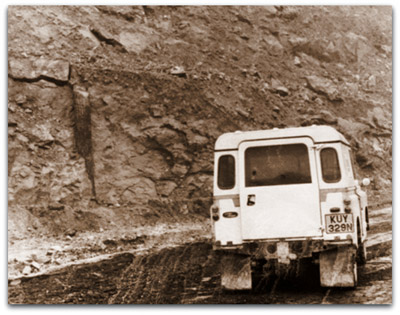
- Wrang Farm Extension Top Hard, Lower Dunsil, Waterloo Marker, 1st Waterloo seams, Sept 1975 - Apr 1977. A fossilised tree trunk exposed in the photo.
|


