1983 - Page 2
Explosion in Battery Charging Station at Ollerton
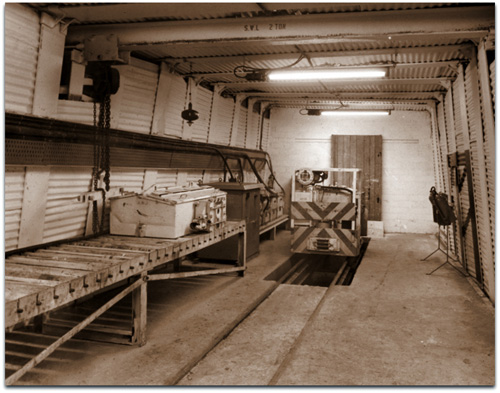 There was an explosion of hydrogen gas caused by a short on a battery in the Loco Charging station in Ollerton pit bottom on Saturday 26th April 1983. 2 electricians and an attendant fortunately escaped major injury. However the incident was fully investigated by the Mines Inspector, because this was the first case of its kind known in the region. Dilwyn Richards the District Inspector was particularly critical of the reporting of the incident. There was an explosion of hydrogen gas caused by a short on a battery in the Loco Charging station in Ollerton pit bottom on Saturday 26th April 1983. 2 electricians and an attendant fortunately escaped major injury. However the incident was fully investigated by the Mines Inspector, because this was the first case of its kind known in the region. Dilwyn Richards the District Inspector was particularly critical of the reporting of the incident.
Full-Arch Setting
Full-arch setting was introduced whilst constructing a large sub-station where 18/19 feet (5.49 / 5.79m) wide arches were erected. A stage-loader crusher was installed to break up large lumps at the coal face.
First Retreat Face at Ollerton
The first retreat 9s Parkgate face was commissioned later in the year. The old 10s Loader gate was re-used but the gate crush caused by the retreating panel was diabolical and snickets to a temporary in seam ‘gate’ were driven periodically depending upon face retreat so that the panel could turn coal. These snickets had to be set out with a dial and at the junction of the new gate a line going forward and backward had to be established so that 2 heads could be driven at the same time to create thirlings. This setting out could only be done during the 20 minutes snaptime and it was left to me to do this being more experienced and quicker with setting up over and on the conveyor belt which was stood for that period. At times I could only lie on the belt without moving so as not to disturb the dial tripod that was perched on the conveyor belt but anchored down with large pieces of stone and virtually stretch my neck to turn out the right angle but with my helmet touching the roof, that’s how high the old gate was, it was lower than the seam extraction on the face. The panel had not finished production when I left the colliery to go to Area Headquarters as Senior Surveyor but all the snickets up to that time were set out by me. Fortunately the panel was off the first panel 10s in the Pargate seam so it was a quicky shift and I would be out of the pit by 11.30am on a special draw providing they were not slinging material beneath the cage at No2 shaft.
Annesley
The Blackshale seam was developed at Annesley (South Nottinghamshire).
The Deep Soft seam at Annesley (South Nottinghamshire) was abandoned, having been developed in 1914.
Bevercotes
A 24 -seater battery-powered paddy train was commissioned at Bevercotes (North Nottinghamshire) in the Parkgate horizon to transport men to 1s face at up to 25 mph.
McGregor Appointed Chairman
 Ian McGregor (70) appointed Chairman designate on 28th March, took over as Chairman of the NCB on 1st September 1983. He was a Scotsman but had been in the USA for years and was seen as a highly controversial man. He had been appointed by James Callaghan (Labour PM) in the past as a part-time director of British Leyland and later went to British Steel. Sir Norman Siddall (3655) (65) 1982-1983 retired (d 2002). Peter Walker MP (Con) had replaced Nigel Lawson MP (Con) as Energy Secretary in June 1983 and Giles Shaw and David Hunt were appointed Coal Ministers. Ian McGregor (70) appointed Chairman designate on 28th March, took over as Chairman of the NCB on 1st September 1983. He was a Scotsman but had been in the USA for years and was seen as a highly controversial man. He had been appointed by James Callaghan (Labour PM) in the past as a part-time director of British Leyland and later went to British Steel. Sir Norman Siddall (3655) (65) 1982-1983 retired (d 2002). Peter Walker MP (Con) had replaced Nigel Lawson MP (Con) as Energy Secretary in June 1983 and Giles Shaw and David Hunt were appointed Coal Ministers.
Steetley Merged With Shireoaks
Steetley (North Derbyshire pit) sunk 1873/76 to the north east of Whitwell village was merged with Shireoaks (Nottinghamshire pit, administered by South Yorkshire Area) on 1st September 1983, E455253 N378470. Coal production had almost stopped in March.
Pleasley
Free steered rubber-tyred vehicles were introduced underground at Pleasley (North Derbyshire), only the second pit to do so.
Concessionary Fuel
The National Concessionary Fuel Agreement for mineworkers was agreed sometime in 1983.
Heat emissions from conveyed coal were tested at Clipstone 65s Low Main panel (North Nottinghamshire) in May 1983. It gave off heat equivalent to 45kW/kmºC. Several other deep pits would be tested.
NUM
Arthur Scargill President of the NUM visited 33s panel in the Parkgate seam at Ollerton (Nottinghamshire). There was a buffet laid on in the Conference Room and we were all introduced to him.
Parliament
Secretary for Trade and Industry, (merged) Cecil Parkinson MP (Con) 11th June – Oct 1983 resigned in disgrace. Succeeded by Norman Tebbitt MP (Con) from 16th Oct 1983-1985.
Method Study
Method Study for special jobs such as rock heading where progress was usually slow due to restrictions by boring and firing or slow cutting due to the type or strength of the heading machines and sparking problems etc was usually argued over with the union men and the ‘3 Wise Men’ management team until reasonable tasks could be achieved. Similarly the odd argument with the union arose when the advance norm was not achieved and then the Surveyor usually involved with the lineal measurements, and the Cost Clerk who calculated out the figures for each job generally had to submit the figures to higher authority where pressure was put on to achieve a satisfactory end result. Fly cutting to straighten out the face line played a critical part, but overall it was generally appreciated that the Surveyor’s linesmen’s measurements were correct and any anomaly adjusted the next time.
Harworth
 Following the County Council CCI (83) regarding new projects, a massive environmental check list was created to be followed and implemented. Such things as visual appearance and its impact on the surrounding landscape were to be noted. Any dust or gas emissions, noise, water supply, drains or run off, whether the land was used for agriculture, recreation etc and would the project have any detrimental effect on the ecology. Other things such as subsidence to housing and services, hazards to the public, social impact, closure of a road, footpath diversion, archaeological site disturbance, mineral sterilisation, effect on road and rail transport, local economy etc, etc, etc. – the mind boggles! These are all potential problems and one such project that springs to mind was the painting of the new concrete headgear at Harworth which had to be blue and yellow to blend in with the skyline! Does it? Another crazy imposition by Planning dept. One can see the headgear from miles away but you can’t see the blue and yellow until quite close. Following the County Council CCI (83) regarding new projects, a massive environmental check list was created to be followed and implemented. Such things as visual appearance and its impact on the surrounding landscape were to be noted. Any dust or gas emissions, noise, water supply, drains or run off, whether the land was used for agriculture, recreation etc and would the project have any detrimental effect on the ecology. Other things such as subsidence to housing and services, hazards to the public, social impact, closure of a road, footpath diversion, archaeological site disturbance, mineral sterilisation, effect on road and rail transport, local economy etc, etc, etc. – the mind boggles! These are all potential problems and one such project that springs to mind was the painting of the new concrete headgear at Harworth which had to be blue and yellow to blend in with the skyline! Does it? Another crazy imposition by Planning dept. One can see the headgear from miles away but you can’t see the blue and yellow until quite close.
Photo of Harworth Colliery From Auditnow
Voted for Overtime Ban
On 13th September 1983 the NCB offered 5.2% pay rise across the board. The NUM decided to wait until the delegate conference of 21st October to reply to the offer. The delegates voted for an overtime ban. This started on 1st November 1983. In December, Arthur Scargill decided to call a strike from March 1984. The coal stocks stood at 57.8m tons!!
Health Monitoring of Gearboxes
Successful in-built health monitoring proved on booster fans was applied for the first time to 2 x 149kW (200hp) AFC gearboxes for field trial at 9s Retreat panel at Ollerton (North Nottinghamshire) in October 1983. The system was microprocessor-based to receive signals from transducers in the gearboxes. Information such as bearing and oil temperature, oil contamination, throughput load and running time in hours etc was monitored.
Manpower Savings Schemes
Manpower savings schemes continued and any saving by the introduction of automatic engines or doubling up of jobs particularly at the surface where the object was to reduce surface labour to a minimum.
Men Trapped At Sherwood After Arches With Wood Struts Collapsed
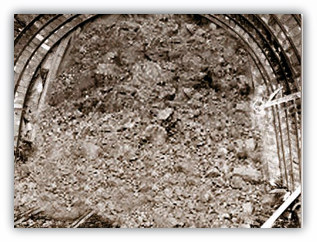 In December 1983, 3 miners were trapped in a section of tunnel at Sherwood (North Nottinghamshire) when a 33 yards (30m) section collapsed. Fortunately after several hours the men were released. The type of metal support used included a section of wood strut and was blamed for the incident. The Inspectorate banned further use of the support. The colliery nursing sister Margaret Sipson and Dr Kerr the medical officer from Edwinstowe HQ descended the mine at 1pm to go to the scene assuming the worst that the men would need medical treatment, however at 10pm the men were brought to safety unharmed and no treatment was necessary. Margaret worked at Sherwood from the early 1970s and retired in 1987 (aged 56). In December 1983, 3 miners were trapped in a section of tunnel at Sherwood (North Nottinghamshire) when a 33 yards (30m) section collapsed. Fortunately after several hours the men were released. The type of metal support used included a section of wood strut and was blamed for the incident. The Inspectorate banned further use of the support. The colliery nursing sister Margaret Sipson and Dr Kerr the medical officer from Edwinstowe HQ descended the mine at 1pm to go to the scene assuming the worst that the men would need medical treatment, however at 10pm the men were brought to safety unharmed and no treatment was necessary. Margaret worked at Sherwood from the early 1970s and retired in 1987 (aged 56).
Sinkings 1983
Collieries sunk or opened in 1983: Amber Valley drift mine (Derbyshire) (firstly owned by J Hudson then H and C Hartshorne and Sons), planning permission for Blackshale working granted in Nov 1981. 2 adits were driven in 1983.
|


