2004 - Page 2
Partnership With Russians With Purchase Of Hatfield
Richard Budge purchased Hatfield Colliery from Hatfield Coal Co in April 2004, the colliery having gone into administration late in 2003. Budge had formed Coalpower in 2001. He went into partnership with KRU the large Russian mining Co who held 52% of the shares.
Coal Investment Aid
In September 2004 under the second round of Coal Investment Aid to provide for up to 30% of the cost of projects to access coal reserves and help to keep the pits profitable, the Government awarded £2.09m to Thoresby, for developing new reserves in 2005, a new conveyor system and other equipment, and £2.54m to Welbeck for accessing new reserves, new infrastructure improvements and new equipment whilst Harworth received £1.72m as part of the scheme for similar projects, all allowing further life to the 3 Nottinghamshire mines. Coal supplies about a third of the country’s electricity demand, half of which is supplied by Britain’s 9 mines.
Lightweight Heavy-Duty Trailing Cables
Lightweight heavy-duty trailing cables were to be installed on 30s, a 1,000m deep 2.5m thick 320m long Deep Soft face at Harworth (Nottinghamshire) where a 3.3kv DBT Electra EL2000 shearer was making its UK debut. The panzer face motors were 600hp each and the AFC chain 38mm thick. The normal flexible trailing cable capable of such power was 72.7mm external dia whilst the new one was 58.3mm. Hopefully this latest design would help to improve performance because output had fallen, on the one face, 19s Retreat.
Department Of Energy
Again more changes. Mike O’Brien MP (Lab) replaced Stephen Timms MP (Lab) as Energy Minister in the latest Government reshuffle by Prime Minister Tony Blair (New Labour). It is noticeable that no one stops in the position for long. This is not good for an industry that is losing its way, with money draining away faster than the coal can be produced. He is the seventh Minister in the position since New Labour came to office in May 1997. Maybe it is a ploy by the Government so that if questioned about the industry no one is fully aware of all the circumstances, not being in the job long enough. First it was Peter Mandelson (Lab) May 1997 but only for a short time, when he was succeeded by John Battle (Lab) 1997 to June 1999. He in turn was succeeded by Helen Liddell (Lab) from July 1999 to Dec 2000. Peter Hain (Lab) was appointed in Jan 2001 and was replaced by Brian Wilson (Lab) in Apr 2002. Stephen Timms (Lab) succeeded in June 2003 until Sep 2004 when Mike O’Brien (Lab) was given the position. Is it the ‘poisoned chalice’ that is being passed on?
New Chief Executives
The new Chief Executive for UK Coal from 1st October 2004 Gerry Spindler (56) an American, replaced Gordon McPhie who had resigned after 3 years as Chief Executive, having been a member of the board since 1993. Gerry Spindler had been a non-executive Director of UK Coal since 2001, previously President of Cyprus Armax Coal, and America’s second biggest coal producer with an output of 90 million tonnes. Prior to that he had been President and Chief Executive at Pittston Mineral Group producing 30 million tonnes a year, and earlier had joined Pittsburgh based Consolidation Coal as a section foreman, rising to Vice President when he left in 1984.
David Jones continued as Chairman for UK Coal based at Harworth HQ.
Dr Ian Roxburgh Chief Executive at the Coal Authority at Mansfield for the past 3 years left his position in September 2004 to take up the position of first Chief Executive of the newly created Nuclear Decommissioning Authority based in West Cumbria. Coal Authority Chair John Harris stated that the Department of Trade and Industry had requested his release and that as well as a respected man he was also well liked and would be sadly missed by all his staff. Albert Scholfield MBE, Director of Mining Information and Services took over as acting Chief Executive and was appointed to the position shortly afterwards.
Scanning Of Plans And A Special Camera
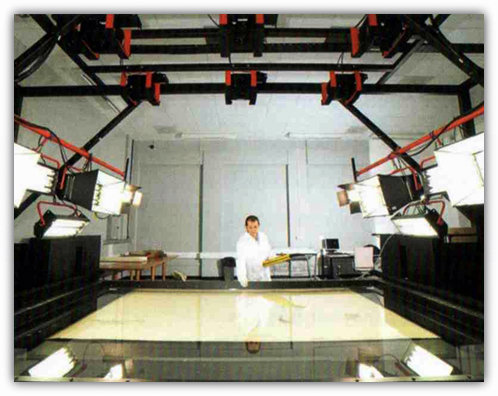 At the Coal Authority, around 50,000 mine plans out of 100,000 under their jurisdiction had been colour photo-scanned and entered into a computer along with many thousands of photographs (35,000+ at December 2004). As stated previously a special 6 camera unit with a large bed, the only one of its kind has been imported to photograph the old and sometimes fragile large roll plans of abandoned coal seams. Many thousands more plans and photographs remain to be copied. Photographs can be lent to the Authority and copied, then returned. Members of the public, as well as working bodies are free to access the plans and photographs on computer. However there is a charge for copies. By 2007 around 110,000 plans had been photographed, the later ones being able to be inputted and seen as one plan sooner than being stitched together in 9 sections as before. This unique expensive camera would be dismantled as surplus to requirements in 2013 albeit that it was known that there are always some plans that need copying at some time or other. Never mind, as usual it was public money. In my opinion this was a short-sighted decision and truly an act that ought not to have been done. In fact in May 2013 a lot of plans were deposited from some Council offices in the West Midlands. There are probably others awaiting such a decision in the future. At the Coal Authority, around 50,000 mine plans out of 100,000 under their jurisdiction had been colour photo-scanned and entered into a computer along with many thousands of photographs (35,000+ at December 2004). As stated previously a special 6 camera unit with a large bed, the only one of its kind has been imported to photograph the old and sometimes fragile large roll plans of abandoned coal seams. Many thousands more plans and photographs remain to be copied. Photographs can be lent to the Authority and copied, then returned. Members of the public, as well as working bodies are free to access the plans and photographs on computer. However there is a charge for copies. By 2007 around 110,000 plans had been photographed, the later ones being able to be inputted and seen as one plan sooner than being stitched together in 9 sections as before. This unique expensive camera would be dismantled as surplus to requirements in 2013 albeit that it was known that there are always some plans that need copying at some time or other. Never mind, as usual it was public money. In my opinion this was a short-sighted decision and truly an act that ought not to have been done. In fact in May 2013 a lot of plans were deposited from some Council offices in the West Midlands. There are probably others awaiting such a decision in the future.
Output Dips Sharply
Thoresby with only a third, and Welbeck with only about one fifth of the planned output for this year and losing money, were languishing at the bottom of the output table for UK Coal, a far cry from days of old when Thoresby used to be at the top of the table for the country, with Welbeck not far behind. The policy of just one production face at a time is fine on paper, but, in mining as we know from past history, things can go horribly wrong. It only needs faulty or bad ground to stop or hamper a face and the production for the pit goes down to zero! Harworth and Welbeck have both been adversely affected by geological conditions and are in review. Even Thoresby miners were finding that the ‘Ollerton’ area of Parkgate coal was not so easily mined as in their patch of the past.
Selby Complex (Yorkshire) Closed After 25 Years
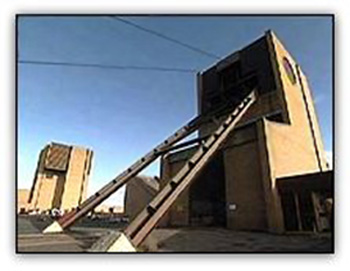 The last coaling shift at Riccall mine in the Selby complex in Yorkshire finished on 26th October 2004 after 25 years. It was planned to last 100 years but lasted only 25. In its heyday the complex employed 3,500 men, but only once produced 12 million tonnes in the year as planned, last year only producing 3 million tonnes and making an operating loss of £3.5m. Many of the coal faces were short length and short life. The total output in 20 years from 262 coal faces and 460 miles was 121 million tonnes. The Manager Willie McGranaghan (11633) was transferred to Harworth. The last coaling shift at Riccall mine in the Selby complex in Yorkshire finished on 26th October 2004 after 25 years. It was planned to last 100 years but lasted only 25. In its heyday the complex employed 3,500 men, but only once produced 12 million tonnes in the year as planned, last year only producing 3 million tonnes and making an operating loss of £3.5m. Many of the coal faces were short length and short life. The total output in 20 years from 262 coal faces and 460 miles was 121 million tonnes. The Manager Willie McGranaghan (11633) was transferred to Harworth.
BBC News - Mourning Subdued As Last Selby Pit Shuts
Only 9 Deep Mines Left
There were now only 9 deep mines left in the country, including 3 in Yorkshire Kellingley, Maltby and Rossington, 3 in Nottinghamshire Harworth, Thoresby and Welbeck, one in South Wales - Tower colliery, one in North East, Ellington colliery and Daw Mill in Warwickshire and a small drift mine at Eckington in North Derbyshire. When I started work in 1953 there were around 950.
Hatfield and Thorne (Yorkshire)
Hatfield colliery in Yorkshire on care and maintenance was to close if a buyer could not be found before March and essential pumping was continuing for administrators Ernst and Young, since previous owners Coalpower ran into trouble.
Nearby Thorne colliery had begun sinking October 1909 but after great difficulties with water ingress was halted in 1914. In November 1918 the freezing process for sinking was abandoned and the Françoise Cementation Co of Doncaster took over from March 1919 and completed the sinkings by March 1926. The shafts began weeping water in 1936 and by 1943 the make of water had increased alarmingly.
The pit was closed for production in 1956 and put on care and maintenance. Shaft repairs were carried out and completed by 1966, however a bulge was found in No1 shaft in 1967. In 1970 weld tears were found in the shaft requiring further repairs which were finished in 1973.
In 1977 a Project team was assigned to the pit and reconstruction began and new style headgears were constructed. No1 winder was commissioned in October 1979 and No2 in December 1980. A new pit bottom was driven at High Hazel horizon at 862 yards (788m) deep, the Barnsley pit bottom being at 924 yards (845m). However the pit was still maintained by the NCB and British Coal and when UK Coal took over it was still maintained at £1m a year since 1992. It was stated that at least £200m to £300m was needed to begin production again, but when the colliery was put up for sale in 2002 there were no takers.

The majestic modern headgears at Thorne were demolished in 2004 and the shafts filled with waste filter cake from Kellingley colliery Coal Preparation Plant. A very bad mistake in my opinion, to say that the pit has always suffered from a major water problem, to put filter cake in the shafts which when mixed with water will create a never ending wet slurry, something that would never have been done under NCB rules (except one pit in Derbyshire where wet slurry was poured in, until halted by common sense!). Of course the cost of graded limestone to fill the shafts properly was the major consideration! The shafts were to be capped with concrete afterwards.
The mine at one time employed 2,800 men and boys and the colliery village of Moorends was built for the workforce. Someone? stated that if necessary, the shaft in-fill material could be removed and the shafts widened, should there ever be a need to in future - yes and pigs might fly!
There was a connection through to Hatfield that was sealed off. Similarly the shafts at Hatfield were also being capped by the Coal Authority, based at Mansfield, in May, when the operators Coalpower went into administration. However Hatfield colliery would find a new lease of life and would be re-opened in 2006 see. |


