The Disaster
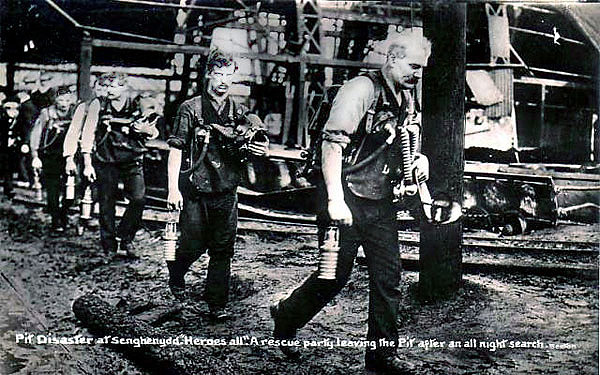
When the explosion occurred on the morning of Tuesday the 14th October, Mr. Shaw, the manager, was in the lamp room at the surface. At 8.10 he heard a report and at once went to the Lancaster Pit and saw that the surface around it was wrecked, the banksman was killed and the assistant banksman injured. Mr. Shaw found that the fan was still working and gave orders to a mechanic to set about taking the broken cage from the top of the downcast shaft and repairing the planking over the pit head. When this was done, Mr. Shaw and
D.R. Thomas, the overman got into the cage in the upcast shaft. They examined the air for 50 yards and found that it was full of smoke and fumes.
Signals were coming from below ground and when others had arrived they went down the shaft. Half way down they saw the body of a man in a tram in the ascending cage with his legs hanging over the cross bars. The man had been blown into the tub at the pit bottom. They signalled to stop the cage and crossed into the other, pulled the body with them and continued their perilous journey. At the Six Feet Landing, the cage jammed on bent girders. They shouted down to the Nine Feet landing where they found that the men from the East Side were all right.
They eventually got the bottom and they found a lot of smoke coming out of the return. They tried to get through the first cross cut on the East side but the doors were burning fiercely so they went to the West side. There again there was a ranging fire in the cross cut, the doors were blown towards the return and the timbering was burning but there was less woodwork on this side and the fire was not a fierce. They managed to put out the fire and got round to the Lancaster Pit where they found Ernest Moss, a shackler, alive behind some empty trams about four yards to the West of the shaft.
Crossing the pit, they found five or six men lying down full length, but all of them later died. These men were the hitchers and worked on the West side. Mr. Redmayne commented that it was odd that these men should have died and the banksman killed when Moses had lived. It was concluded that he must have been protected from the full effect of the blast and the explosion would have gained momentum in going up the shaft from the considerable quantities of dust that would have been blowing off the tubs.
The overman, D.T. Thomas, gave a clear and graphic account of his movement to the inquiry. He said that when he got into the Main West Level and worked along to the east., 'It looked exactly like a furnace.' He was then told by the manager to go to the East side with a party of men whilst he and some others remained on the West side.
Shaw went along the Main West Level for about 40 yards to the hauling engine where he found the planking of the engine starting to blaze. He and others knocked down the planking and extinguished the fire. They went on to the crab engine and the timber there was on fire and every collar that I could see ahead was blazing. There had been no falls but the laggings just behind them were starting to give way. Mr. Shaw retraced his steps and joined Thomas and his party and helped them to put out the fire in the East side cross cut. He then tried to get into the Six feet seam but was stopped by a fall so he came back to the East York Level where he found some men from the East side who had not been effected by the explosion. The overman informed him that he had withdrawn all the men from the East side workings.
Shaw said:-
"I told him to keep them where they were and to bring them within 100 yards of the pit, and that as soon as I had the York Pit right for travelling in I would send for the men and let them up."
The ventilation was now short circuiting and there was a strong current passing from the intake to the return through the West side cross cut. The shaft was cleared, all the injured men collected and taken to the cage and from there to the surface. The East side also sent men up in the cage, 28 at a time.
There was only one who survived the explosion, W.H. Lasbury, an assistant timberman. He went down the York shaft on the morning of the explosion at about 7.50 a.m. and went to the West York by the return. He then went about 20 to 30 yards below the engine on the York West incline when he heard a dull report. He was enveloped in a cloud of dust, which travelled from behind him and he lost his light. He fell forwards and he called to the engineman asking if he was all right to which he replied that he was. He turned back to the pit and groped his way out. As he neared the cross cut he heard a 'sound as of air rushing through the doors in its ordinary way.' as he drew near 'the doors crashed open and I heard a splintering sound' and he staggered back just on the inbye side of the doors, collected himself and staggered to the bottom of the York shaft where he dropped. This gave an indication that there had been two explosions. Meanwhile, Shaw had gone to the surface with his party to get further assistance. He had been down the pit for an hour before work started to repair the water pipes in the shaft with which to fight the fires in the West Main Level. The fire in the East side cross cut was controlled by breaking a pipe on the East side leading from the column in the upcast shaft although it was damaged. The column in the downcast was completely cut off. Shaw started work within the hour to connect the pipes in the downcast shaft and bring water through the first cross cut to the West side but he was greatly hindered with the fumes and smoke which affected his eyes very badly. there were many problems with the work and it took quite a time. It was not until the Porth Rescue Station arrived with breathing apparatus that a proper connection was made. There was a mix up with the message that called them out and much valuable time had been lost. There was a trained Rescue Brigade at the colliery but there was no breathing apparatus kept at the colliery.
The Commissioner commented:-
"In my opinion the efficiency of the water supply was a most regrettable incident. Of course there is always the risk of broken pipes in shafts or underground being broken by the force of on explosion, but the time lost in repairing them would be much less than that absorbed by having to install a complete column."
When Dr. Atkinson and Mr. Redmayne arrived at the colliery on Tuesday afternoon at 5.30 p.m. the fires were being fought by water and fire extinguishers. There was no actual fire visible. It was buried under falls and it was arranged to fill and remove as much of the burning debris as possible with the object of advancing against the fire.
Shifts were arranged to carry out the work. Each shift lasting six hours and acting under the direction of a colliery official or mining engineer.
The speed of the fan was slackened on the day of the explosion and a committee of mining engineers and others were appointed on Wednesday midday to control the rescue operations. It was suggested that sand would do the job but this was overruled as unnecessary. It was not until October 17th that sand bags were procured from Cardiff.
At the Inquiry Mr. T. Greenland Davis, Junior Inspector of Mines was questioned about this point by Clement Edwards. He was asked:-
"I think you were present at an earlier stage when the Chief Inspector considered the question of using sand, and Mr. Leonard Llewellyn said it was not a sandy district, and I said if it were a question of sand I could get a hundred volunteers, get the railway company to run a train, and we would have sand within a few hours from Penarth and Mr. Llewellyn said they would have the fire out before they could get back."
It was not until stoppings were constructed to control the fire, problems with gas had been overcome and the ventilation restored that the exploration of the workings was undertaken.
It was not until 10 p.m. on Tuesday night that an attempt was made to enter the Bottanic District. When the Inspector arrived at 5.30 p.m. on Tuesday he was informed that the air current on the East side was short circuiting near the pit bottom. It was realised that gas could come from that side of the pit and get to the fire and it was arranged that the West side should be carefully watched and the roads leading to the West side examined. Messrs. T.G. Davies and P.T. Jenkins, Inspectors of Mines and two others did this about 9 p.m. which resulted in the discovery that the air, instead of coming from the No.1 North was passing into the Bottanic from the East side. With this knowledge, an exploring party was sent into the Bottanic District at 10 p.m. It was 11.30 when the first man was discovered alive but unconscious. By the early hours of Wednesday morning 18 men had been rescued alive. Work continued until all the bodies were recovered from the mine.
The official report into the disaster refrains from listing the victims by name and gives only a number, job and the cause of death. Four hundred and twenty one were identified and eight were not. The larger number included seven who were brought from the pit alive and later died at home or in hospital. Eleven bodies were left in the mine buried under falls which brought the total death toll to 440.
|


