|
Turkey Field (situate at Babbington) Page 2
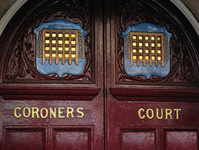
Inquest Reports From Newspapers
Re Nottinghamshire Fatal Accidents
Nottingham Journal - Friday 03 July 1846

On Friday, Mr, Swann, the Coroner for the County, held an inquest at Babbington, upon the body of George Tissington, aged thirty two. Deceased had been employed as engineer for eighteen months in Messrs. North, Wakefield, and Morley’s pits at Babbington, and on Thursday the day before the inquiry deceased descended the engine shaft to repair the bucket door, and Thomas Foster went down a part of the way to “hearken” i.e. for the purpose of giving information to the men above, of anything that might be wanted by those below. Deceased proceeded to the bucket door which is nearly at the bottom of the shaft, but about fifteen feet below there is a scaffolding which is generally under water, and underneath that is a greater depth of water. William Morris, who followed deceased stated that when he had unscrewed all the nuts but two, the weight of the water forced the bucket door off, which knocked deceased backwards, and he and the door fell on the scaffold below. Deceased received no injury by this fall, but when he and the bucket were being drawn up, in consequence of the damp being in the pit the shouts of “hold on” {which means stop the horse which turns the gin}, from Thomas Foster who was “hearkening” were not heard in consequence of the damp in the pit, which had made Foster very weak and ill, and consequently his voice was very feeble. The result was that the poor fellow was struck by some “stays” and was precipitated to the bottom of the pit into the water above the scaffolding which was from twelve to fourteen feet deep. Three hours elapsed before deceased’s body was found. Deceased fell upon Morris’s hand, which he had upon the bucket door, steadying it, and hurt his thumb, but so unconscious was he that it was deceased falling, that he thought deceased had thrown something down upon him, and he shouted “What in the world George have you thrown down at me?” Verdict. “Killed by accidently falling down an engine shaft”. Deceased was a married man, and has left four children.
Nottinghamshire Guardian - Thursday 21 October 1852
On the 18th instant Mr, Coroner Swann, held an inquest at the Broad Oak inn, Strelley on the body of a youth eighteen years of age, named James Webster. The deceased was employed in lowering coal wagons down the incline at Mr. North’s, colliery at Turkey Field. On Friday morning while so engaged, the wagon he was breaking came into contact while running speedily with a number of other wagons which were standing still. When the collision took place the deceased fell between the buffers of first and second wagon and was crushed between them. As soon as he could be extricted, which was not until a quarter of an hour had elapsed, he was a corpse. A verict in accordance with the facts was returned.
Nottinghamshire Guardian - Thursday 26 November 1857
On Friday last an inquest which had been commenced on the previous Wednesday before Mr Coroner Browne, was brought to a conclusion at the General Hospital Nottingham, and terminated in a verdict of manslaughter. The unfortunate deceased was named James Thorley, and was an ostler in a coal pit at Babbington. On the previous Sunday night he was ascending out of the pit and through the negligence of the engine driver was drawn up too high, twisted round the windlass, and pitched upon the roof of the engine house. He was so severely injured by the fall that he died on Wednesday morning. A companion who was with him when the accident occurred happily saved his own life by clinging to the windlass. The following evidence was taken by the coroner. Eustace Carver, resident surgeon of the General Hospital, said that on the previous Monday morning about three o'clock, the deceased was brought to the Hospital suffering from a compound fracture of the left leg, a fracture of the left arm. And his face fearfully lacerated, many of the frontal bones, being broken, he expired on Wednesday morning. John Eley, underviewer, at Mr. T. North’s, colliery said, The deceased was fifty five or fifty six years of age, and was an Ostler in what is called the “Turkey Field Pit” belonging to Mr. North and situate at Babbington in the parish of Strelley. I knew that the deceased had to go down into the pit on Saturday night to feed the horses. I was not on the spot when the accident occurred, but at twelve o'clock on Sunday night I was sent for, to the pit, and on my arrival found Thorley lying in the engine house with his head much injured and an arm and a leg broken. I got him into a conveyance and sent him to the General Hospital at Nottingham. William Smedley, the engineman is the person whose duty it is to let anything down or draw anything up the pit. When say a man wishes to come up from the pit bottom, a bell, which rings in the engine-house, is pulled three times, and when the engine to turn on steam, he pulls a bell which rings at the bottom of the shaft. The man then gets onto the cage gives another signal and is drawn up. When the cage in which the man is seated arrives within twenty yards of the top another connected with the apparatus which rings this bell is an indicator by looking at which any person accustomed to it can tell how far anything has come up the pit. I saw Smedley after the accident occurred and he was sober. There appeared to be nothing amiss with the signal apparatus on Sunday night. Nothing has been done at it since and it works now. John Braithwaite, farm servant of Cossall said; Last Sunday night at ten o’clock, deceased took me down the pit and we stayed there until twelve o’clock. When we wanted to come up again Thorley, rang a bell three times; a bell at the bottom of the shaft then rang once, and after Thorley signalled again we began to ascend. When we got a yard above the mouth of the pit the cage stopped, and Thorley shouted to the engine man to drop us, but we began to go up again. I exclaimed, “We shall be killed James”, Thorley replied “We are all right”. Just as the cage was going over the wheel I grabbed hold of the head spokes. The deceased and the cage went over the wheel which is about ten yards above the mouth of the pit. When I got to the ground again, I found Thorley by the engine house much hurt; I went into the engine house and told Smedley I thought Thorley was dead. He came out and Thorley was carried into the engine house. Edwin Smith, stoker at the Turkey Field Pit, deposed; It is my duty when any man is coming up out of the pit, to stand at the break, and on Sunday night I was at my post. When the deceased and Braithwaite were about to ascend, the customary signals were given and Smedley rang his bell to indicate he was ready. After a short time, I cast my eyes upon the indicator, and perceiving it to beat 14 called out to Smedley, “Oh Bill, Bill, stop” and put my break down directly. I did not hear the bell which generally rings when the cage is a short distance from the mouth of the pit after I put on my break, I saw the chair and the man who was coming up from the pit fall on the roof of the engine house. If the steam had been shut off by the engineman I think the drum might have been instantly stopped by my break.
Nottinghamshire Guardian - Thursday July 28, 1859
An inquest touching the death of William Henson, aged seventy years, of Babbington, was held at the house of Mary Oldershaw, The Broad Oak Strelley, on the 16th instant and by adjournment on the 26th instant, before C. Swann, Esq, coroner. We gather from the evidence then adduced that deceased was a wagon shunter on Mr. North’s, Colliery at Babbington, and on Friday the 15th instant, at about a quarter past twelve o’clock, was sitting on a heap of posts at the bottom of an incline on to a siding waiting for the wagons to come up from the colliery. It was the deceased’s duty to draw the empty wagons on arrival at the bottom of the incline on to a siding, and to bring the loaded wagons forward ready to be drawn up. It unfortunately happened that the wagons deceased was waiting for, had been brought by the men in charge, too far down the incline before attaching them to a wire rope, provided for the purpose of working the loaded and empty trucks up and down the incline, and consequently the wagons began to move, every moment increasing the velocity. Blocks of wood were thrown on the rails, pressure of the brakes, and other means were tried, but all in vain to arrest their progress by the men in charge; and continuing their fearful descent, the deceased not having time to escape was killed on the spot. The jury returned the following verdict: “That the deceased was accidentally killed on a colliery railway, and the jury strongly recommend that no truck in future be allowed to go up or down the incline unless it has good and efficient brakes attached to it, so as to stop it whenever necessary”.
Nottingham Journal - Friday 28 January 1864
On Tuesday afternoon a very shocking accident occurred at Babbington Colliery, near Strelley. A young man named Job Severn, in the employ of Mr North, was doing some work in connection with a stationary engine at the mouth of the pit, when he was caught in the machinery and his body badly mutilated. Both his arms were cut off and his face much injured. Death resulted in a few minutes. An inquest will be held |