Banner
Address FT Site Email CCL Info In Memory Menu Philip Individuals Search Webmaster Content Work Fionn Bob
Information and photographs submitted by subscribers are posted in good faith. If any copyright of anyone else's material is unintentionally breached, please email me


Roland Laycock

Modern History
Lamp


From:
Sent:
Subject
:
Roland Laycock
21 Mar 24
Pit Closure, Released Documents
 

Coal Not Dole
India celebrates historic milestone in coal production

India extracted a record one billion tons of coal last year to fuel its booming, energy-hungry economy


From:
Sent:
Subject
:
Roland Laycock
21 Sep 2024
Pit Closure, Released Documents
 

The NCB and NUM had settled the dispute on 5 separate occasions until Thatcher intervened

In 2014 secret documents and cabinet papers were released. So what did they reveal.

These papers are available to anyone that might be interested from the National Archives at Kew. One of those secret documents from September 1983 shows in a note that ministers were considering to close 75 pits. Hold on a moment during the 1984/85 strike Thatcher constantly insisted only 20 were to close. It seems to clarify that miners, the public and Parliament were misled and Scargill might just have been telling the truth.

The document from September 1983 was marked 'Not to be photocopied or circulated outside the private office'. It records a secret meeting of just 7 people in Downing Street which included Thatcher, the chancellor, energy and employment secretaries and it seems the minutes were recorded by someone called Lillian. Those present were told that the 'Pit closure programme had gone better this year than expected as one pit had been closed every three weeks resulting in the workforce shrinking by 10%'. MacGregor now wanted to go further and close a further 75 pits which meant the industry would soon be reduced from it's current figure of 202,000 to 138,000. However, it was decided that, no closure list should be provided and instead they should be closed on a pit by pit basis (wonder why). They were told that the outcome would be

  • two thirds of Welsh miners would be made redundant
  • half in the North East
  • a third in Scotland
  • half in South Yorkshire
  • almost half in the South Midlands
  • the entire Kent coalfield would be wiped out.

(Oh that's why) The last paragraph of this document states. 'It was agreed that no record of this meeting should be circulated'. The next week it was requested that the same small group should meet regularly but 'Nothing should be put in writing to clarify the strategy that exists between Mr. MacGregor and the secretary of state for energy'. Hmmm you told everyone you were keeping out of it and it was a matter between the NCB and NUM.

I have mentioned on here before that the NCB and NUM had settled the dispute on 5 separate occasions until Thatcher intervened. Two of those occasions are discussed in the released documents. The first relates to the dock strike in July 1984 and as a result Thatcher started to prepare for and call a State of Emergency because of the fear of not being able to land enough imported coal or enough food. She considered using troops to unload and move goods from the docks. A secret poll was conducted which shows 71% of the public were against it. There is no indication who undertook the poll. Norman Tebbit wrote a secret and personal letter to Thatcher stating time was not on their side and urged that urgent measures should be taken because secret estimates showed coal stocks would run out in January. He wanted her to 'Open up a new front against the NUR and ASLEF because they are reducing the movement of coal and coke'. He also wanted her to take legal injunctions out against the rail unions and to settle the dock strike.

The second moment when they stared into the abyss occurred in October 1984 when NACODS voted by 82% for industrial action which meant there would be a total shutdown of the British coal industry. A secret list of worst case scenarios was presented to her which included a 3 day week. Ouch she must have thought. It probably brought back memories of Ted Heath and 1974. Deals were done with the NCB, NACODS and the NUM. Then for no apparent reason NACODS withdrew the threat. I have not seen anything in the released papers to say why but I could hazard a guess.

Other important issues from the time show that the Home Secretary Leon Brittan was told to get chief constables to adopt a 'More vigorous interpretation of their duties'. They also bemoaned the fact that magistrates 'Were dragging their feet in processing those arrested' Does anyone remember David Hart (the Tories called him the Blue Pimpernel). He was an old Etonian who organised and funded the working miners' anti strike movement. The personal diary of Thatcher shows he had 3 secret meetings with her at No. 10. A note on another secret file shows that he rang Thatcher to tell her the press had found out that he had direct access to her. He told her he was 'Infinitely deniable'. With regards to the well publicised back to work campaign the documents highlight that in reality it was 'No more than a trickle' in the first 6 months of the strike 'with no more than 500 going back to the pits in July 1984'

For those of us that were described as 'The enemy within' it is interesting that in October 1984 Thatcher was going to take this further and extend the charge of seditious insurrection not just to miners and left wing councils in Liverpool and London for resisting cuts in services; but also against the whole Labour party. Remember that's bordering on Treason and is still a hanging offence in Britain Even Kinnock was going to be described as a puppet to Scargill. I don't know about you guys but I don't mind being called the enemy but I don't want him in there with me. We were all going to be described as 'Enemies of democracy'. Nevertheless, the publication of her private papers now show this was dropped from her speech to the Tory conference. Why I hear you ask. It was suddenly removed and found too divisive because of the IRA bomb attack on her Brighton hotel in October 1984. I know what you're thinking lads but keep those thoughts to yourselves.


From:
Sent:
Subject
:
Roland Laycock
3 Sep 2024
'Hurry up' over £4.8bn pension battle
 

'Injustice!' Ex-miners beg Rachel Reeves to 'hurry up' over £4.8bn pension battle

The controversy stems from a pension deal made in the early 1990s. Thousands of former British miners are urging the Government to "hurry up" and rectify what they see as a decades-long injustice regarding their pensions.

The miners, who spent years working under gruelling conditions, are locked in a bitter dispute over £4.8 billion in pension entitlements they claim are rightfully theirs - and are begging Chancellor Rachel Reeves to intervene, as promised in Labour's election manifesto.

The controversy stems from a deal made in the early 1990s, after the privatisation of British Coal, where the Government guaranteed the Mineworkers’ Pension Scheme (MPS).

However, this agreement also allowed the Government to claim half of any surplus generated by the scheme.

Over the years, the Government has reportedly collected approximately £4.8billion from the fund, while miners argue that this money should have been distributed among them and their widows. Mick Newton, 61, a former miner from Nottinghamshire, voiced the frustration shared by many. He said he had to retire early, on a reduced pension, because mining gave him psoriatic arthritis. He told the Telegraph : "We always knew from day one that an injustice was being served upon us."

The miners argue that the Government has profited off their deferred wages and demand the return of these funds.

Despite a recent Labour manifesto promise to “end the injustice,” miners remain sceptical, fearing their hopes may once again be dashed. Bert Moncur, 66, another ex-miner, described how the pension battle has impacted his retirement. Mr Moncur said: “The Government didn’t put any money into the scheme. All the money is mineworkers’ and it’s deferred wages. Nobody’s got a right to that money except miners and their widows." Mr Moncur, like many others, says he feels cheated out of a decent pension, adding: “We’re going to be robbed to the grave. There’s no doubt about it unless they give every penny back.”

Labour promised to review the surplus arrangements and return the £1.4 billion Investment Reserve Fund to members in its 2024 manifesto, however, there is no clear timeline or guarantee that this will happen. Mr Newton argues the money in the fund should be freed up, fast. He said: “Every year it’s been used as a cash cow for the government, but also, we believe, mineworkers are being punished all the way to the grave. It’s time for the Government to step up and hurry up.”

Trek

Miners on a half-mile rail trek to the coal face at one of the Manchester Collieries pits. December 1937


From:
Sent:
Subject
:
Roland Laycock
11 March 2024
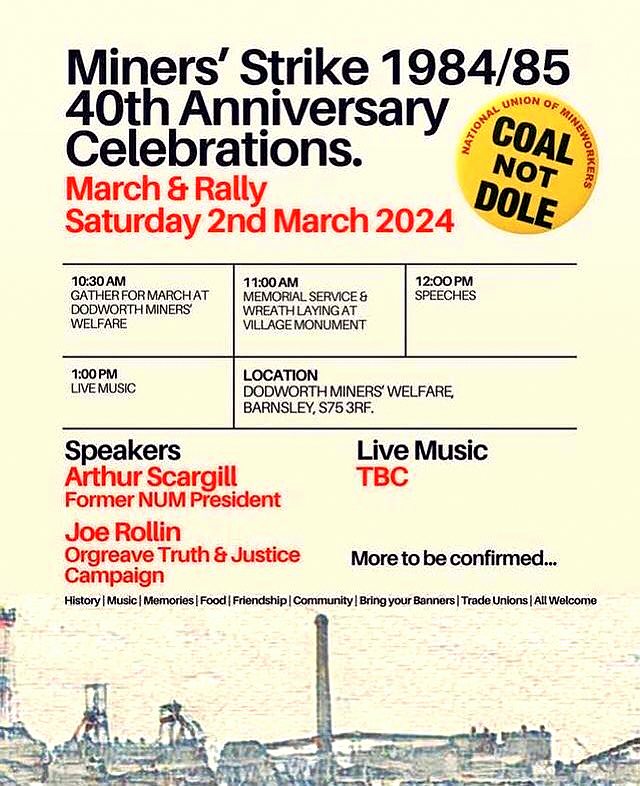
Miners Strike 40th Anniversary
 

Veterans of 1984-85 UK Miners’ Strike Mark 40th Anniversary With March and Rally

Crowd

YouTube

Miners March 40 Years After War With Thatcher: With Arthur Scargill & George Galloway

March-1

Miners in a once bustling South Yorkshire coal region marched with their champion, Arthur Scargill, at the weekend (March 9, 2024) to mark 40 years since their war with Margaret Thatcher.

The strike’s fortieth anniversary takes place amid a resurgence of the class struggle not just in Britain but internationally.

The 1984-85 miners’ strike was the most heroic struggle ever undertaken by the British working class. It saw a year of unimaginable hardship as around 150,000 miners took on the might of the state, with over 26 million days lost in the largest action since the 1926 General Strike.

The strike’s fortieth anniversary takes place amid a resurgence of the class struggle not just in Britain but internationally.

On Saturday 9 March, hundreds of former miners and their families marked the 40th Anniversary of the 1984-85 British miners’ strike, with a march and rally in South Yorkshire, England.

The Hatfield Miners’ Strike Parade assembled at the Broadway Hotel in Dunscroft, near Doncaster, and marched along Station Road, East Lane and Waggons Way to the former Hatfield Colliery. The march, led off by the Doncaster & District, & East Yorkshire Pipe Band, and the Armthorpe Elmfield Brass Band, was greeted along the way.

Hatfield

Former miners and the families marching with the Hatfield colliery National Union of Mineworkers banner as they leave the site of the now closed pit.

Under the shadow of the rusting headgear and remains of buildings at the Hatfield pit, miners commemorated the strike and held a minutes’ silence for miners who were no longer alive. Hatfield was closed by British Coal in 1993, one of many pits shut in the years that followed the strike’s defeat. It was reopened in 1994 by a team from the pit’s management, as the Hatfield Coal Company Ltd., before closing again in 2001 as unprofitable. Private operator Richard Budge restarted coal production in 2007, but the pit finally closed in 2015, along with two remaining pits, Kellingley Collieries in Yorkshire and Thoresby in Nottinghamshire—marking the end of deep coal mining in the UK.

The parade proceeded to the nearby Hatfield Pit Club in Stainforth, where a rally was addressed by former National Union of Mineworkers (NUM) President Arthur Scargill who led the union during the 1984-85 strike.

Scargill

Former National Union of Mineworkers President Arthur Scargill speaking at the 40th Anniversary event at the Hatfield Pit Club, March 9, 2024.

In a speech lasting almost an hour, Scargill detailed the main events during the strike, noting that at every key juncture it “could have been won” were it not for the sabotage by right-wing sections of the NUM leadership and the leaders of the National Association of Colliery Overmen, Deputies and Shotfirers (NACODS).

Scargill explained that NACODS members had voted to strike by an 80 percent majority based on a joint agreement with the NUM. This would have led to every pit in the country being forced to close—including those in Nottinghamshire kept open by scab labour. However, said Scargill, two days before a meeting arranged at conciliation service ACAS to settle the dispute, “NACODS told us they had changed their mind… and to this day I’ve never had an answer… No explanation has ever been given as to why NACODS performed this sellout, which has terrible consequences, which led to the destruction of the whole of Britain’s deep mine coal industry.”

Scargill made similar remarks throughout his speech regarding the response of NUM areas leaders to police attacks on pickets, and later on their ending the strike—insisting their sabotage was inexplicable and only hinting at their actions reflecting the interests of British Coal and the Tories.

The fact is that for 40 years, Scargill himself has offered no explanation of such behaviour, because this concerns the pivotal question of leadership and programme which led to the defeat of the miners.

To give a truthful account of the strike would require that Scargill address the sabotage of the strike not just by NUM areas and NACODS but by the entire trade union bureaucracy, led by the Trades Union Congress (TUC), which left miners to fight alone for an entire year. And he would have to address the role of the Labour Party, whose leader Neil Kinnock was a notorious opponent of the strike.

Recalling the Battle of Orgreave coking works in the summer of 1984, he said all that was required was more mass picketing and to continue fighting the police to a standstill. Scargill himself was arrested and beaten at Orgreave, requiring hospitalisation.

The events at Orgreave said Scargill, “were almost a replica of what had happened all those years before a Saltley Gate”, a reference to the mass mobilisation of the working class in Birmingham that closed a fuel storage depot which led to victory in the 1972 miners’ strike. “But instead of repeating that by bringing more pickets as I urged from my hospital bed, the [NUM] areas for some reason didn’t do it…. I’ve no doubt in my mind that if Orgreave had stayed closed, the strike would have been over.”

Scargill, then and now, proceeds on the assumption that the strike’s isolation by the TUC and Labour Party could have been overcome by a repeat of the trade union militancy that led to the fall of the Heath Conservative government in 1974.

The Socialist Equality Party attended the parade in Yorkshire, with a new pamphlet. The Lessons of the 1984-85 miners’ strike, which explains the real lessons to be drawn from the miners’ courageous fight.

Pamf

The pamphlet’s introduction places the strike’s defeat in the framework of “a major shift in economic organisation, with an aggressive turn by the major corporations to global investment and internationalised production,” noting that globalisation “demanded the deregulation of the economies of the advanced industrial countries, the slashing of tax rates, destruction of welfare provision and a massive increase in the exploitation of the working class in the drive to become internationally competitive and secure a share of world markets.”

It was the impact of globalisation that produced the wholesale abandonment by the nationally-based labour organisations of their old reformist programmes and their transformation into corporatist adjuncts of the transnational companies and national governments:

“Scargill fought the strike based on a national reformist programme. He sought to force a defeat on the Thatcher government solely by militant trade union action and to then convince the Labour Party and Trades Union Congress (TUC) to implement a national ‘Plan for Coal.’

“Instead, the miners were faced with a political struggle against the state and every instrument at its disposal, led by a government determined to crush ‘the enemy within’ at all costs, and the deliberate and systematic isolation and sabotage of their struggle by the trade unions and the Labour Party.

The foundations for the complete transformation of the trade unions into partners of the corporations and state, and of the Labour Party into an avowed defender of free market capitalism under Tony Blair, began with the crushing of working-class resistance in the miners’ strike. “This defeat inaugurated a decades-long and historically unprecedented decline in industrial action and the living standards of the working class.”

The pamphlet’s introduction insists: “Four decades ago, the miners’ strike proved the necessity of waging the class struggle based on a worldwide strategy through the building of rank-and-file organisations of class struggle and a new socialist and internationalist leadership in the working class.”

Mehring Books is the publishing arm of the World Socialist Web Site

Atten

Attendees at the parade at the Socialist Equality Party stall

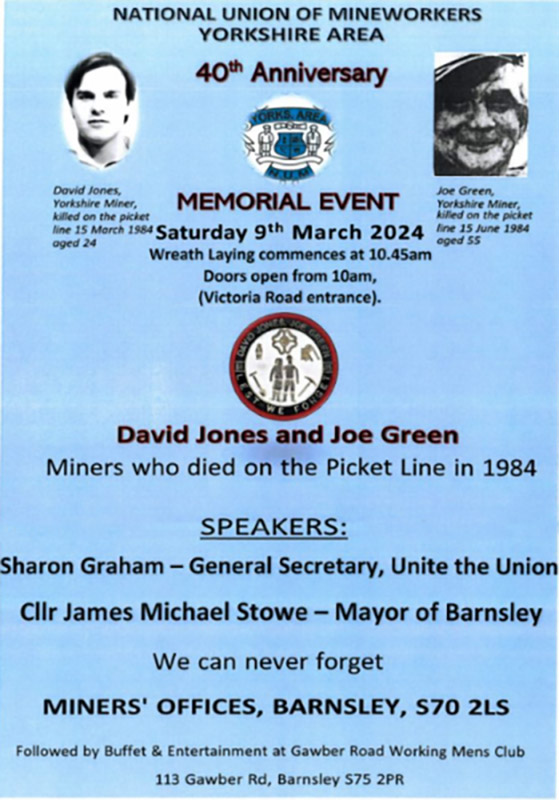
In Barnsley, over 200 people including ex-miners attended the annual memorial lecture for David Jones and Joe Green, two miners who were killed during the 1984/85 strike. The annual lecture takes place at the NUM headquarters, with the majority of those in attendance union bureaucrats.

The main speakers, Labour councillor James Michael Stowe and Sharon Graham, the UNITE general secretary, both called for a Labour government and made no criticism of party leader Sir Keir Starmer or the presence of war mongers Dan Jarvis MP, who was on the platform, and John Healey, the Shadow Defence Secretary.

The SEP’s new pamphlet insists: “It is essential that the working class, especially its younger generation, is armed with the lessons of the 1984-85 miners’ strike. This will immeasurably strengthen them in the life-and-death conflicts they face and in building the revolutionary leadership they must have.”

 

AM

NUM-Y


Orgreave


Scargill

Divider


S7 Page 7
Menu
Pit Terminology - Glossary