1879
Dunston Extraction
At Dunston colliery (Sheepbridge Coal and Iron Co Ltd) 90 acres 1 rood and 22 perches had been mined from commencement to Lady Day 25th March 1879, Surveyors Coke and Mills of Chesterfield Sep 1879.
Langwith
At the newly sunk Langwith colliery difficult working conditions were experienced albeit the Top Hard seam was 5’ 10” (1.78m) thick.
Shaft Accidents At Portland Colliery

On 6th June 1879 there was a shaft accident at Portland No2 (Butterley Co) when 2 men were killed and several others injured. Shaft widening was being done and at about 130 yards (119m) deep the sinking scaffold gave way because of the weight and several men fell off to the bottom of the shaft some 70 yards (64m) below. One of the men broke an ankle!
A further shaft incident at the same pit resulted in another accident on 15th November when a man fell 10 yards (9m) resulting in his death on 23rd November 1879.
Candle Fired The Powder
An accident occurred at Pleasley on 11th July 1879 when a collier was injured as he stuck a lighted candle near to an old shot and it fired the powder.
Union
The South Yorkshire Miners’ Association split up in Derbyshire in December.
Colliery Name Change
South Normanton colliery name changed to Winkcobank or Wincobank.
My Maternal Great Grandfather Robert White born at Blidworth in 1859
He moved to Huthwaite as a small child with his parents Ann and Eli living at Sherwood Street, Hucknall Under Huthwaite and on leaving school worked as a farm labourer locally at Crow Trees Farm Fulward Cutting.
 His father Eli was a collier. Realising that miners earned more money than farm labourers he signed on as a collier just down the road at Winkcobank near South Normanton. He was buried in a roof fall when he was about 20 years old, and assumed to be dead, was transported home by horse and cart, or carried as in the sketch and covered by a tarpaulin, as was the custom of the day, also with a knock on the door with the statement – ‘We’ve brought him home missus’… His young wife Jessie at the time when confronted by the sight succumbed to a heart attack, and died from the shock. His father Eli was a collier. Realising that miners earned more money than farm labourers he signed on as a collier just down the road at Winkcobank near South Normanton. He was buried in a roof fall when he was about 20 years old, and assumed to be dead, was transported home by horse and cart, or carried as in the sketch and covered by a tarpaulin, as was the custom of the day, also with a knock on the door with the statement – ‘We’ve brought him home missus’… His young wife Jessie at the time when confronted by the sight succumbed to a heart attack, and died from the shock.
However he was not dead, but very badly injured with a twisted back pushing some of his ribs round, and for the rest of his life Robert walked with a very bad stoop due to his twisted ribs and a deformed back, but recovered sufficiently to work in the pits again.
He subsequently recovered from his injuries and moved to Brinsworth, South Yorkshire where he lodged and remarried to Emma Leeson the daughter of the couple who were the landlords and later lived at Masbro’ and Rotherham area, where they had 7 children, my Grandfather Eli being born 8th February 1884 at Whiston.

Denaby Main
He became a coster monger running a green-grocery business from a hawker’s cart later. Emma died at Sutton in 1926 aged 66, In the 1901 census Robert White was listed as a collier aged 42 (and his eldest son Eli, at 17 (my Grandfather) was a pony driver), both working at Denaby Main in South Yorkshire. (photo). He returned to Sutton-in-Ashfield, Nottinghamshire with most of the family in 1907 firstly living on Spring Bank, Kirkby Road, and later ran a chicken farm behind the bungalow he built on the unmade road Carsic Lane. He built a further bungalow next door for his eldest daughter Mary, a seamstress.
He collapsed and died after shovelling a load of coal into his coalhouse in July 1949. He was 90 years old! Coal killed him in the end.
Depression
1879 was another bad year for coal. The depression was beginning to bite. However mines were still sunk by speculators, and others changed hands assuming better times were ahead. It was stated by Mr Harrison of the Barber Walker Co that
‘a profit of £9,000 had been made from High Park, Brinsley, New Watnall and Moorgreen, but a loss of £2,550 had been experienced from Cotmanhay and Eastwood collieries’.
Royal Commission
A Royal Commission on mines and mining was carried out in 1879, however it would be 1887 before another Act was passed.
Collieries Sunk or Opened in 1879
- Bathurst Main (Minnikin and Co), Bolsover
- Birley South (Jeffcock and Dunn)
- Blackshale (CH Plevins) Newbold
- Brockwell (CJ Saunders)
- Carr Close Ilkeston (Enoch Mould)
- Cossall (Cossall Colliery Co) sunk Feb 1878-May 1879 – referred to locally as Hewlett’s pit, after the Chairman of the company Alfred Hewlett, Managing Director was William Holding (350)
- Cottam (Appleby and Co)
- Cottam New (Renishaw Coal and Iron Co), Eckington
- Cutthorpe (J Springthorpe) Chesterfield
- Digby (Digby Coal Co) sinking
- Grassmoor (Messrs Barnes)
- Hallows Farm (Dronfield Silkstone Coal Co)
- Hartington (Staveley Coal and Iron Co)
- Hewlett, production started 1879 and screens were built
- Highfield (George Senior) Chesterfield
- Hill Top (Dronfield Brick Co) Dronfield
- Hill Top (Marshall and Tingle) South Normanton (Derbyshire), 2 pits 14 yds (12.8m) deep, started working Top Hard, surrounded by old works. There was a 3 ft (0.91m) fault between the shafts
- Hollingwood (New) sinking (Staveley Coal and Iron Co Ltd)
- Millbrow (Ludworth Brick Co) Ludworth
- Newfield (Knowles and Co) Burton
- Shallcross (Buxton Lime Co) Buxton
- Silkstone (JH Andrews and Co) Chesterfield
- Silkstone (Messrs Barnes) Chesterfield
- Silkstone (WG Cursham) Belper
- Silkstone (Thomas Holdsworth) Clay Cross
- Silkstone Main (Andrews Bros) Dronfield
- Snowdon Lane (C Swift) Dronfield
- Waterloo (Buxton Lime Co), Whaley Bridge
- Watnall New (Barber Walker and Co)
- Wheeldon Mill (SM Lancaster), Chesterfield
- Woodhouse (EH Phillips), Dronfield.
(29 Pits)
The Following Collieries Changed Hands in 1879
- Carr Close, Ilkeston, (No1 Engine pit 60 yards (55m), No2 Wind pit 56 yards (51m), from Jos Pearson to Bardsley and Smith
- Cottam Old and Cottam New from Appleby and Co to Renishaw Coal and Iron Co
- Danes Moor from Clegg Bros to Clay Cross Co
- Dolly Tunnel from Butterley Iron and Coal Co to Thomas Bennett
- Gresley from CF Hastings to Lord Donington
- Grasscroft Wood from Knowles and Co to Israel Knowles
- Gresley Wood from Hall and Boardman to Moira Colliery Co
- Grassmoor from Barnes and Co to Grassmoor Co
- Hasland from Industrial Coal Co to Dr Cornelius Black
- Kirkhallam from Thomas Whitehouse and Son to West Hallam Coal and Iron Co
- Kilburne from G and T Small to J and N Nadin
- Locoford from Tapton Coal Co Ltd to Philemon Hicks
- Lindridge from Desford Colliery Co to M Petrie
- Marehay from Ford and Mart to Marehay Colliery Co
- New Heanor from HH West to WJ Grimshaw
- Northfield from Pyatt and Swann to Northfield Colliery Co
- Pilsley from Pilsley Colliery Co to Holdsworth and Co
- Renishaw from Chesterfield and Boythorpe Coal Co to C Black and Co
- Storforth Lane from the Industrial Coal Co Ltd to Dr C Black
- White Lane Silkstone from Richardson and Vardy to Andrew Vardy
- Woodhouse Dronfield from W Booker and Co to EH Phillips
- Winksbank colliery changed name to Winkcobank by the South Normanton Colliery Co.
Colliery Closures in 1879
- Barker colliery Cotes Park pit (named after John Barker) Deep Soft, fin Lady Day
- Brickyard, Hill Top, Dronfield
- Bridge House (John Crookes) Deep Soft, 2 Jul 1879, open work met old hollows, Surveyor William P Howard AMICE
- Campbell (Staveley Co) Blackshale, 27 Jun 1879, Agent AW Barnes, Surveyor E Wheldon
- Carr Close (Enoch Mould and Co) for White Barn Colliery, Newcastle, Staffs, previous owners Bostock, Mould and Co 1870 up to 1876, then Smith, to Lady Day), Ilkeston, near Rutland Colliery wharf, Roof Soft 2’ 4” (0.71m) and Deep Soft 3’ 9” (1.14m), Main Soft, 12 feet (3.6m) blue bind between, No1 Engine pit 60 yards (55m) and No2 Wind pit 56 yards (51m) deep, fin July 1879, Butterley Co worked Brown Rake ironstone 20 yards (18m) and 18 yards (16.5m) to North, other side of railway line and old workings by Mr S Shaw via adit and vent shaft 26 yards (23.75m) to south, old shaft 26 yards (23.8m) Norman colliery (Dr Norman), original plan made by Surveyor AP Hunter, a later plan by Francis Calvert Gillett (1187) Mar 1880
- Coleorton (Coleorton Colliery Co) Upper Main seam, 27 Aug 1879
- Comber Wood (John Shirtcliff), Killamarsh, Sough coal 3’ 0” (0.91m) and Furnace, UC shaft 5 yards (4.5m), DC 12 yards (11m)
- Compstall (Andrews and Son), Glossop, Mountain seam
- Coolham (Two Sheds) nr Whaley Bridge, Simmondley seam
- Cottam Old (Renishaw Coal and Iron Co), Eckington
- Cossall (Lynch and Co), Cossall, Nottinghamshire, Piper
- Cuckoo pits, local name, near Cossall, Piper shafts 15 yards (14m) and 14 yards (13m) abandoned by Cossall Colliery Co 12 Dec 1879, by William Holding, Manager
- Cutholme (J Oldfield), Brampton, Deep Hard (Potters), Surveyor WH Howard 1 Oct 1879
- Cutthorpe (J Oldfield), Brampton, Deep Hard
- Elm Tree (Newmarket) (Miss Ellis), Clay Cross, Silkstone – bind top, siblers 1’ 9” (0.53m), dirt 2” (0.05m), coal 1½” (0.04m), dirt 2” (0.05m), nickers 9” (0.23m), dirt 3” (0.08m), bottoms 1’ 5” (0.43m), batts 2” (0.05m), fireclay seat earth, Footrill mouth and Air shaft, dip of coal 1in9, and another Footrill and Air shaft to north, 2 Jul 1879, Surveyor
Joseph Archer
- Hartshay pits Clod coal, shafts 27 yards (24.5m) and 65 yards (59.5m), pillar left for shafts
- Hasland (Industrial Coal Co) stood
an old Hewlett pit was abandoned
- Hill Top or Ball Hill (Marshall and Tingle), South Normanton, 14 yards (13m) to Top Hard, met unknown old workings both sides, closed Dec, Thos Evans Inspector received the plan in Jan 1880
- Hill Top Brickyard (Dronfield Brick and Tile Works) Blackshale top bed 2’ 5” (0.74m), dirt 10” (0.25m), bottom bed
1’ 11” (0.58m), total 5’ 3” (1.60m), fin Dec 1928, abandoned 28 Mar 1879
- Hollingwood New (Staveley Coal and Iron Co), Staveley
- Holme Farm (J Crooks), Newbold, Silkstone
- Kitchen Wood (W Bedford and Co) Trial pits to Blackshale coal 2’ 3” (0.69m), muck 1’ 6” (0.46m), coal 2’ 0” (0.61m), met old works, abandoned Feb 1879
- Langley Mill, John Beardsley closed his mine sooner than carry on employing Butties, which he said, was a ‘rotten system’
- Lower House (Stanfield and Co), New Mills
- Manor (Messrs Lucas) Dronfield
- Marehay (Butterley Co) Ell coal 2’ 7” (0.79m) and Black Rake, bind with ironstone bands abandoned Lady Day 1879, (see 1894), connected to Wharf pit (or Whiteley) 114 yards (104m) to Main Soft, and Brickyard pit 116 yards (106m) to Ell, Calley pit 130 yards (118.75m) to Ell, 178 yards (162.75m) to Hard coal
- Newland (Green and Co), Killamarsh, High Hazle
- Newmarket (Kirby and Cross), Clay Cross, Silkstone
- Oakerthorpe (Geo Pearson) leased from RC Strelley, Blackshale at 100 yards (91m), Waterloo at 53 yards 48.5m), point of dip 60º South East, 1in7, section Tops 1’ 4½” (0.42m), dirt 5¼” (0.13m), Tinkers 11” (0.28m), dirt 3½” (0.09m), operations suspended 29 Apr 1879
- Oakerthorpe (Lord Donington) Ashby, Main, 14th Aug 1879
- Renishaw Station (Black Bros), Eckington, Hollingwood coal (Sitwell or Deep Soft), coal 9” (0.23m), bat 3” (0.08m), coal 1’ 4½“ (0.42m), inferior coal 1’ 0” (0.30m), coal 1’ 7” (0.48m), floor indurated clay, total 4’ 11½“ (1.51m), pit 113 yards (103m ) deep at side of Canal, rise of seam on end 1in14, bord, met old workings and shaft, abandoned
Mar 1879, Surveyor John Gould Civil Engineer and Mining Surveyor
- Shirland (Pyatt and Swann), there was a sough mouth, a pit 15 feet (4.6m) deep, a Pump shaft and Blackshale shaft.
- Marley Hall pits lay to the SE (closed …?)
- Snibston No2 (Snibston Colliery Co) sunk by (Geo, Robert, Stephenson, Joseph Sandars and Charles Binns) Middle Lount 5’ 4” (1.62m) and Hard, at 213 yards 1’ 6” (195.2m), abandoned 26th June 1879 HMI signed 25 Jun 1879, left off coal winding 16th May 1877, Manager JHR White
- Springfield (Henry Amos Knighton (cert 75), Hill Top, Eastwood and W Smith, Langley Mill, owners), Greasley, Comb 3 ft (0.91m) thick stopped on account of water, also Top Hard (section soft 1’ 0” (0.30m), Rifler 1’ 3” (0.38m), main hard 1’ 6” (0.46m), stother 1’ 3” (0.38m), floor coal 2’ 0” (0.61m) total 7’ 0” (2.13m), started Mar 1873 also stopped on account of water, worked up to Old Men’s workings, drift and UC shaft 5 yards (4.5m) and Engine house shown, dip of seam 3” to 1 yard (0.08m to 0.91m)
- Tom Lane (Barrow?) near Duckmanton closed after 43 years
- Troway (Rhodes Bros), Dronfield
- Old Watnall (Barber Walker and Co) Top Hard, Coombe, Top Soft, 30 Oct 1879, the stables were situated close to the pit bottom
- Old Western pit (Butterley Co)
- Whaley Bridge (Horwich House Level) (Buxton Lime Co) 18” (0.45m) seam or Red Ash (see 1885)
- Whittington Forge (Knowles and Co), Whittington, Silkstone
- Whittington (Knowles and Co), Whittington, Silkstone
- Woodhouse (W Booker and Co), Dronfield, Silkstone (or Blackshale). The mineral estate was part Booker’s and Charles Lowe. There was an old Water level to the south. Surveyors were Grace and Archer Mineral Surveyors of Sheffield and Wakefield. (37)
- Awsworth (Awsworth Iron Co) Blackshale, strong grey rock over seam top coal 1’ 3” (0.38m), dark bat 9” (0.23m), inferior coal 9” (0.23m), 6” dark bat (0.15m), 1’ 3” (0.38m) bottom coal, 1’ 0” (0.35m) dirt, finished Lady Day 1879.
- Kimberley (Chas Seely and Co) Deep Hard seam abandoned 1 Feb 1879
- Old Watnall Coombe and Top Soft abandoned 30 Oct 1879.
John Boot & Son
The firm of John Boot & Son, Surveyors of The Orchards, Hucknall under Huthwaite went into liquidation on 27/1/1879. It is thought that the time taken by them for obtaining the potential site chosen for New Hucknall Colliery caused this as the proposed colliery ought to have been sunk earlier than 1877 and at work and the firm went into debt as jobs became scarce. John Thomas Boot the son was 53 in 1879 and needed to have a job. It is not known whether he carried on surveying for another company: however he would be mentioned in 1900 when he entered the New Inn Level sough near Silver Hill pit.
Newmarket Elm Tree Pit
It was noted that at Newmarket Elm Tree pit (Miss E Ellis), (Derbyshire), there was a Basset pit, footrill mouth, a Drawing shaft 13 yards (12m) deep, and an old shaft 16 yards (15m) re-opened as an air pit for the mine. Coal was worked by Clarke and others and gotten by A Kirby the defendant. Manager was Mr Hall, who said that part had been ‘worked across the road’. There was a post or pillar support for Elm Tree House. A heading was driven for Miss Ellis the Plaintiff. The pit was closed on 21st Feb 1879, because of a dispute of trespass with Kirby, owner of neighbouring mine. Seam section: siblers 1’ 9” (0.53m), dirt 2” (0.05m), coal 1½” (0.04), dirt 2” (0.05), nickers 9” (0.22m), dirt 3” (0.07m), bottoms 1’ 5” (0.43m), batts 2” (0.05m). Coal banks had been worked by William Barber, a benk was driven and worked by John Willows and William Shakespeare from Barker’s ‘Ending’ to an old gate and solid coal. Another gate was called a ‘Siding’. Benks (faces) to the west side were worked by John Williams. A plan drawn by Assistant Surveyor to Joseph Archer to a scale of 33 feet to 1 inch for the plaintiff was produced for the hearing of Ellis and Kirby. Outcome?
The Great Depression
1878 and 1879 were the worst years of the Great Depression. James Haslam (1842-1913) founded the Derbyshire Miners’ Association in 1880 and in the following year the joint union, the Derbyshire and Nottinghamshire Miners’ Association decided to split up and go their own separate ways. He was elected Liberal / Labour MP for Chesterfield in 1906 until his death. The inaugural meeting of the Association was held at the Sun Inn, Chesterfield by 5 men in Sep 1879. The General Secretary was James Haslam, President Richard Bunting and Treasurer William E Harvey (1852-1914). The others were John Catchpole and John Smith. Heather Colliery Co suspended working at their mine.
North West Derbyshire
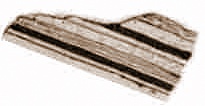 The mining around the Axe Edge and Goyte Valley pits (North West Derbyshire) had now begun to decline. The most productive period for the small coalfield was in the previous one hundred years, peaking around 1800. The House coal outcropped towards Axe Edge and dipped about 1in6 as shown. The other seam lying in a basin was mainly used for the production of lime for the local farms. The mining around the Axe Edge and Goyte Valley pits (North West Derbyshire) had now begun to decline. The most productive period for the small coalfield was in the previous one hundred years, peaking around 1800. The House coal outcropped towards Axe Edge and dipped about 1in6 as shown. The other seam lying in a basin was mainly used for the production of lime for the local farms.
Fatal Accidents in 1879
- Aspenshaw, Joseph Bennett (25), fall of roof 20 Aug 1879
- Boythorpe, Daniel Townsend (46), run over by tubs on the surface 26 Sep 1879
- Boythorpe, William Ward (17), crushed by slack bucket on the surface 1 Nov 1879
- Chisworth, Isaac Radford (36), fall of roof 31 Dec 1879
- Clay Cross No2, Sam Spencer (64), fall of roof 7 Mar 1879
- Dunston, James Moore (38), fall of roof 31 Jul 1879
- Ellistown, Thomas Smith (51), fall of roof 9 May 1879
- Grassmoor, Anthony May (50), fall of coal 4 Mar 1879
- Grassmoor, Benjamin Pearce (26), fall of ground 15 Jul 1879
- Grassmoor, Israel Knowles (35), fall of roof 18 Sep 1879
- Grassmoor, Herbert Farnsworth (15), fell out of a wagon on the surface 25 Nov 1879
- Heather, Edward Laurence? (26), mortar board fell down shaft 26 Mar 1879
- Holbrook, Geo Frost (24), shotfiring accident 14 Oct 1879
- Hollingwood, Geo Potter (41), fall of coal 29 Jul 1879
- Hollingwood: James Anderson (22) 6 Mar 1865
Barrowcliff (26) 5 Oct 1866
William Samuels (23) 11 Mar 1867
Herbert Start (12) 12 Mar 1867
- Hollingwood, James Firth (15), 20 Aug 1879
- Langwith, Joseph Nichols (24), shotfiring accident 23 Nov 1879
- Manners, Charles Beardsley (27), fall of roof 28 Jul 1879
- Mapperley, Frederick Laurence (24), fall of coal 25 Mar 1879
- Oakwell, John William Riley (16), fell into sump 5 Jun 1879
- Pilsley, Joseph James (19), fall of coal 21 Aug 1879
- Renishaw Park, John Elliott (14), crushed by a pony 16 Feb 1879
- Renishaw Park, Luke French (18), fall of roof 20 Sep 1879
- South Leicestershire, Henry Poole (18), fall of roof 30 Sep 1879
- Springwell, John Hudson (42), fall of roof 13 Oct 1879
- Swanwick, Geo Taylor (46), fall in a roadway 20 Feb 1879.
Output
The output for 1879 was 7,450,370 tons from 234 Derbyshire pits and 4,249,242 tons from 41 Nottinghamshire pits and 1,035,016 tons from 21 Leicestershire pits.
The Nottinghamshire pits were generally more modern, not so steep and also usually drier than the shallower Derbyshire pits, giving better working conditions overall.
1879 was another bad year for coal. |


