1882
Sinkings
During 1882 sinking began at Glapwell by the Sheepbridge Co with two 14 feet (4.26m) diameter shafts and at
Markham No1 E444945, N372305, by the Staveley Co, both to the Top Hard seam and
Clay Cross Co purchased Park House pit from Wingerworth Coal Co.
Fatal Accidents
The third fatal accident at Silver Hill (Nottinghamshire), and the first in the lower horizon was on 20th April 1882, when
John Wright (24), stallman was killed by a fall of roof in the Silkstone seam workings.
Changed Hands
Clinton colliery at Brinsley changed hands from Beardsley and Others, to Peter Newton.
Buxton Lime Co owners of Axe Edge and Thatchmarsh changed name to Goyte and Thatchmarsh colliery working Mountain seam.
King’s Patent
|
1882 the King’s Patent safety winding device was tried at Pinxton No1 pit
Langton (Coke and Co) at the close of the day’s work on
27th September in the presence of Walter Salmond Agent and Manager, Sam Alsop Manager and John King the inventor of the hook. The two-deck cage loaded with coals of plus 2 tons was lifted into the headgear and the rope went flying over the pulley leaving the cage suspended. The rope was brought back over the pulley and reconnected to the hook. The engine lifted the cage and lowered it to the pit top running on level. This was done in a time of 4 minutes and 12 seconds. The shackle was changed and new rivets were put in and coupled up ready for work.
This took another
7 minutes and 58 seconds. The total time for the experiment took
12 minutes 10 seconds.
It had proved to be a total success. The safety hook would be used at many collieries in the future.
Langton Deepened
The No7 shaft at Langton was deepened to the Deep Soft and Deep Hard seams at
215 yards (196m). A pair of engines was bought from Lockoford colliery (Philemon Hicks), Chesterfield. |
Explosion At Park House
At the Park House (Clay Cross No7 pit) (Clay Cross Co) Danesmoor, (Derbyshire) there was an explosion on 7th November 1882 at 10am. 45 men were killed and the wooden headstock was demolished by the blast. The bodies were brought out at No8 pit nearby. Candles were used for illumination. Safety lamps were introduced later. HMI Thomas Evans stated that he thought a fan would be better than the existing 8’ 6” (2.6m) long underground furnace for ventilating the mine. (see list of dead under HMI report below).
Clay Cross No 10 shaft was sunk at Morton, but never developed.
Bestwood
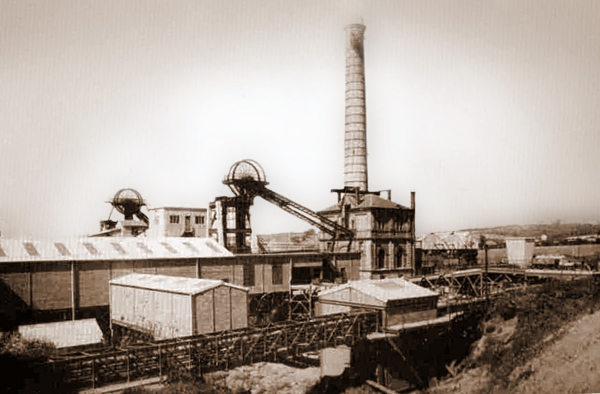
Bestwood (Nottinghamshire)
Strikes
There was a 5 weeks strike at Bestwood (Nottinghamshire) beginning in November, over the Bestwood Coal Co’s refusal to increase the men’s’ wages by 10%. They were the only company in the county to provoke a strike over this issue. Some of the men known to have been active during the strike were refused work afterwards.
At the Staveley Co pits of Hartington, Old Hollingwood, Ireland and Springwell, 795 men and 82 boys came out on strike for 7 days. The men at Church Gresley in South Derbyshire worked on as others in the area went out on strike. They had suffered badly previously in a bitter struggle during the 1860s.
Newfield Abandoned
The decision to abandon and fill in the shaft at Newfield with clay was made by JC Gillett and Thomas Evans HMI and
Lord Donington reluctantly agreed in Oct 1881 because the workings were flooded and water rising up the shaft and also seeping into Rawdon workings and was completed by early 1882.
Collieries Opened or Sunk in 1882
- Blackshale (CH Plevins and Co), Newbold, Silkstone
- Clay Pit (JH Birkinshaw), Clay Cross, Silkstone
- Church Gresley (Charles F Hastings, Lord Donington), Burton, Moira Main and Little
- Dore (William Wilbraham), near Sheffield, new sinking, but stood
- Horwich Tunnel (Buxton Lime Co), Whaley Bridge, Red Ash or 18” (0.45m)
- Markham No1 (Staveley Coal and Iron Ltd) sinking
- Mickley (EH Phillips), Dronfield, Mickley and Silkstone
- Moor Hole (WE and GH Wells), Eckington, Deep Hard
- Nesfield (Sheepbridge Coal and Iron Co), Sheepbridge, Silkstone
- Peawit (Wingerworth Coal Co), North Wingfield, Top Hard
- Potters (CH Plevins and Co), Newbold, Silkstone
- Streetfield (John Worrall), Eckington, Hard Coal
- Unstone Apperknowle (Unstone Coal and Coke Co Ltd), Unstone, Silkstone
- Avenue (Clay Cross No 9), was sunk in 1881- 1882 by Clay Cross Co Ltd
- Trowell Moor pit (Dunn Bros) opened, but this only caused added depression by overproduction.
(14 Pits)
The Following Pits Changed Hands in 1882
- Hucknall Huthwaite from Mellers to Hucknall Huthwaite Co
- High Lane from Trustees of J and G Wells to Andrew Vardy
- Plumbley from John Rhodes to Plumbley Colliery Co
- Wallsend from Tapton Coal Co Ltd to George Orwin
- Bestwood Coal and Iron Co changed to Bestwood Coal Co
- Digby Colliery Co changed to Digby Coal Co.
Collieries Closed in 1882
- Alma (J Jowitt)
- Alderwasley (Barton and Shaw) Mountain seam, 15 Apr 1882
- Ambergate (Barton and Shaw) Ganister coal towards outcrop of Belper Lawn, adit and shaft 1 Feb 1882, abandoned 11th Feb, Freehold belonging I Bowmer and copyhold land to Mr Frost Esq, part worked in both
- Awsworth (Awsworth Iron and Coal Co) (Nottinghamshire) 2 shafts 73 yards (66.7m) Low Main or Furnace 3’ 8” (1.12m), some coal gotten prior to lease 1875, Piper pit – 3rd shaft 31 yards (28.3m) last worked Mix 1874, section kind bind and water shale 5½“ (0.14m), coal 2’ 10” (0.86m), hard listy coal 10” (0.25m), dark bind clunchy and water, and Threequarter, Blackshale 130 yards (119m) to top coal 1’ 3” (0.38m), dark bat 9” (0.23m), inferior coal 9” (0.23m), dark bat 6” (0.15m), coal 1’ 3” (0.38m), one area finished Lady Day 1879, abandoned 11th Apr
- Barlow (Sheepbridge Coal and Iron Co)
- Birchwood (Chas Seely and Co)
- Bole Hill (Marshall and Tingle)
- Bretby (Countess of Chesterfield) Stockings, Woodfield, Eureka
- Broom House (Whittington and Sheepbridge Coal Co)
- Butterley Park 1,2,3,4 (Butterley Iron and Coal Co)
- Clay Cross No1 Cannel pit, (Clay Cross Colliery Co), (owner’s executors late Sir William Jackson, Bart),
Parish of North Wingfield, 7th Jan 1882, depth 85 yards (77.75m), several other shafts (6 ?), No9 pit 32 yards (30m) c1872, staple pit? 1848, No1 pits, 2 shafts 85 yards (77.7m) and a staple pit down to Silkstone or Blackshale goaf. (information supplied by Mr Vardy later 8 Feb 1887)
- Compstall Road (Andrews and Son), Ludworth
- Comber Wood (John Shirtcliffe), Killamarsh
- Cordon Meadow or Ormonde, (John Beardsley) 5 shafts to left of railway, old Hards found through take
(Surveyor John Beardsley 1872) (old hollows) Dunston seam (Butterley Co from 1882, John Holbrook, Surveyor 6th Mar 1884)
- Dunston Hall (George Orwin or Sheepbridge Coal and Iron Co) Dunston or Deep Soft seam, roof coal 1’ 0” (0.30m), clod 7” (0.18m), main coal 4’ 6” (1.37m), floor soft spavin 1’ 0” (0.30m). 6 adits and one shaft. Worked through an old shaft, finished Feb 1882. A separate area with 2 shafts worked by Dunston and Barlow Co met old works all round, Surveyor Richard Geo Coke (547) 1868, finished probably in 1879
- Foxley Oaks (Whittington Silkstone Colliery Co Ltd), Drawing shaft 154 yards (140.8m) to Silkstone or Blackshale, off New Bridge Lane, in liquidation, Manager William D Holford, Whittington, Nov 1882, inc Footrill Engine and Dunstan
- New (1864) pits, had coke ovens, washing machine, loco shed, weighing machine
- Gosforth (Dronfield Silkstone Co) Blackshale or Silkstone 16th Mar
- Grasscroft (Knowles and Co), Whittington, Silkstone, adit, shaft Drawing pit 154 yards (141m), dip 1in4,
abandoned Nov 1882
- Grasscroft Wood (Israel Knowles) Blackshale 10 Feb 1883
- Highfield (George Senior), Newbold, Deep Hard
- High Lee and Lower House (Thos Bennett) Yard mine, 3’ 0” (0.91m), 2 shafts, 7th Jan 1882
- Holmes Cutthorpe (W Holmes), Newbold, Piper and Walkers coal, 69 feet (18m) below Mickley 28 Dec 1882
- Honeycroft Rake Ironstone Mine (West Hallam Coal and Iron Co) ironstone and Kilburn seam 4’ 6” (1.37m),
A Whitehouse
- Kirk Hallam (A and W Whitehouse, West Hallam Coal and Iron Co), West Hallam, Kilburn 4’ 6” (1.37m)
shaft 83½ yards (76m) and ironstones, M Severn for Co, May 1882, Richard Growcroft Agent and Surveyor
- Marehay (William Drury Lowe) Soft coal 4’ 0” (1.22m), Nov
- Millfield (Mathew Hobson) Ilkeston, Dogtooth seam, 11th Apr 1882, Thos Evans HMI
- Morley Hill (Geo Pearson and Co), Wingfield
- Moorhole and High Lane (J and G Wells), Eckington, Silkstone
- Newcastle (Alfred A Mundy) Shipley, Heanor, sunk 1837, closed after 45 years
- Northfield (Northfield Colliery Co), Shirland, owner Richard Swann, South Normanton, minerals purchased of late
John Wilson, Deep Hard 5’ 0” (1.52m) and Soft, drawing pit 182 yards (166.5m), Pumping pit 187 yards (171m), also Air pit near Goose Green, Surveyor Howard Gould ME, Chesterfield
- North Wingfield (North Wingfield Colliery Co), North Wingfield, Waterloo and Ell, Deep Soft, last worked Nov 1882, shaft unsafe, 9,000 gals of water pumped per hour at the shaft, script William H Hayne, Manager Henry Foley
- Oxclose or Silkstone Main (JH Andrews and Co), Dronfield, Silkstone, top coal 3’ 0” (0.91m), dirt 1’ 2” (0.36m), bottom coal 2’ 0” (0.61m), total 6’ 2” (1.88m), pit 74 yards (67.65m), air pit 65 yards (59.4m), dip of seam about 1in18 east, met old workings, abandoned Aug 1882, Surveyor William Wilde, Whittington
- Pool Works (Ensor and Co), Gresley
- Riddings New Deeps (James Oakes and Co), Derbyshire, Kilburn, 2’ 3” (0.69m), depth 250 yards (228.5m), met main fault 60 yards (55m) to north, Cromford Canal to south, No6 pit between Nottingham Turnpike Road and
Greenhill Lane Road, to boundaries of Selston and Codnor Park
- Salterwood (William Drury Lowe), Denby, Soft coal – section – coal stoney 1’ 6” (0.46m), coal good 2’ 0” (0.61m), hard list 2” (0.05m) coal soft 4” (0.10m), inclination 3¼” to the yard (0.08m to 0.91m), point of inclination S70◦East,
- No1 shaft 84 yards (77m) and No2 shaft 65 yards (59.5m), (JH Andrews for owners) closed 29th Nov
- Springfield (Knighton and Smith)
- Silkstone Main, Oxclose (JH Andrews) Silkstone, Sep
- Rutland 1,2,3 (Rutland Coal Co), (No3 Peewit) Ilkeston
- West Hallam (A and W Whitehouse), West Hallam, Deep Soft, Deep Hard
- West Hallam (West Hallam Coal and Iron Co) 15 yards (13.75m) shaft to Kilburn, and Honeycroft Rake ironstone (open work), Surveyor M Severn
- Whitwick (Whitwick Colliery Co) Splint and Minge, 1st July 1882
- Wigwell (Matthew Shaw) Wigwell Brick Works, 1’ 2” (0.34m) Wigwell coal, 2’ 6” (0.76m) clunch, open workings and
2 entrances and 2 vent shafts, finished 1st Feb 1882. A tram road and a toll bar were adjacent.
Waddell Fan (Waddle)
A 35 feet dia (10.67m) Waddell (Waddle) fan was installed at Denby Hall (Derbyshire).
Linby Engines
The largest pair of haulage engines in the Midlands area were installed at Linby Colliery in June1882 and switched on by Mrs Nall (who previously some 9 years previously had cut the first sod for the colliery). The 1,000 hp compressed air engines were on the surface and air was piped down the 425 yards (388.6m) deep 14 feet (4.27m) diameter shaft in 12 inch (0.30m) diameter pipes. The engines were made by Messrs Walker Bros of Wigan and the steam to operate them was from 4 Lancashire boilers, each 30 feet (9.14m) long by 7 feet (2.13m) diameter at 50 to 60 lbs per sq inch. Only one shaft was used for turning coal at present and the output had reached 16,000 tons for the week. It was proposed to turn coal at both shafts in the near future.
At nearby Annesley Colliery the output had reached 15,000 tons. Henry Lewis was the Manager for both pits and Mr Grey was Agent. Coal was being extracted at about 60 acres per year from the 3,000 acre lease.
Note...similar but smaller hp engines had previously been installed at Clifton and WollatonCollieries.
Inrush At Snibston
Around 400 men and boys were out of work when there was an inrush at Snibston No1 from old workings and the water was soon encroaching into No2 pit.
Manager Fined Again
In July 1882 the Manager at Boythorpe Michael Straw was fined 10s (50p) plus costs of £2 1s 6d (£2. 7½ p) for contravening Section 18 of the Coal Mines Regulation Act 1872 for not allowing Patrick McDermot to perform his duty as checkweighman. There were no meal breaks at Boythorpe.
Owner Summoned
On 7th December 1882 George Small joint owner of Kilburn Colliery was summoned by Thomas Evans HMI that he did not maintain travelling roads in the mine and Assistant to Evans, Arthur Stokes HMI gave evidence that on 29th September a youth named Joseph Annable, pony driver ganger was killed due to the roof bind falling as it was overhanging the sides of the gate which was so narrow that it took the hair off the horse’s side when passing. The under-viewer was WC Parkin but the case was proven and the Company was fined £10 plus costs.
Fatal Accidents in 1882
Compiled by Thomas Evans (Inspector of Mines)
- Albert, Arthur Varley (26), fall 16 Aug 1882
- Albert, William Marriott (32), fall 7 Nov 1882
- Alma, Thomas McTye (17), fall 18 Sep 1882
- Bailey Brook, George Eyre (29), explosion 9 Jan 1882
- Bestwood, Thomas Knowles (14 or 16), run over by tubs 6 May 1882
- Birchwood, George Shipman (aged 35), killed in a fall of ground 2 Jan 1882
- Blackwell B Winning, James Poplar (22), crushed by tubs 7 Jul 1882
- Brinsley, Thomas Naylor (54), fall of ground 15 Dec 1882
- Clay Cross No3, James Williams (15), fall in roadway, tubs 5 Jun 1882
- Cossall, Jessie Mitchell (19), fall 18 Oct 1882
- Grassmoor, William Burnham (61), fall 6 Mar 1882
- Hasland, James Taylor (52), fall 14 Feb 1882
- Heage, William Jeffcock Hobson (31), fall 3 Nov 1882
- Holbrook, James Caroline (26), fall 13 Mar 1882
- Hundall, Sam Stringer (68), crushed by tubs 29 Jun 1882
- Hundall, Joseph Widdowson (37), fall of coal 19 Nov 1882
- Kilburn, Joseph Annable (13), fall of roof 26 Sep 1882
- Kilburn, Hiram Croft (20), fall of coal 15 Oct 1882
- Kilburne, William Muir (16), metal prop flew out 24 Nov 1882
- Langley, Tristram Poundall (52), fall 9 Aug 1882
- Langwith, James Hatton (36), fall of roof on 20 Dec 1881, died 13 Feb 1882
- Langwith, William Wordsworth (28), fall 1 Mar 1882
- Langwith, John Day (28), fall 15 Apr 1882
- Langwith, John Humphrey (15), run over by tubs 18 Apr 1882
- Langwith, William Burrows (56), crushed by the cage 28 Apr 1882
- Linby, Sam Barratt (16), crushed by tubs 21 Mar 1882
- Linby, Amos Abell (14), crushed 21 Oct 1882
- Lodge, Sam Limb (21), fall of coal 13 Nov 1882
- Manners, John Riley? (15) 18 Oct 1883
- Marehay, Thomas Haynes (35), fall of coal 6 May 1882
- Marehay Main, Robert Redfern (27), explosion of firedamp 15 Sep 1882
- Mickley, Richard Payne (35), fall 6 Oct 1882
- Mickley, Henry Broomhead (36), Sam Lowe (28) and Edward Lowe (16), all 3 were killed when the cage came unhooked and fell down the shaft 6 Oct 1882
- New Hucknall, William Hartwell (33), fall 21 Mar 1882
- New Hucknall, George Shooter (55), run over by waggons 14 Jun 1882
- Newstead, Sam Severns (13), fell from screens 25 May 1882
- Park House Clay Cross No7 (Danesmoor), the following 45 men were all killed in an explosion at 10am in 4’ 6” (1.37m) thick Blackshale seam on 7 Nov 1882: -
- Pentrich, Sam Waller (52), run over by tubs 20 Apr 1882
- Pinxton No1, William Hodgkinson (50), run over by tubs 6 Jun 1882
- Renishaw Park 1, Thomas Cunliffe (27), crushed by the cage 3 Jan 1882
- Ripley, William Kirk (47), shot exploded 14 Jun 1882
- Seymour, Thomas Morris (36), fall of roof 10 Sep 1882
- Shirland, William Linacre (39), fall of roof on 21 Dec 1881, died 21 Jan 1882
- Shirland, Uriah Bowler (50), fall of roof 12 Jun 1882
- Somercotes, George Bacon (..?) was killed on 21 Jul 1883
- South Leicestershire, Richard Payne (35), fall of roof 5 Oct 1882
- Stubley, William Grindlow (54), winding rope broke in a disused pit 7 Jun 1882
- Swanwick, John Hill (14), run over by tubs 27 Jul 1882
- Tibshelf, George William Spur (27), fall of roof 26 Jul 1882
- Waingroves, Sam Storer (31), fall of roof 23 Jun 1882
- Wollaton, Joseph Crich (33), fall 22 Aug 1882.
Fatal Accidents Newcastle
- Birch and Beck 12 Jan 1861
- Robert Hopcroft (30) 20 Apr 1875
- Albert Beswick (14) 10 Aug 1880
|


