1895
Inrush Of Water
On 25th February 1895 there was an inrush of water at Diminsdale (Diminsdale Colliery Co), near Tibshelf from ancient workings, however no-one was injured but the men were thrown out of work,. There were 67 underground and 19 on the surface. However it was agreed to pay them out of union funds. The Babbington Colliery Co who ran Tibshelf collieries nearby employed around 2,000 and had enlarged the Tibshelf colliery club at a cost of a further £2,000. An Infants school had been built in 1889. Locally known as Dimsdale. (see 1896).
Dispute Over Explosives
 There was a dispute at New Hucknall (New Hucknall Colliery Co) over changing from ordinary powder to ‘Roburite’ for shotfiring. The men contended that the old powder was cheaper and also easier to use, remembering of course that the colliers fired and had to purchase their own powder at that time. There was a dispute at New Hucknall (New Hucknall Colliery Co) over changing from ordinary powder to ‘Roburite’ for shotfiring. The men contended that the old powder was cheaper and also easier to use, remembering of course that the colliers fired and had to purchase their own powder at that time.
Strike
There was a strike at Alfreton (Blackwell Colliery Co) over a holing machine being introduced.
Dronfield Closed
Unstone Main Co ceased operations when their drift mine at Dronfield was closed.
Parliament
 A Conservative Administration lasted from
June 1895 until December 1905. A Conservative Administration lasted from
June 1895 until December 1905.
Prime Minister Lord Salisbury (Conservative) 1895-1902, was succeeded by Arthur Balfour until 1905.
President of Board of Trade,
C Ritchie (Con) 1900.
Principal Secretary of State Sir Matthew White Ridley MP 1895-1900.
Use Of Screens
 At Hollingwood colliery (Staveley Coal and Iron Co) they began using screens or forks instead of shovels for loading out Deep Soft in 1895, as large coal was required and no small coal or dust was to be loaded out. The idea would spread. At Hollingwood colliery (Staveley Coal and Iron Co) they began using screens or forks instead of shovels for loading out Deep Soft in 1895, as large coal was required and no small coal or dust was to be loaded out. The idea would spread.
285 men and boys u/g, 62 s/f were employed.
Russian Ponies
Russian ponies were introduced at Clifton colliery (Clifton Colliery Co), Nottingham and a total of 136 would be purchased up to 1915.
Pillar And Stall
A typical example of a system of mining employed around this period is shown where pillar and stall and room and pillar working was used and then the pillars were robbed as they retreated towards the pit bottom. However the first coal cutter was introduced at Ibstock.
Moira Colliery Co.
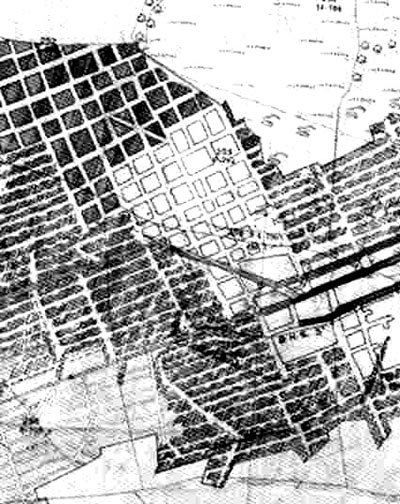 On 1st October 1895 the Moira Colliery Co Ltd was formed. Lord Donington had died in July. John Turner was General Manager for the Co and Thomas Bourne Manager for Church Gresley where there was a reconstruction when the UC shaft was re-bricked and deepened and another shaft was widened from 8’ 0” (2.43m) to 14’ 0” (4.27m) dia and deepened. The output for Reservoir colliery was 93,483 tons, Church Gresley 68,233 tons and for Rawdon 67,344 tons. Manager for Rawdon and Marquis was TA Wilson up to 1897 when SA Warburton became Manager. On 1st October 1895 the Moira Colliery Co Ltd was formed. Lord Donington had died in July. John Turner was General Manager for the Co and Thomas Bourne Manager for Church Gresley where there was a reconstruction when the UC shaft was re-bricked and deepened and another shaft was widened from 8’ 0” (2.43m) to 14’ 0” (4.27m) dia and deepened. The output for Reservoir colliery was 93,483 tons, Church Gresley 68,233 tons and for Rawdon 67,344 tons. Manager for Rawdon and Marquis was TA Wilson up to 1897 when SA Warburton became Manager.
Coal Dust Explosion
On 11th November 1895 at Blackwell A Winning (Blackwell Colliery Co) near Alfreton, (Derbyshire) there was an explosion caused by an overcharged shot.
Some parts of the mine naked lights were permitted, but on the Monday morning when the ‘datallers’, whose job it was to prepare the pit for full work, six men and one boy were killed – James Fryer (?), John Jones (?), Thomas Straw (?), James Nee (?), William Martin (?), … and John Gibson (?) (ganger) and his horse.
It appeared that the large ventilation fan was working slowly and it was surmised that the explosion was caused by the small blasting operation which was being conducted which liberated a large quantity of methane gas suddenly.
However it was proved that it was a coal dust explosion as there was no methane gas present at the site. This type of explosion is far more severe than a gas explosion. Later, methods to suppress dust would be introduced, such as water sprays, water ampoules and the spreading of stone dust (pulverised limestone).
Union
The Nottinghamshire Miners’ Association now had 15,459 members and 44 branches.
Kirkby

At Kirkby, locally known as Summit (Butterley Co), the manpower had increased to 450 in the Top Hard seam with 135 on the surface.
Portland Gang Line
Until 1890s coal was transported in tubs by a jig (a self acting incline) from the Portland pits and the Top Mexboro’ pit to the Bottom Mexboro’ pit (Bog and Wink). Here the coal was loaded into wagons and weighed then taken by the ‘Coffee-pot’ engine to Brake House and on to the Cromford Canal wharf at Jacksdale near Codnor Park forge.
Lord Donington Died
Lord Donington owner of pits in South Derbyshire and Leicestershire died. His pits would be administrated by his Executors for several years.
Arkwright Town
A 63 years lease for 5,000 acres of coal was granted by William Arkwright to Staveley Coal and Iron Co. He also built the colliery rows at Arkwright Town on the site of the Arkwright mine.
Collieries Sunk or Opened in 1895
- (Kirkby) Bentinck 1,2,3 (New Hucknall Colliery Co) sinking
- Bonds Main (Staveley Coal and Iron Co) began sinking
- Bridge House (E Wright and Co), Brampton, Tupton seam
- Brimington (SM Lancaster) Chesterfield, Silkstone
- Cres(s)well (Bolsover Colliery Co) sinking
- Field House (Soar and Quail), Brampton, Tupton Threequarters
- Glebe (Edward Tingle) Barlborough, 4/2
- Hill Top (Henry Naylor and Co) Eastwood, Top Hard 3/3
- Measham (W Tate) Main coal, Manager William Tate (947), Thomas Jones (no cert), 19 u/g, 6 s/f
- Nether Heage (Joseph Bowmer) Belper, Norton
- Newbold (Derbyshire Silkstone Colliery Co) Silkstone
- South Wingfield Speedwell (South Wingfield Colliery Co) re-opening
- Warsop Main (Staveley Coal and Iron Co) sunk, tubbing installed in the shafts in the water-bearing measures
- Whitwell (Shireoaks Colliery Co).
Collieries Closed in 1895
- Alton (Deerleap shafts) 199 yards (182m)
- Apperknowle (The Unstone Coal and Coke Co Ltd) Dronfield, Blackshale, Mr RS Ward’s Trustees, met old workings, finished 9th Apr 1895
- Blackfordby Coal and Clay pit (Trustees of late Lord Donington) Raffaree coal and Chance coal, 25 May 1895, Surveyor George J German
- Brickyard (W Rigley and AW Claxton) Heanor, Top Hard standing
- Cowley New (J Chetwynd)
- Dale (Robert Angle Dent) Killamarsh, 2 Foot or Sough coal abandoned Nov 1895, (Arthur H Stokes HMI signed plan 19th May 1900)
- Dronfield (Unstone Main Co or Unstone Coal and Coke Co Ltd) ancient level went through pit bottom, abandoned 31st May (Fallswood No2 to S, Forge pit up to turnpike, Wreaks Lane adit and shaft and Old Gosforth to West)
- Furness Clough and Chinley (Levi and Elijah Hall) White Ash mine coal 11½” (0.29m) thick, at 48 yards (44m)
app, very thin and inferior, 20th July, Red Ash mine 1’ 6” (0.45m) at 25 yards (23m)
- Grove (SM Lancaster) Newbold, Dunston standing
- Hollingwood Deep Hard, using Hartington pit shaft, 31 Dec 1895
- Hopewell (Derbyshire) (Staveley Colliery Co?)
- Lodge (execs of William Hall) Greasley, (Nottinghamshire) Deep Soft at 78 yards 1 ft 8 in (71.75m) abandoned
25th June 1895, reached boundary to Digby Colliery Co
- Marehay (Butterley Co Ltd) Ell and Black Rake ironstone, total 6’ 8” (2.03m) Frederick Channer Corfield Agent, abandoned Dec 1895
- Moira Netherseal Woodfield seam 31 Dec 1895
- Nelson Street, Heanor (Claxton and Rigley), Top Hard, headings sunk on old works, Dec
- New Dronfield Silkstone colliery (Unstone Coal and Coke Co Ltd), Blackshale, worked up to Old Gosforth Colliery workings, 31 May 1895
- During a period of depressed coal prices the Pinxton No1 pit finished working in May 1895 and No3 pit in June 1895, (Coke and Co)
- Nutbrook (EM Mundy) Deep Soft
- Upperthorpe (Thomas Jackson, previously Thomas Griffiths Richards) Dayhole and Air pit 8 yards (7m) deep, High Hazels 4 feet thick (1.22m), met old works May, abandoned Dec 1895, 4/2, Surveyor: JW Tankard
- Wheeldon Mill (SM Lancaster) Brimington, Piper standing, 2/1.
Fatal Accidents 1895
- ? Osbourne (..?) and ? Norman (..?) were killed at Westwood 10 Nov 1895
- Alfred Williamson, an engine man aged 24, drowned at Plumbley 17 Mar 1895 whilst attempting to rescue three children who had fallen through the ice on the colliery pond. All four perished.
- Henry Amos Knighton, the Colliery Manager at Bagworth, aged 55, was fatally injured 19 Aug 1895 when he either jumped or fell off the colliery loco on the Midland Railway siding.
- Jim Robinson (13) Incline boy at Coleorton No3 (Bug & Wink) was attempting to ride on a set of full trams on 24 May 1895 and fell in front of the train
Snibston Overwind
On 25th Jan 1895 there was an overwind at Snibston Colliery. George Swain (aged about 60) a winder for 40 years was noted to be acting erratic. No one was on the cage as the men fortunately, who had signalled to come up the shaft, had got off. The cage reached the top of the shaft and dropped back down again and smashed into the pit bottom. The ascending cage smashed into the winding wheel where it jammed causing consderable damage to the pit head. The cages were very badly damaged, fortunately no one was injured. Swain had never had an accident before. The Manager was J W Richardson.
Price of Coal
The average cost of a ton of coal at the pithead in the Midlands area was 5s 8½d (28½p).
1895 was a bad year for the industry. |


