1926 - Page 2
Ponies Continued
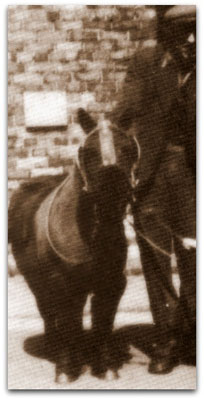  At Tibshelf pits (Derbyshire) for example about 35 Welsh ponies about 4 feet (1.22m) high max were employed underground. Up to 80 ponies were underground at Pleasley (Derbyshire) (Stanton Ironworks Co). At Tibshelf pits (Derbyshire) for example about 35 Welsh ponies about 4 feet (1.22m) high max were employed underground. Up to 80 ponies were underground at Pleasley (Derbyshire) (Stanton Ironworks Co).
Management Kept
The Pits Open
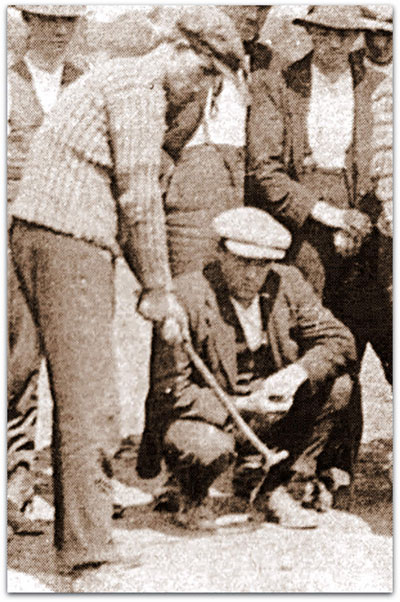
Management worked on pumping and other operations to keep the pits open. Soup kitchens were organised and set up for the strikers and their families. The summer of 1926 was particularly long and sunny. The men used to play Peggy or Nipsey, a game using sticks, to pass the time away.
Squatting On Haunches
Many a miner would be squatting on his haunches wiling the time away, chatting to his mates.
The pose was a general one in the pit as seats were few and far between, indeed it was the done thing when I started work proper in 1953.
Revival of Mining
There was a small revival of mining at Thatchmarsh (North West Derbyshire) that had been abandoned in June 1919, when coal was supplied to the Magpie lead mine.
Shallow Working By Striking Miners
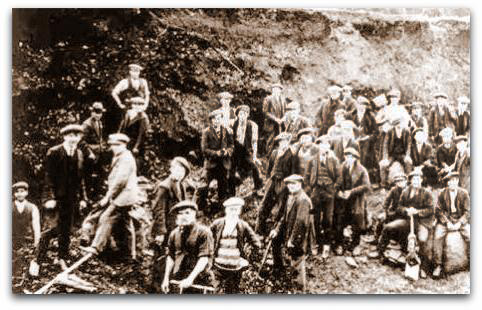
There was a resurgence of shallow pit working by the striking miners and there were ugly scenes of violence and breaking of ranks at the outcrop workings in many parts.
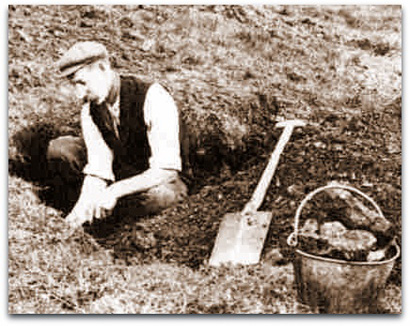
At Blackwell B Winning there were Top Hard workings, from the end of the surface sidings to the North of the pit.
|
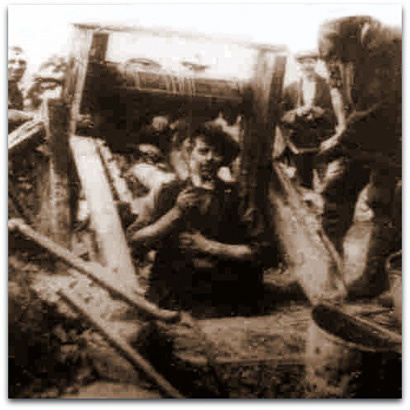 |
Working of a shallow seam by drift and opencast at Coalfield Wood (Bloomer Wood in the Dumbles), Doles Lane, off Sutton Road, Kirkby-in-Ashfield, Nottinghamshire was carried out by a few unemployed miners, coal loaded out by horse and cart and also at Kenning’s Park, Clay Cross.
Blackshale seam diggings were done from the sidings at Calow colliery. Shallow shafts were sunk at Church Gresley, Newhall and Swadlincote and coal was worked on the pillar and stall system with the coal in buckets or boxes being raised to the surface by a turn beam – hand wallowing.
 The local pit tips were areas of activity as many men with their families scrambled about searching for discarded coal, as to most this was the only form of heat and power available to them. The local pit tips were areas of activity as many men with their families scrambled about searching for discarded coal, as to most this was the only form of heat and power available to them.
Uniformed constables from the Manchester Police force were drafted into the Bolsover district to quell any potential violence. They were billetted at Bainbridge Hall. Edward Bainbridge was the Managing Director of the Bolsover Co. During May 1926, the Mayor of Chesterfield swore in many special constables to assist the regulars.
Joseph Birkin of Eastwood, a member of the Nottinghamshire Miners’ Association Executive Committee organised and profited from outcrop working as he had done in 1921.
He was one of the leaders of the British Workers’ League which was an organisation of Butties supported by some owners, in particular the Bolsover Co. There was quite a deal of outcropping done on a commercial scale. On 5th July the NMA made an appeal to the Police, local councils and the Mines Inspectorate to try to outlaw outcropping.
The garden behind 117 Norman Street, Ilkeston stretched down to the wall between it and Granby Pit. Top Hard coal seam is about thirty feet down in this vicinity. Tom Pounder, then about 12 years old, and a mate decided to help out during the 1926 strike by digging a coal pit at the bottom of the garden. After a morning they were down about two feet! A few striking colliers turned up, asked what they were doing, and joined in and in due time reached coal at about thirty feet down.
- Click Here To Read More -
Brannigan's Jazz Band
Poor Law And Pawn Shops
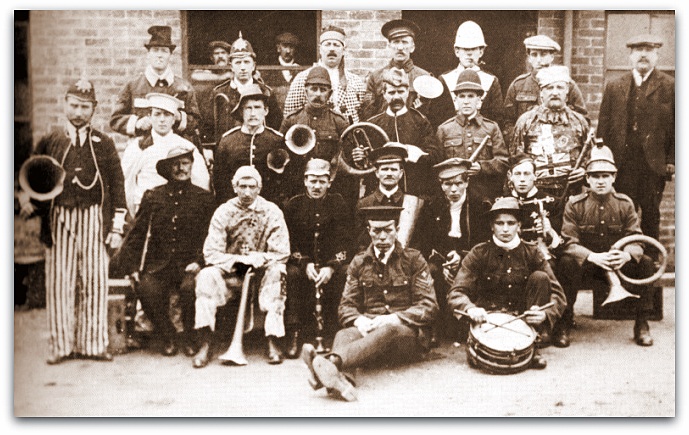
 The miners were a gregarious breed and found many ways of surviving. Parades/marches, appeals at which collections were made. There were professional and commercial contributions and local businesses were cajoled from fears of intimidation or sympathy to provide eggs, milk, butter and meat free or at a very low cost. At Clay Cross, Brannigan’s Jazz Band, a team of about 20 miners in fancy dress toured the districts collecting money from well-wishers to help with the campaign, because after only 10 weeks of long struggle, the strike pay or ‘nipsey money’ was gone. For the rest of the lock out the men had to rely on the Poor Law for subsistence money to support their families. There was a food voucher sometimes and 2 shillings to pay for gas, but that was used mainly to keep up the insurance payments as it would have cost the Parish more money to pay for a pauper’s grave. Pawn shops did a roaring trade as miners and their families found it hard to make ends meet. Many women pawned their wedding rings and whatever other jewellery they may have had to help feed the family. Many of these items would never be redeemed. The families managed to survive on starvation rations, but were beaten into submission. I believe some of the pigeon lofts became vacant. The miners were a gregarious breed and found many ways of surviving. Parades/marches, appeals at which collections were made. There were professional and commercial contributions and local businesses were cajoled from fears of intimidation or sympathy to provide eggs, milk, butter and meat free or at a very low cost. At Clay Cross, Brannigan’s Jazz Band, a team of about 20 miners in fancy dress toured the districts collecting money from well-wishers to help with the campaign, because after only 10 weeks of long struggle, the strike pay or ‘nipsey money’ was gone. For the rest of the lock out the men had to rely on the Poor Law for subsistence money to support their families. There was a food voucher sometimes and 2 shillings to pay for gas, but that was used mainly to keep up the insurance payments as it would have cost the Parish more money to pay for a pauper’s grave. Pawn shops did a roaring trade as miners and their families found it hard to make ends meet. Many women pawned their wedding rings and whatever other jewellery they may have had to help feed the family. Many of these items would never be redeemed. The families managed to survive on starvation rations, but were beaten into submission. I believe some of the pigeon lofts became vacant.
My Grandfather White’s suit and bowler hat and best boots were pawned every week on a Monday for ? (2s 6d (12½p) and 10s (50p) in the 1930s), retrieved on the Friday or Saturday, ready to go to the football match at Notts County on the Saturday or Club on Sunday! He was too proud to do it himself, so ……!
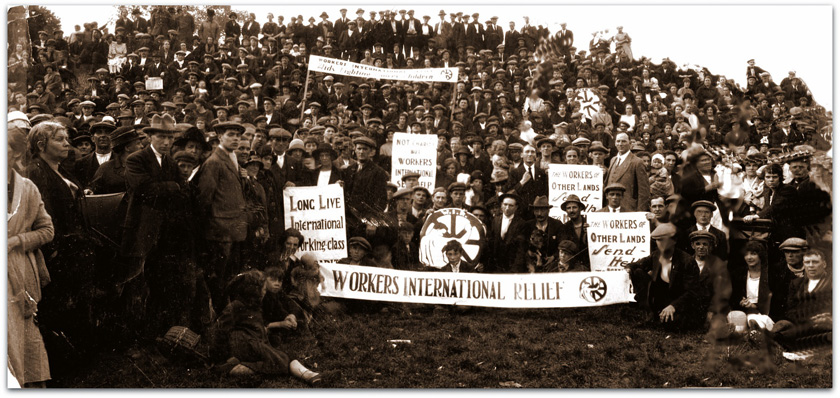
My Grandad Eli White Speaking At Sutton Lammas
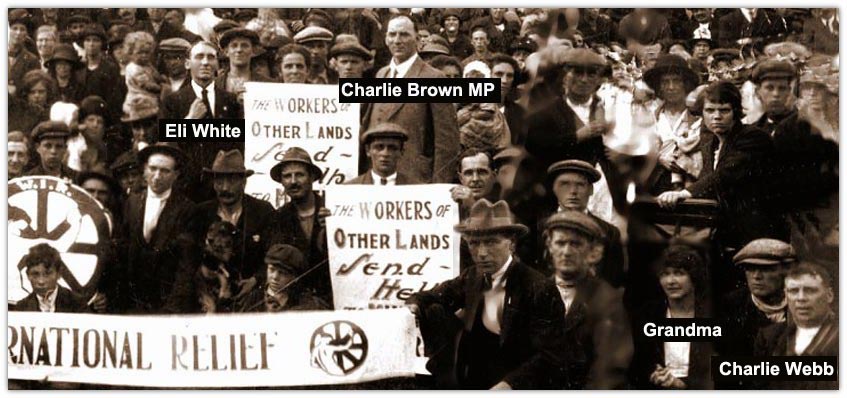
Click Photo For Some Names
Click Again To Close |
 |
The owners again had the upper hand and invited men back to work, but many men picked out as 'trouble makers' or 'active union members' against the return to work, such as my Grandfather Eli (Ikki) White, (second row centre right with right hand on lapel) a great follower of Arthur Cook and an orator in his own right seen here speaking to a host on Sutton Lammas ground. He was a collier at New Hucknall (from 1907 in the newly opened Waterloo (locally called New Huckna' Wattaloo seam). He was ostracised and sacked, black listed and refused work in all pits after the strike ended. However he had admitted to me that on reflection, that grabbing the Manager Percy Muschamp by the throat in a fit of madness through the pay office hatch was not a thing he should have done, even when in a heated argument! It was to cost him dearly. My Grandmother Cissie is sitting on the ground, third from right. Charlie Webb his friend and neighbour to the extreme right, later working at Silverhill until he retired. I believe the tall well dressed man 4th to the right of my Grandad was his dear friend Charlie Brown later MP (Lab) for Mansfield from 1929-1940.
On leaving school at 13 years old where he was the brightest pupil in the class at Whiston, South Yorks my Grandad always said that the Headmaster had begged him to further his education, however he went to work at the Bessemer Steel Works for about 12 months, lodging out to be nearer work, then entered the mines as a pony ganger at 14, and later collier at Denaby Main where his father worked similarly as a collier, and then at the new Silverwood colliery also in South Yorkshire opened 1903, where he had been very proud to have been in charge of a stall in the Barnsley Bed at 19 years old. I think he must have worked at Aldwarke Main for a short time as he used to relate to me about how he was not able to get on the chair but his mate did. The rope snapped and the cage or chair went down the shaft and his mate and 3 others were killed.
 He was a local councillor in the 1920s and 1930s and again in 1940s and 1950s. He was a local councillor in the 1920s and 1930s and again in 1940s and 1950s.
Following his sacking he was forced to seek employment elsewhere and worked for the Sutton-in-Ashfield Gas Works Co as a labourer digging trenches, ran the Labour Club as steward for a time, and finally as a labourer for Sutton Urban District Council, and in doing so never earned a big wage. He was a local councillor in the 1920s and 1930s and again in 1940s and 1950s. He was a founder member of the local Labour Party and a Lay Preacher for a time and an active member of the Co-operative movement and Anglo-Soviet relations during the Second World War and also a school Governor. His friend and Member of Parliament for Mansfield, Charlie Brown sadly died in 1940 and his widow Phoebe always had a portion of our Sunday dinner ever afterwards, my Mum and I used to take it in turns to deliver it, whatever the weather, rain, sunshine, hail, snow or blow. I can only surmise that they must have given my grandparents some help in the past when all seemed lost. His old bunch of mining friends Arthur Walton, Charlie Webb, Frank Hickton, and others such as Dickie Smith and Charlie Carnell called at the house every Sunday to sample whatever my Grandmother had to offer before they all set off for a pint or two at the Unwin Road Club.
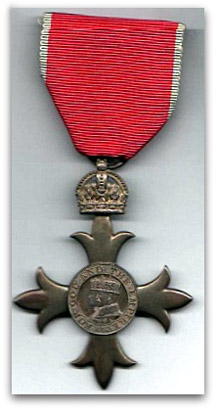
 Eli was awarded the MBE in King George VI’s honours list of 1949 for his tireless work to the community. We were all so very proud of him. Eli was awarded the MBE in King George VI’s honours list of 1949 for his tireless work to the community. We were all so very proud of him.
His wife, my Grandmother, Florence or ‘Cissie’ White previously a maid at Fitzwilliam Hall in Yorkshire before marriage, helped with the soup kitchens during the strike and later was a member of the Board of Guardians for many years who met regularly at the Workhouse, Mansfield Victoria Hospital, to help the poor of the Parish, and later worked as a cleaner to eke out the expenses.
She had her cohorts as well, some being wives of the ones mentioned, usually filling the house for chats and cups of tea etc, if I remember correctly every Tuesday afternoon, because the house always seemed to be full of women all wearing hats, even my Grandmother wore one on that day when I came home from school. |