1969 - Page 2
Collieries in North Derbyshire Area in 1969
- Area Director: P Cliff Parry (4149)
- Deputy: Robert B Dunn. (17 pits)
- CME: Tom W Peters
- Deputies: Des Marriott (5671) and John W Atkinson
- Production Managers: Jack W Smalley (3722), Des Stringer (5143), Bas G Wright (5160), P Julian Griffiths (5676)
- Area Surveyor: Norman Smedley. 18,000 men, £46m turnover.
- Arkwright Drift mine, 550,000 tons from 1st and 2nd Waterloo seams, 800 men
- Bolsover 737 yards (674m) deep, 650,000 tons from Deep Hard seam, 550 men
- Glapwell 679 yards deep (621m), (and Bramley Vale Drift), 1m tons from Deep Hard, Low Main and Clowne seams, 1,700 men
- High Moor Drift mine, 500,000 tons from Clowne seam, 230 men
- Ireland, 376 yards deep (344m), 550,000 tons from Deep Hard and Piper seams, 710 men
- Langwith, 536 yards deep (490m), 760,000 tons from Main Bright and Clowne seams, 1,100 men
- Markham, 691 yards (632m), 1.3m tons, 2,000 men
- Ormonde, 401 yards (367m), 870,000 tons from Piper, Low Main and Blackshale seams, 1,150 men
- Oxcroft Drift mine, 700,000 tons from Clowne seam, 700 men
- Westthorpe, 149 yards (136m) and drift, 570,000 tons from Thorncliffe and Flockton seams, 750 men, developing Chavery seam
- Whitwell, 578 yards (528m), 550,000 tons from Hazel seam, 960 men, £1m reorganisation
- Williamthorpe and Grassmoor, 545 yards (498m), 900,000 tons from 2nd Waterloo, Deep Hard, and Piper seams, 1,600 men
- Warsop, 558 yards (510m), 800,000 tons from Main Bright and High Hazles seams, 1,250 men
- Renishaw Park, 265 yards (242m) and drift, 320,000 tons from Chavery seam, 450 men
- Shirebrook, 756 yards (691m), 1m tons from Clowne and Deep Soft seams, 1,400 men, recent £4m reorganisation scheme
- Pleasley, 750 yards (686m), 600,000 tons from Waterloo, Deep Hard and Piper seams, and the combined Deep Hard Piper development, locally known as the Dukeries, 1,100 men.
Licensed Mines
All in North Derbyshire:
- Doe Lea (Doe Lea Colliery Co Ltd) Top Hard 15/5, Manager G Gilbert
- Lightwood (Handley Collieries Ltd) Deep Hard 16/7, Agent HS Lee
- Moor Side (Dent Main Colliery (1924) Ltd) Parkgate 16/7, Agent B Hutchinson, Manager WE Carnell
- Mossbrook (Mossbrook Colliery Ltd) Parkgate 3/2, Manager JW Fidler
- New Plumbley (W Redfern and Sons Ltd) Parkgate 7/2, Manager Henry Blair.
Output 1968-1969
- 11,566,280 tons was produced by 19,662 men at an OMS of 54.4 cwts at pits in North Derbyshire
- 11,129,889 tons by 17,915 men at an OMS of 55.4 cwts in South Nottinghamshire
- 11,715,299 tons at an OMS of 57.7 cwts by 19,093 men in North Nottinghamshire Area

 Dowty Company Dowty Company
Dowty Co acquired Bonser Engineering at Hucknall in 1969 and began manufacturing a wide range of mining equipment.
Reconstruction Scheme Completed
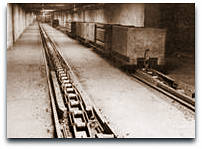
The 12-year reconstruction scheme at Hucknall (South Nottinghamshire) was completed. A new shaft had been sunk with new pit bottom with lofco creeper haulage for mine cars and tubs and the other two headgears had been refurbished with reinforced concrete. The surface reconstruction had been particularly difficult due to the neighbouring main railway lines passing through the site, Midland Railway 1848, Great Northern 1882 and Great Central 1898. New workshops, stores, coal preparation plant, winding houses, pithead baths, offices and lamproom were built.
 Coal Queen Competition Coal Queen Competition
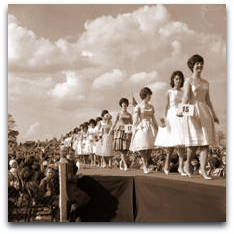
A yearly Coal Queen of Britain contest was inaugurated and organised by Coal News with co-operation from CISWO. The Coal Queen was chosen from the 15 Coalfield finalists and of course the local Coal Queens chosen in North Derbyshire, South Derbyshire and Nottinghamshire were given the task of opening solid fuel show houses etc and launching safety campaigns as part of their duties apart from parading at the local Miners’ Galas.
Over 60s Forced To Retire
At Williamthorpe (North Derbyshire) 150 men over 60 years of age were forced into early retirement to increase efficiency. 1,780 men were employed at the mine.
Bell Pits Revealed
Opencast mining at Stretton (Derbyshire) revealed some ancient bell pits.
End Of Handfilling
The Dunsil seam was abandoned at Teversal (North Nottinghamshire) in July 1969, bringing to an end the handfilling methods at the pit. Some parts of the main roads in this seam were driven in rock and remained unsupported to the end. The few ponies that were left were employed on supplies and then on salvage. They would be defunct by 1970. There was a further reorganisation at Pleasley, where the Waterloo was re-opened. Mechanisation of the Dunsil seam had been tried at this colliery with limited success.
Holiday Entitlement
Holiday entitlement for miners now was 23 days a year, comprising 10 annual, 6 statutory, 4 Colliery Rest days and 3 Individual Rest days (i.e. days that one could chose when pre-arranged).
Power Station Opened
The 1920 MW Cottam coal-fired power station on the side of the River Trent near Retford
was opened.
NUM Mining Engineers
Periodic visits were made to collieries by NUM Mining Engineers, sometimes by request from the local branch. An extract from one at Silverhill (Nottinghamshire) dated 21st August 1969 from Len A Clarke (2664) NUM Mining Engineer to Joe Whelan Agent of NUM.
It was a twilight shift (6pm – 1am) visit to 26s panel Low Main seam and he was accompanied by W Gascoyne NUM Branch Secretary, H Sage Workmen’s Inspector and Jack H Atkins (3808) Safety Engineer (ex Undermanager) … ‘the tail gate was not more than 3 feet (0.9m) high and 4 feet (1.22m) wide for about 400 yards (365m), 1% of methane in general body, 12,300 cu ft of air passing per minute, temperature at gate lip 83º F dry bulb and 81ºF wet bulb giving 90º saturation of air, very close to possible heat stroke conditions - shocking.
Shotfiring could not be done due to gas percentage and low ventilation at 153 feet (47m) velocity per minute could have given rise to gas layering.
Ripping lip was too far behind and the ‘round the houses conveyor system’ was in operation at the face which was in very good condition being about 5 feet high’.
This was a very bad report at the time but not necessarily typical, although the Low Main seam was known to have bad gate conditions and unfortunately in the main gate hand tramming was still being done to take supplies to the lip some 500 yards (460m) inbye.
This report would be given to the Manager and a copy to HMI who would follow up the report to see what immediate action had been taken. In this case floor dinting as well as back ripping was carried out with some urgency, allowing the panel to carry on working as the coal was desperately needed.
Self Rescuers Introduced
  Self-Rescuers were introduced gradually throughout the coalfield and were worn on one’s belt ready for action if needed, to be used in case of fire or smoke to enable one to get into a fresh air gate. By flicking open the sealed metal case, a mask with nose clip and head harness could be pulled out and deftly worn. The self-rescuer was designed to give protection against concentrations of up to 1½% carbon monoxide for a period of about one hour. A component called hopcalite inside the rescuer oxidises any carbon monoxide to a low concentration of carbon dioxide but the hopcalite does not provide its own oxygen and cannot give any protection if the atmosphere is seriously oxygen-deficient, such as may occur downwind of a serious fire or Self-Rescuers were introduced gradually throughout the coalfield and were worn on one’s belt ready for action if needed, to be used in case of fire or smoke to enable one to get into a fresh air gate. By flicking open the sealed metal case, a mask with nose clip and head harness could be pulled out and deftly worn. The self-rescuer was designed to give protection against concentrations of up to 1½% carbon monoxide for a period of about one hour. A component called hopcalite inside the rescuer oxidises any carbon monoxide to a low concentration of carbon dioxide but the hopcalite does not provide its own oxygen and cannot give any protection if the atmosphere is seriously oxygen-deficient, such as may occur downwind of a serious fire or  explosion, therefore it is imperative to get to fresh air as soon as possible. The air going into the rescuer passes through a chemical that dries it, as moisture de-activates the catalyst. The earlier models generated a lot of heat and were therefore very uncomfortable. A self-rescuer must never be regarded as a substitute for closed circuit breathing apparatus. Periodic training courses would follow when one was forced to wear the apparatus and walk round a circuit. Maintenance of the self-rescuer was very important also. explosion, therefore it is imperative to get to fresh air as soon as possible. The air going into the rescuer passes through a chemical that dries it, as moisture de-activates the catalyst. The earlier models generated a lot of heat and were therefore very uncomfortable. A self-rescuer must never be regarded as a substitute for closed circuit breathing apparatus. Periodic training courses would follow when one was forced to wear the apparatus and walk round a circuit. Maintenance of the self-rescuer was very important also.
 According to John H Rippon, Geologist, the self-rescuers were not introduced at High Moor (North Derbyshire) and Cotgrave (South Nottinghamshire) until well into the 1970s. According to John H Rippon, Geologist, the self-rescuers were not introduced at High Moor (North Derbyshire) and Cotgrave (South Nottinghamshire) until well into the 1970s.
Wood Pecker
An Impact Ripper Dosco UTR introduced at Cotgrave (South Nottinghamshire). One nicknamed the ‘woodpecker’ was installed at Ollerton (North Nottinghamshire) in a roadway enlargement for North loader mine car empties. M and C Boom ripper introduced at pits previously.
New Drifts At Moorgreen
Two 1in4 drifts were driven at Moorgreen from the Tupton to the 2nd Waterloo seam at the bottom of the surface drift. |


