1978 - Page 2
Making Old Shafts Secure
 A safety system regarding the location and making safe of old mine shafts had continued throughout the 1970s by the NCB and an instruction booklet issued and during 1978 almost 400 abandoned mine shafts were made safe on the moors and fields of West Derbyshire. 270 shafts were found on Bonsall Moor alone. All the shafts in the Meden Valley between Stanton Hill and Teversal were searched for and found using a Cobra boring rig on a safety frame (by North Nottinghamshire Area Boring Team, Maurice Lamb, in charge). The tops of the shafts were then exposed and the shafts filled with stone chippings and capped with concrete. A safety system regarding the location and making safe of old mine shafts had continued throughout the 1970s by the NCB and an instruction booklet issued and during 1978 almost 400 abandoned mine shafts were made safe on the moors and fields of West Derbyshire. 270 shafts were found on Bonsall Moor alone. All the shafts in the Meden Valley between Stanton Hill and Teversal were searched for and found using a Cobra boring rig on a safety frame (by North Nottinghamshire Area Boring Team, Maurice Lamb, in charge). The tops of the shafts were then exposed and the shafts filled with stone chippings and capped with concrete.
Jubilee Drift
In August 1978 the 1,650 yards (1,500 m) long dog-leg 1 in 4.5 Jubilee drift at Shirebrook (North Derbyshire) was commissioned and the output from the colliery was conveyed up this drift from underground and delivered direct to the new coal preparation plant overland. LOBA pumps used to control the 140 g.p.m issuing from the basal Permian sands.
First Chock Shields
 The first ‘chock shields’ in the region were installed at Ollerton (North Nottinghamshire) in 1978 and the region’s first ATM face (Advanced Technology Mining) was set up. 172 Four leg Dowty chock shields with lemniscate action were installed on the 270 yards (247m) face line and for the face time the 6’ 6” (1.98m) high Parkgate coalface became a place of relative safety, as there was a canopy of steel stretching the full length of the face as the chock shields at 5 feet (1.5m) centres virtually butted up to one another. The first ‘chock shields’ in the region were installed at Ollerton (North Nottinghamshire) in 1978 and the region’s first ATM face (Advanced Technology Mining) was set up. 172 Four leg Dowty chock shields with lemniscate action were installed on the 270 yards (247m) face line and for the face time the 6’ 6” (1.98m) high Parkgate coalface became a place of relative safety, as there was a canopy of steel stretching the full length of the face as the chock shields at 5 feet (1.5m) centres virtually butted up to one another.
I personally supervised and assisted in setting out the marks for the chock centres because it was necessary that the larger than normal supports did not bind on one another. A further action by me was to set out the loader gate face head position further downhill, the fairly steep dip of 1 in 8 being from supply gate to loader gate so that when the face began production hopefully the face would advance with both gates being straight, so it became imperative to control panzer creep and I made constant checks on grade change from angles of dip on the AFC and face check lines every week on the panzer (as on all other panels) taken by my underground staff in order to keep minimum movement of the panzer and adjust when necessary according to the changing dip and conditions (one only learns this from past experience). This is necessary with an advancing face, otherwise bends are created in the gates as the equipment tied to the face panzer has to follow it.
Face sprags and chock extensions prevented coals from falling or flushing into the travelling track. The cost of the face installation was almost £2.5m, the most expensive ever in North 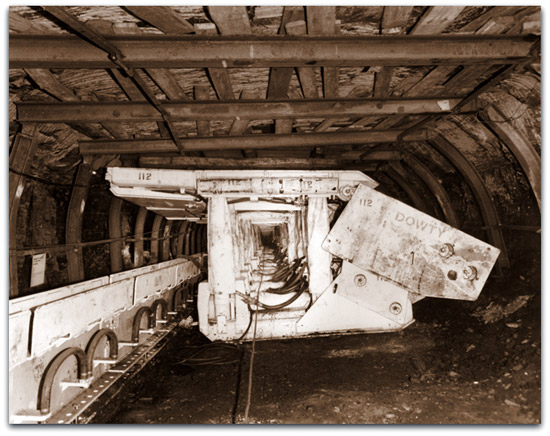 Nottinghamshire. These supports were quite large, weighing several tonnes and had to be dismantled for transporting on special 8 wheeled bogie trams and then reassembled underground in a specially constructed building station close to the new face line. The design encompassed rear lemniscate legs, which allowed the support to let down the roof behind the coalface with much more reliability. No more would dirt from the waste flush through into the travelling track as on many faces in the past. 2s panel was 686m below the surface and production started October 1978 with a Double-Ended-Ranging-Drum-Shearer (DERDS). Nottinghamshire. These supports were quite large, weighing several tonnes and had to be dismantled for transporting on special 8 wheeled bogie trams and then reassembled underground in a specially constructed building station close to the new face line. The design encompassed rear lemniscate legs, which allowed the support to let down the roof behind the coalface with much more reliability. No more would dirt from the waste flush through into the travelling track as on many faces in the past. 2s panel was 686m below the surface and production started October 1978 with a Double-Ended-Ranging-Drum-Shearer (DERDS).
The coal production for the first week was + 8,000 tonnes. Also with a canopy of steel above ones head, one of the safest places in the pit was on this new style coalface.
At Ollerton (North Nottinghamshire) as at many other mines, the No1 shaft steam winder had been replaced with an electric winder in the summer holidays.
Belt Weighers Introduced
Under the Weights and Measures Act 1963, belt weighers were introduced in 1978. The instrument could determine the weight of material passing over it, and the value was transmitted to the Control Room and recorded.
Coal Preparation Systems
Coal Preparation systems in use are listed:
North Nottinghamshire Area:
- Bevercotes, Dense Medium/Dense Medium Cyclones/Froth Flotation cleaning process with a capacity throughput of 600 tonnes per hour
- Blidworth, Dense Medium/Baum/Froth Flotation 450 t.p.h.
- Clipstone, Baum/Froth Flotation 400 t.p.h.
- Creswell, Dense Medium 320 t.p.h.
- Harworth, Baum/Froth Flotation Dense Medium 300 t.p.h.
- Mansfield, Froth Flotation 470 t.p.h.
- Ollerton, Baum/Froth Flotation 400
- Rufford, Baum/Froth Flotation 800 t.p.h
- Sherwood, Baum 300 t.p.h
- Silverhill, Baum/Froth Flotation 300 t.p.h
- Sutton, Baum/Froth Flotation 300 t.p.h.
- Teversal, Bretby Hybrid/Cone 50 t.p.h
- Thoresby, Baum 550 t.p.h
- Welbeck, Baum 420 t.p.h.
At Thoresby Trellcord screen cloths helped to overcome a serious blinding problem in the dry fines section of the coal prep plant.
South Nottinghamshire Area:
- Annesley, Dense Medium 260 t.p.h
- Babbington, Baum/Dense Medium 400 t.p.h. ceased
- Bentinck, Dense Medium DM Cyclones/Froth Flotation 800 t.p.h
- Calverton, Baum/Froth Flotation 550 t.p.h
- Cotgrave, Dense Medium Dense Medium Cyclones 600 t.p.h, Baum/DM Cyclones/Froth Flotation 550 t.p.h
- New Hucknall, Dense Medium/Greaves Jig 250 t.p.h
- Newstead, Concentrating Tables 555 t.p.h.
North Derbyshire Area:
- Arkwright, Greaves Box / Baum 200 t.p.h
- Bolsover, Baum 175 t.p.h
- Langwith, Dense medium 400 t.p.h
- Markham, Baum/Dense Medium/Froth Flotation 900 t.p.h
- Pleasley, Baum 200 t.p.h
- Renishaw Park, Rheolaveur/Trough 75 t.p.h
- Shirebrook, Dense Medium 400 t.p.h
- Westthorpe, Greaves Box 60 t.p.h
- Warsop, Baum/Dense Medium/Froth Flotation 400 t.p.h
- Whitwell, Greaves Box/Baum 300 t.p.h.
South Midlands Area: South Derbyshire:
- Cadley Hill, Dense Medium 350 t.p.h
Leicestershire:
- Desford Dense Medium 350 t.p.h
- Bagworth Baum / Dense Medium 550 t.p.h
- Snibston Dense Medium 550 t.p.h, Rawdon Baum 350 t.p.h
- Warwickshire: Birch Coppice Dense Medium 300 t.p.h
- Baddesley Cyclones / Dense Medium 250 t.p.h
- Daw Mill Dense Medium 350 t.p.h
- Newdigate Dense Medium 200 t.p.h
- Coventry Dense Medium and DM Cyclones 550 t.p.h
- Kent: Betteshanger Froth Flotation 300 t.p.h
- Snowdown Baum / Froth Flotation 250 t.p.h
- Tilmanstone Baum / Froth Flotation 250 t.p.h.
South Yorkshire Area: pits in North Nottinghamshire:
- Manton Baum / Froth Flotation and Dense Medium 400 t.p.h
- Shireoaks Dense Medium 250 t.p.h. Derbyshire
- Steetley Greaves Box 80 t.p.h
Chutes at Gedling
12 chutes were lined with Trellex rubber at Gedling (South Nottinghamshire).
Selston Deep Soft Exploration
At Selston (South Nottinghamshire) a heading was driven in the Deep Soft seam during 1977-1978, the seam being abandoned in 1932, Surveyor Eric W Harpham (2469) (3/8/50), Manager Len A Peach (6237). |


