1978 - Page 4
First Rapid Loading Bunker
 Langwith was the first pit in the country to have a Rapid Loading Bunker at the surface. A train could be loaded in 20 minutes. Langwith was the first pit in the country to have a Rapid Loading Bunker at the surface. A train could be loaded in 20 minutes.
In 1963/64 thin-seam shearers were installed in the Clowne seam, a hard, woody seam. The seam was accessed by driving cross-measures drifts from the Main Bright seam. It was said that an Undermanager had asked the Manager to stop the seam as it was getting progressively thinner from a maximum of 30” (0.76m) down to below 24” (0.61m) and around 8” (0.20m) of hard floor had to be cut also. The reply he got was that it would continue to be worked whilst ever he could hold his flame lamp vertically. One of the workmen stated that the pit props were only as high as milk bottles and that only slimly-built miners could work on the coal face due to the low height.
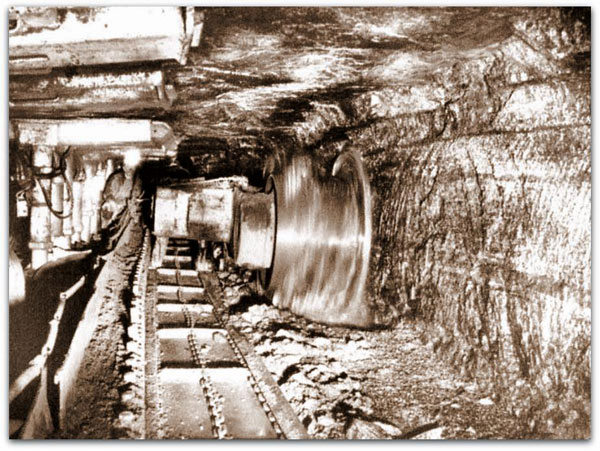
Cutting the hard dirt floor created very bad dusty conditions.
The Main Bright seam also deteriorated in quality but the reserves were allocated to neighbouring mines due to distance out from the pit bottom.
Most of the production was destined for the River Trent side power stations.
There was an underground connection to Glapwell in the Top Hard seam under the Scarcliffe area. It is said that an Undermanager who worked at Langwith but lived at Glapwell used the connection to get to work??
A borehole was drilled from High Hazel near No2 pit bottom. No reasonably thick seam was found after drilling some 905 yards (827m) Surface boreholes were drilled in 1956/57 to explore further seams below Top Hard.
The pit had made a profit up to 1970-1971, however £2m losses were recorded for 1971-1972 and 1972-1973. At this time Main Bright and Clowne seams being worked with workings in Main Bright almost up to Creswell shafts.
 In 1959 the NCB and CISWO purchased the former Chapel premises at Nether Langwith and converted it to create a Youth Club. However these premises would be sold in 1972. The village housing was refurbished at a cost of around £500,000 in 1964/65. Indoor toilets and bathrooms were provided. In 1959 the NCB and CISWO purchased the former Chapel premises at Nether Langwith and converted it to create a Youth Club. However these premises would be sold in 1972. The village housing was refurbished at a cost of around £500,000 in 1964/65. Indoor toilets and bathrooms were provided.
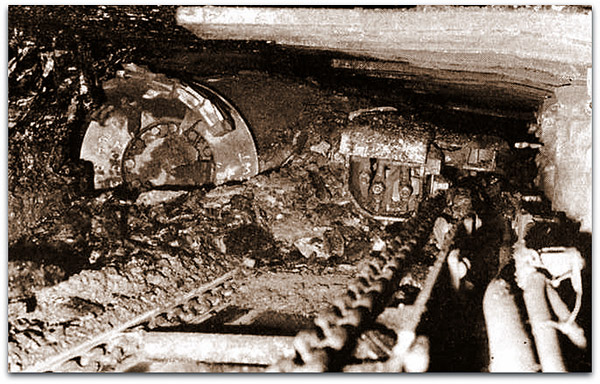
Another connection was driven to Creswell at the High Hazel seam level. This had been done at the Inspector’s request as a second emergency egress for the pump man in Langwith pit bottom (North Derbyshire Area colliery) as pumping operations was to be carried on and one shaft had been closed. However water would back up towards Creswell (North Nottinghamshire Area colliery) along this roadway and would be carefully monitored by the Creswell Surveyor Bill Fox (3061). Due to the amount of water issuing, a pumping station would have to be made at the surface (1974) and was completed by the Area Tunnelling team of North Nottinghamshire Area who then had to maintain the station and pay for the pumping. Even trepanners (Seen above) struck the floor on occasions causing incendive sparks
There was some picketing and aggravation from Derbyshire NUM men about building the pumping station by Nottinghamshire men but then they realised it was for their benefit when they returned to work otherwise the pit would be flooded and no job to go back to.
There was a steel staircase installed in No1 shaft from Main Bright to High Hazel. This shaft was left open for pumping water and also to act as a gas vent.
No2 shaft was filled up to High Hazel horizon in 1970 and finally filled to the surface and capped by 1st October 1984.
One of the last to remain working at the pit as it closed down was Harry Knight (born 1925). He had started at the pit when 14 years old and had worked there for 41 years ending his working life as Safety Officer and he stayed on pumping water and testing for gas escaping from No1 shaft.
Output: by
- 1881 around 2,000 tons per week, around 100,000 tons per year
- 1883: 76,375 tons
- 1884: 134,500 tons
- 1896: 2,300 tons / day in 8 hours 40 minutes shift.
On Friday 21st Dec 1921 in two 7 hour shifts a record 2,476 tons was turned
- 1929: 584,796 tons
- 1947 the output was 545,927 tons produced by 1,388 men the maximum ever employed.
- 1962 Maximum output was 845,392 tons produced by 1,247 men and boys.
- 1975/76 the tonnage had slumped to 489,238 tonnes produced by 828 men.
Top Hard: Worked by
- Stalls radiating out from the pit bottom until mid 1930s
- then longwall advancing panels were created.
Reached Shirebrook and Clipstone boundary to South 1928-May 1933
- to West of shafts Nov 1919
- to North West Nov 1918
- to Langwith boundary to North in 1908-1912
- to Welbeck boundary to North East May 1929
- redeveloped to South East in 1943 - finished Feb 1948
- connection to Clipstone 1953
- last panel between faults to South finished Nov 1958.
Panel Nos: High Main...
- 53s W
- 65s N narrow short panel
- 57s W
- 56s W
- 55s W
- 54s W
- 70s N
- 69s N
- 68s N
- 2s SW narrow panel
- 1s Se
- 26s SE
- 25s SE
- 23s SE
- 24s SE
- 22s SE
- 21s SE
- 28s SE face headed out but abandoned. 41s NW
- 4s NE short life
- 31s S
- 42s NW
- 9s SW
- 6s SW
- 5s SW
- 27s NW
- 7s SW
- 2s SW
- 43s NW
- 52s W
- 58s W
- A narrow panel
- SE panel
- B
- D
- F
- H
- 89s short life and narrow
- 91s SE
- 92s SE
- 93s SE
- 99s W
- m SE
- 78s SE
- 79s SE
- N
- 75s
- J
- G
- E
- C
Training face NW short life
- 67s W
- 51s W
- 60s W
- 61s W
- 59s NE
- 62s NW
- 63s NW
- 50s SE
- 8s NE
- 3s
- 44s NW
- 45s NW
40s heads, stopped
- 98s E
- 94s SE
- 95s
- 96s
- 97s
- 74s SE
- 90s NE.
Main Bright:
- 8s NW
- 5s NW
- 3s SW
- K20s retreat
- SW
- K62s SW
- K63s SW
- K64s SW
- 1s NW
- K17s NW
- K16s NW
- K12s NW
- 2s NW
- 4s NW
- 9s NW
- 10s NW
- 11s NW
- 12s NW
- 6s NE narrow panel
- 60s NE
- K11s NW
- K14s NW
- K40s NW
- K15s SW
- K18s SW
- K61s SE
- K60s NE
- K61s SE
- K42s heads stopped 1973.
Clowne:
- K30s NW
- D SW
- K75s SE retreat
- K29s SE
- K28s NW
- K38s SE short retreat
- K27s NW
- B NW
- K21s NW
- K37s NW
- E NW
- G NW
- F NE short life coal 28”
- K36s NW
- K29s SE retreat
- K76s SE retreat
- K31s SE retreat
- K70s NW
- K71s NW short life
- K31s SE
- K32s SE shortened down
- A NE
- B NW.
Manpower: Sheepbridge Coal and Iron Co:
- 1894: 1,076 Top Hard, 251 s/f;
- 1895: 1,173 Top Hard, 300 s/f;
- 1896: 1,044 Top Hard, 240 s/f
- 1897: 1,037 Top Hard, 234 s/f
- 1898: 909 Top Hard, 227 s/f
- 1899: 900 Top Hard, 247 s/f
- 1900: 892 Top Hard, 235 s/f
- 1901: 900 Top Hard, 206 s/f
- 1902: 950 Top Hard, 212 s/f
- 1903: 898 Top Hard, 183 s/f
- 1904: 960 Top Hard, 183 s/f
- 1905: 1,034 Top Hard, 190 s/f
- 1906: 1,096 Top Hard, 183 s/f
- 1907: 1,028 Top Hard, 173 s/f
- 1908: 1,084 Top Hard, 181 s/f
- 1909: 1,150 Top Hard, 104 s/f
- 1910: 1,200 app Top Hard, 200 s/f
- 1911: 1,234 Top Hard, 239 s/f
- 1912: 1,345 Top Hard, 247 s/f
- 1913: 1,620 Top Hard, 262 s/f
- 1914: 1,661 Top Hard, 287 s/f
- 1915: 1,080 Top Hard, 252 s/f
- 1916: 1,228 Top Hard, 366 s/f
- 1917: 1,232 Top Hard, 282 s/f
- 1918: 1,206 Top Hard, 458 s/f
- 1919: 1,498 Top Hard, 398 s/f
- 1920: 1,523 Top Hard, 416 s/f
- 1921: 1,643 Top Hard, 312 s/f
- 1922: 1,678 Top Hard, 317 s/f
- 1923: 1,731 Top Hard, 351 s/f
- 1924: 1,715 Top Hard, 355 s/f
- 1925: 1,642 Top Hard, 336 s/f
- 1926: 1,610 Top Hard, 314 s/f
- 1927: 1,654 Top Hard, 346 s/f
- 1928: 1,555 Top Hard, 349 s/f
- 1929: 1,680 Top Hard, 372 s/f, 584,796 tons
- 1930: 1,728 Top Hard, 367 s/f
- 1931: 1,647 Top Hard, 372 s/f
- 1932: 1,585 Top Hard, 378 s/f
- 1933: 1,382 Top Hard, 344 s/f
- 1934: 1,310 Top Hard, 337 s/f
- 1935: 1,362 Top Hard, 370 s/f
- 1936: 1,347 Top Hard and High Hazel, 375 s/f
- 1937: 1,370 Top Hard and High Hazel, 405 s/f
- 1938: 1,360 Top Hard and High Hazel, 400 s/f
- 1939: 1,300 app Top Hard and High Hazel, 402 s/f
- 1940: 1,263 Top Hard and High Hazel, 407 s/f
- 1941: 1,208 Top Hard and High Hazel, 436 s/f
- 1942: 1,173 Top Hard and High Hazel, 418 s/f
- 1943: 1,109 Top Hard, High Hazel and High Main, 426 s/f
- 1944: 1,194 Top Hard, High Hazel and High Main, 441 s/f
- 1945: 1,156 Top Hard fin, High Hazel and High Main, 462 s/f, 1,618 total
- 1946: 1,350 men app.
Output and Manpower NCB: No2 Area EMD:
- 1947: 545,927 tons, @ 33.7 cwts per manshift, 1,388 men max
- 1948: 535,454 tons, 1,388 men
- 1949: No2 Area closed down, transferred to No1 Area: 503,103 tons, 1,336 men
- 1950: 463,859 tons, 1,253 men
- 1951: 482,381 tons, 1,248 men
- 1952: 509,702 tons, 1,238 men
- 1953: 488,568 tons, 1,258 men
- 1954: 509,008 tons, 1,283 men
- 1955: 491,296 tons, 1,250 men
- 1956: 493,210 tons, 1,285 men
- 1957: 421,771 tons, 1,313 men
- 1958: 424,151 tons, 1,326 men
- 1959: 469,226 tons, 1,315 men
- 1960: 567,634 tons, 1,272 men
- 1961: 637,180 tons, 1,256 men
- 1962: 845,392 tons (max), 1,247 men, 62.5 cwts per manshift
- 1963/64: 808,764 tons, 1,226 men
- 1964/65: 795,250 tons, 1,202 men
- 1965/66: 639,738 tons, 1,157 men
- 1966/67: 645,193 tons, 1,116 men
North Derbyshirehire
- 1967/68: 636,838 tons, 1,109 men
- 1968/69: 696,700 tons, 1,133 men
- 1969/70: 703,577 tons, 1,125 men
- 1970/71: 598,930 tons, 1,109 men
- 1971/72: 473,125 tons, 1,090 men
- 1972/73: 530,701 tons, 1,029 men
- 1973/74: 385,979 tons, 995 men
- 1974/75: 497,674 tons, 960 men
- 1975/76: 489,238 tons, 896 men
- 1976/77: 363,878 tons, 710 men
- 1977/78: 405,161 tonnes (398,761 tons), 580 men
- 1978/79: 130,124 tonnes, 285 men. Ceased production 4th August 1978 (220 men). Most of the men were offered work at neighbouring mines.
|


