2003 - Page 4
Coal Imports
Unfortunately coal imported from Australia and Colombia and South Africa has proved to be far cheaper delivered than UK can produce before delivery. Other sources are from the vast reserves in Russia and other European neighbours. There are still billions of tonnes of untapped coal in this country and much of it in the two counties of Derbyshire and Nottinghamshire and to a lesser degree in Leicestershire as well as tremendous reserves in Yorkshire, Lancashire and several other locations. The mining of this coal by traditional methods of the past is impossible, as some of the seams have been worked in part and others are considered too thin, and of course the old mines have been filled in. Some shallow seams will be worked by opencast means. Methane gas is also being pumped from mines closed in the last 20 years or so by Alcane Energy. New methods not yet invented will have to be devised if this deeper valuable commodity is to be exploited. Coal gasification has been tried on a small scale but as yet has proved unsatisfactory; however this may prove to be a good method of extracting gas in the future. Old tips are being dug over and discarded small coal of the past being recovered. Extra capacity is being obtained on a small scale from methane gas being obtained from waste landfill sites as stated earlier where the gas is being used to produce electricity. Talk of global warming by the extra carbon dioxide in the atmosphere has been blamed on the burning of fossil fuels. The existing coal burning power stations are reaching their economical or practical life and major decisions have to be made soon before it is too late, to ensure that Nottinghamshire coal lying on the doorstep of the Trent side power stations can be used for the next ‘x’ number of years.
Subsidence
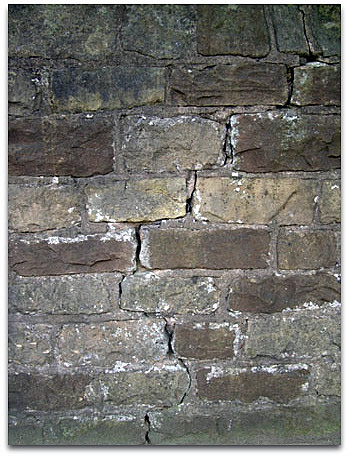 Of course with mining, the coal and in parts, the overlying layers of strata are removed, and in doing so creates a void which then allows the overlying strata to subside. This causes subsidence at the surface and where mining is carried out under villages and towns much damage is done, usually in the form of cracks in houses and walls and roads which all of us will have seen at some time. Much damage is also done to the services such as water pipes, sewers, gas pipes and electric cables. Where repair work had to be done to housing, including driveways etc, generally speaking it is only ‘nuisance’ work, where firms are called in to remove damaged work and replace with new. To the people concerned it is major disruption and in some cases can occur several times where several seams are worked in succession. I have had 2 parts of a concrete drive and internal repairs and decorating done in the 1970s from subsidence caused by several workings from Shirebrook Colliery. Tilt is also a major problem sometimes even though there is no actual movement or breaking of brickwork. Many people accepted cash settlements but did not spend the money on repairs and when trying to sell the property difficulties were experienced as the damage was still evident. Some residents have found that because they live in a mining area it is difficult to obtain building insurance. When road works are repaired this sometimes requires roads to be closed or traffic regulated causing aggravation to the motorist and extra time necessary to complete a previous journey. In the late 1970s the amount of money required for subsidence damage reached a colossal sum particularly in the North Nottinghamshire Area, (£128m), and questions were asked in Parliament, it being of course taxpayers’ money! Some unscrupulous dealings with outside contractors and some NCB personnel ended with sackings and jail sentences. Of course with mining, the coal and in parts, the overlying layers of strata are removed, and in doing so creates a void which then allows the overlying strata to subside. This causes subsidence at the surface and where mining is carried out under villages and towns much damage is done, usually in the form of cracks in houses and walls and roads which all of us will have seen at some time. Much damage is also done to the services such as water pipes, sewers, gas pipes and electric cables. Where repair work had to be done to housing, including driveways etc, generally speaking it is only ‘nuisance’ work, where firms are called in to remove damaged work and replace with new. To the people concerned it is major disruption and in some cases can occur several times where several seams are worked in succession. I have had 2 parts of a concrete drive and internal repairs and decorating done in the 1970s from subsidence caused by several workings from Shirebrook Colliery. Tilt is also a major problem sometimes even though there is no actual movement or breaking of brickwork. Many people accepted cash settlements but did not spend the money on repairs and when trying to sell the property difficulties were experienced as the damage was still evident. Some residents have found that because they live in a mining area it is difficult to obtain building insurance. When road works are repaired this sometimes requires roads to be closed or traffic regulated causing aggravation to the motorist and extra time necessary to complete a previous journey. In the late 1970s the amount of money required for subsidence damage reached a colossal sum particularly in the North Nottinghamshire Area, (£128m), and questions were asked in Parliament, it being of course taxpayers’ money! Some unscrupulous dealings with outside contractors and some NCB personnel ended with sackings and jail sentences.
Pillars Of Support
On occasions large areas of coal been sterilised by leaving pillars of support for lakes (e.g. Clumber Park), special old buildings (e.g. Hardwick Hall and Teversal Church), large buildings (e.g. Hollins Mill at Pleasley), structures such as tunnels (e.g. Rowthorne Tunnel), bridges and roads (e.g. M1 motorway), viaducts (e.g. Mansfield Railway town viaduct) etc, and complex shopping centres (e.g. Mansfield Four Seasons), Pumping stations (e.g. Boughton, also Papplewick and the Severn Trent Water Pyramids at Eakring), and the like and so on.
Examples where failure to leave such pillars resulted in severe damage at the surface were Rufford Lake, where a fissure caused by workings from Ollerton colliery drained the lake, also damage to the kilns at Kirton Brickworks by other workings from Ollerton, the Co-operative Dairy at Southwell Road, Mansfield which had to be demolished because it was unstable due to damage caused by workings from Mansfield colliery. At Skegby Church, St Andrews damage was done caused by workings from Teversal colliery by undermining in the Dunsil seam (a pillar had been left in Top Hard). Many gravestones had toppled over, (even coffins rearing up I remember seeing when carrying out some subsidence levelling there in the early 1960s), The Sewage works at Skegby and Alfreton were also damaged causing the water to run the ‘wrong way’ at the filter beds. In the late 1950s a pig was lost down a fissure in the magnesian limestone at Stoneyford Road Farm, caused by workings from Sutton colliery. In the distant past, greed by the various colliery concerns caused damage to shafts by robbing shaft pillars that had been designed by surveyors from calculations according to depth, dip of strata etc and in many cases caused the closure of the mine. Ollerton colliery shaft pillar was riddled with roadways and possibly aggravation from these affected the shafts where a large fault passed through No2 shaft during the sinking. This was stated as a reason for closing the colliery in 1994, damage to the shafts. The small amount of damage to the shafts such as a slight bowing of the brickwork could have been repaired by either a private firm or the Area tunnelling team and I still maintain that the colliery was closed to allow the neighbouring colliery Thoresby to carry on working as Ollerton still had many years of reserves. As was proven Thoresby worked quite a few panels in the closed Ollerton ‘take’ up to 2010, the last panel being some 11km from Thoresby shafts but obviously much nearer to Ollerton shafts and I feel that many more panels could have been worked. I have mentioned that 2 development gates had been headed out at Ollerton and the brand new face line 19s was being equipped to retreat back for approximately 18 months when the colliery was closed.
Interaction
In the Teversal group of pits up to 9 coal seams were worked in parts but the main ones being Top Hard, Dunsil, First Waterloo, Deep Hard, Piper, Low Main, Yard and Blackshale. A small area of Threequarter was worked near to Silverhill shafts and massive cases of interaction between workings were experienced. Teversal, working the upper seams, was always under influence experiencing subsidence from Silverhill and Sutton working the lower seams mainly Deep Hard, Piper and Low Main some hundreds of metres below and subsidence at the surface would have the combined effect of all the seams to some degree. There was an influence of a lesser nature from the higher workings thrown down to the lower workings. At Teversal there was a great deal of interaction when working the Dunsil seam under the Top Hard at 30 yards (28m) above. Similarly more interaction was experienced when working the First Waterloo seam at 10 yards (9m) below Dunsil and heavy weighting was experienced when approaching pillar edges in Top Hard 40 yards (37m) above and Dunsil 10 yards (9m) above. The Yard seam and Blackshale were worked after Teversal had closed.
In South Derbyshire and Leicestershire there are many instances of interaction between workings and albeit that they are small areas the density of workable coal seams is great and it is noticeable that most of the panels in that region were relatively short lived compared to the Nottinghamshire and Derbyshire pits.
 Support For Railways Support For Railways
The Railway companies in the past had argued for support to their railways and originally a 40 yards (37m) barrier was left, irrespective of depth. This became part of the ‘Old Mining Code’ in the 1840s.
Of course at shallow depths this was probably quite adequate, but as the deeper seams were worked this was not adequate and calculations using the angle of draw are used now, not only for railways but the motorways also (M1 e.g.).
Notice to British Gas needs to be given to any working approaching or proposing to undermine their large gas main criss-crossing the country. One such gas main crosses the Calverton colliery take, another across Silverhill take towards Tibshelf.
As stated earlier, notice also has to be given to the Electricity Board regarding the National Grid pylons and large sub-stations.
However referring to the sketch of the various main line railways and numerous colliery connections in the Nottinghamshire and Derbyshire Coalfield and to a lesser degree in the South Derbyshire and Leicester areas as one can see it was a nightmare for Surveyors and Planners to sort out. Coal cannot be worked in certain areas due to circumstances, as above, and also restrictions by pre-existing Chancery Court Orders, Town & Country Planning restrictions, Rivers Authority, Leases, subsidence etc and of course due to modern mining techniques with panel working, many areas were sterilised and are unable to be accessed.
Miners' Pension
A further problem seemed to come to the forefront in 2003. Although it was known that to guarantee a pension for miners and staff, the Labour Government had agreed that to do so they would take half of the surpluses made by investments when the stock market was doing well and in doing so raked in many millions. In 2003 the shares dipped but the Government still took almost £300 million. There are still around £3 billion of past surpluses in the funds destined to be collected by the Government although the two pension schemes, the Mineworkers Pension and British Coal Staff Superannuation schemes were both in deficit. The Coal Communities Campaign began to try to negotiate in 1999 for a fairer deal by stating that it was the miners’ money in the first place!
Opencast Sites
Opencast: included
- Renishaw (HJ Banks and Co): Upper Chavery 0.78m, Lower Chavery 0.22m, Sitwell upper 0.28m, Sitwell Main 1.25m, 15/10/03
- Stonebroom (HJ Banks and Co Ltd): Bottom Waterloo 0.25m, Waterloo Marker 0.23m, Top 2nd Waterloo 0.57m, Bottom 2nd Waterloo 0.50m, 3rd Waterloo 0.59m, finished 20/02/2003.
|


