|
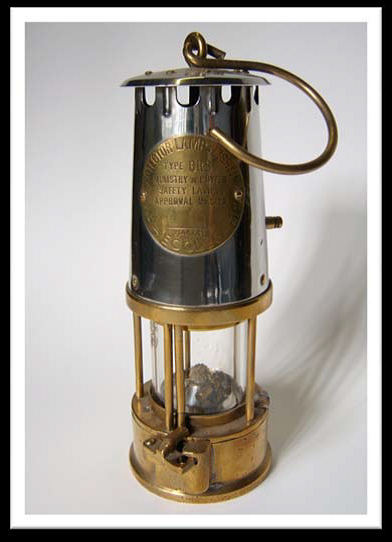
Flame Safety Lamp
Canaries were used to detect carbon monoxide underground until the 1990s
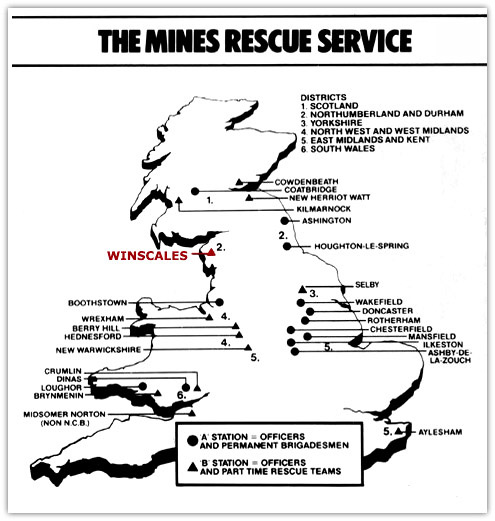
Winscales Mines Rescue Station

Winscales Mines Rescue Station. Garages are to the left, with training galleries situated behind, now houses.
Foreground, Station Entrance, now Hunday Manor Hotel, right hand side Hunday Farmhouse.
Taken from a book, 1986.
Outside Winscales Mines Rescue Station
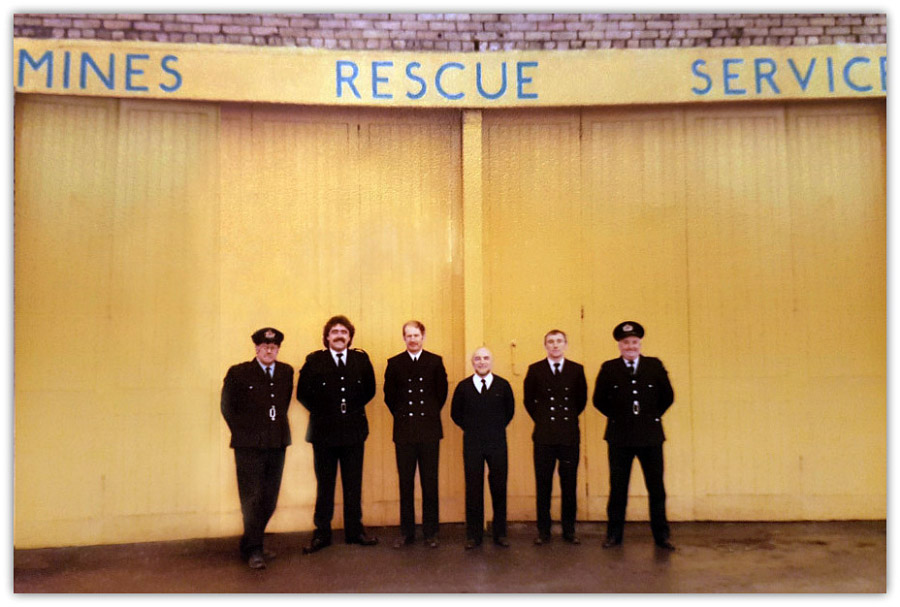
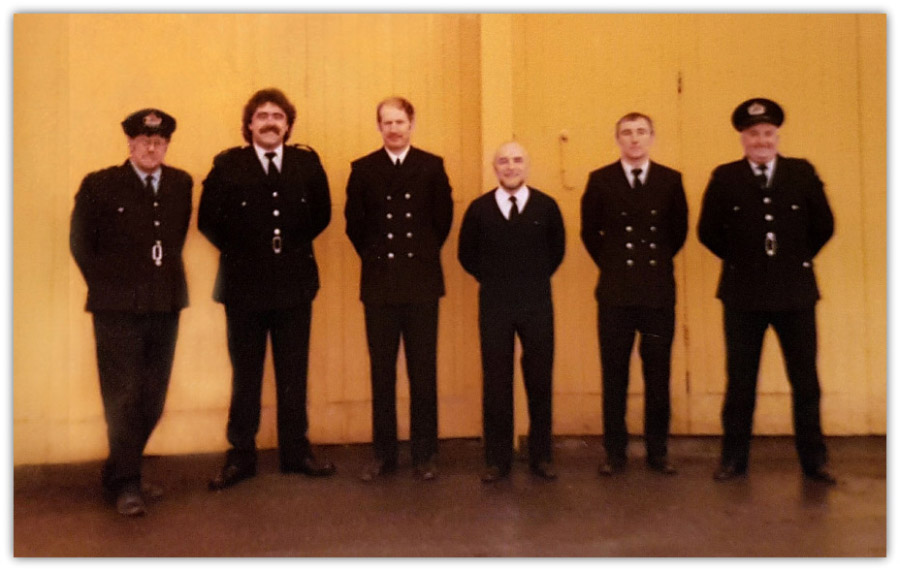
From LR, Gordon Sloper, Alan Barker, Pat Robertson, Derek Norman, John Hudson and Superintendent Manning.
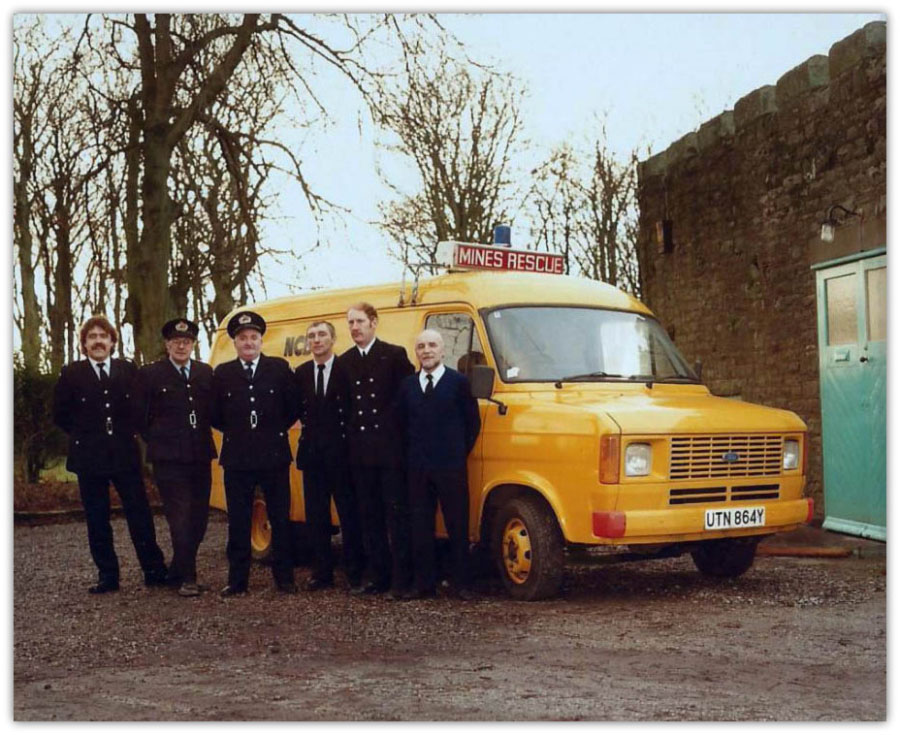
Alan Barker, Gordon Sloper, Sam Manning, John Hudson, Pat Robertson, Derek Norman
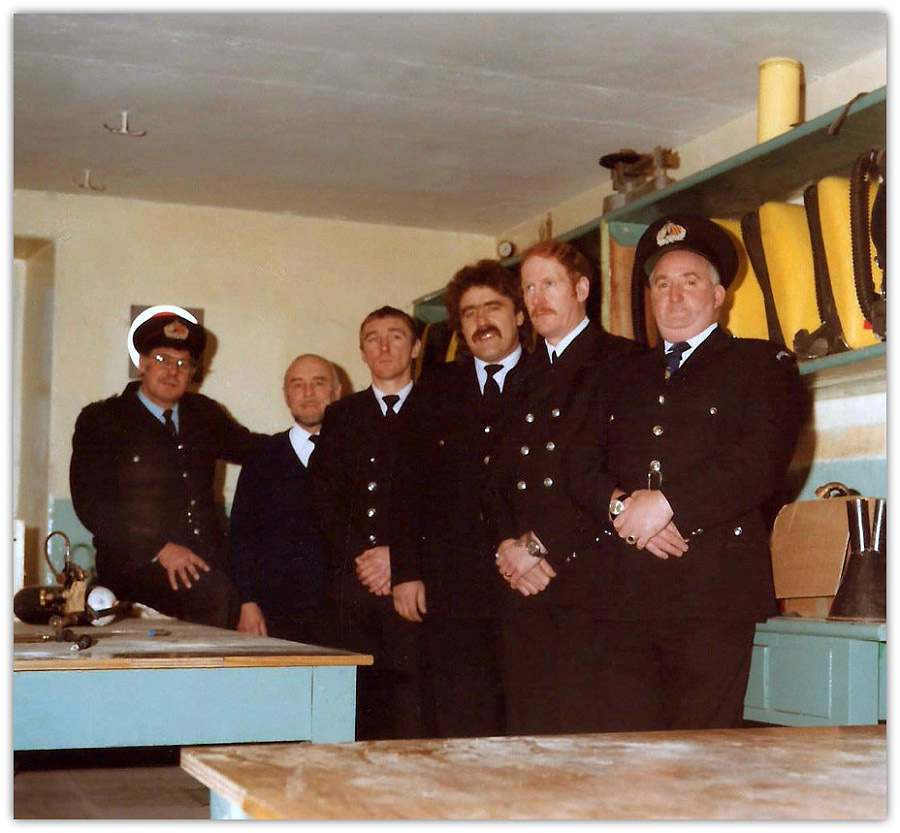
From Left - Gordon Sloper, Derek
Norman, John Hudson, Alan Barker, Pat Robertson and Sam Manning
The photo was taken in the apparatus room, after the station had officially closed and everything was being stripped out. The breathing apparatus (BA) on the right of the picture are Siebe Gorman, Aerolox, liquid O2 set.
Superintendent, Fred Taylor’s Retirement
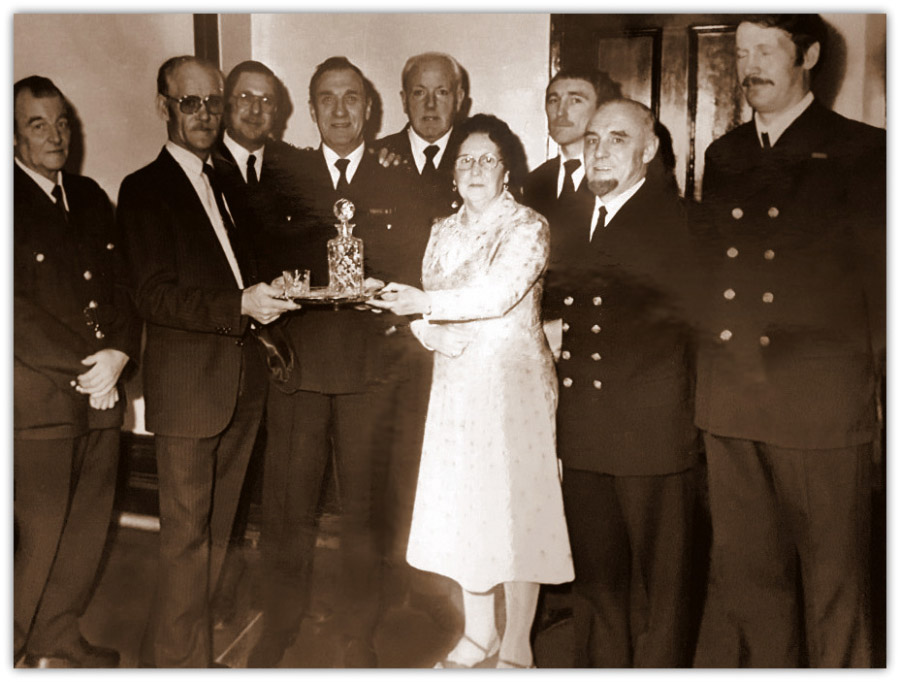
LR, Norman Fearon, Instructor. Next I think was a Superintendent from N/E, Gordon Sloper, Fred Taylor, Hughie McClellan, Mrs Marjorie Taylor. John Hudson, Derek Norman and Pat Robertson.
Mines Rescue Service
In the 1911 Coal Mines Act it sets out the early forms of the rescue service at collieries. In the 1911 Coal Mines Act it states, it shall be the duty of the owners, jointly and severally of the mines to which these Regulations apply, to make adequate provision in the manner laid down in the Regulations for the safe conduct of rescue and other necessary work in the mines after an explosion or a fire or otherwise in an atmosphere which may be dangerous to life. So it was in 1913 the Cumberland Mines Rescue Brigade was formed and served the Cumberland Coalfield up to the last deep undersea mine closed its shafts.
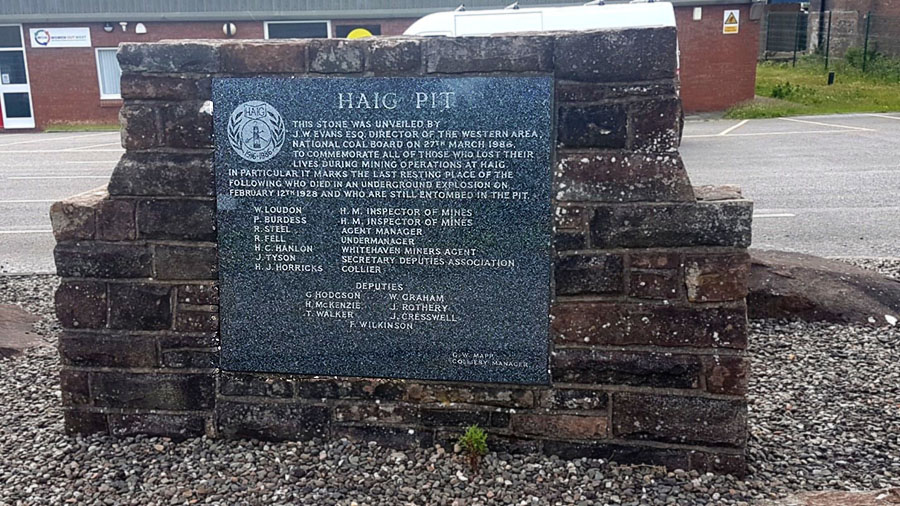
Superintendent S.B. Manning made his last inspection at Haig Colliery on Friday 7th February 1986, to see that the shafts were sealed at the bottoms, and no miner would ever go down these shafts again. Thus ended 72 years of service to the coal industry of Cumbria, and closure of the last remaining deep mined colliery within the Cumbria area.
Cumberland Mines Rescue Service
The Rescue Service in Cumberland began officially in 1914 when the Rescue Station at Brigham was opened. The first Superintendent was Major Tucker assisted by Instructor J. Charlton. Between the years 1915 and 1921 the records show that 218 part time rescue workers from 27 pits were undergoing training at Brigham Rescue Station. From 1920 until 1953 Brigham station attended 8 colliery explosions as well as countless other incidents in the Cumberland coalfield...Since then although records are incomplete, more than two thousand men must have undertaken training at both Brigham and Winscales.
The service has always prided itself on having the "pick of the crop", so to speak, in the calibre of the men who have and still serve in the Mines Rescue Service.
Miners are an elite group within British Industry, and the Mines Rescue Workers are the cream of that elite. They serve their fellow men, selflessly and with undisputed courage, facing some of the most appalling dangers known to man in pursuit of his daily bread.
In 1951 the Rescue Station at Brigham closed and the Winscales site was opened, this was considered to be a more central position for responding to the existing mines. From 1914 to 1986 the number of mines associated with Mines Rescue Service is known to be at least 54.
Solway colliery, the last deep mine within the Workington area was closed in 1973.
*Winscales rescue station was a ‘B, scheme station, and because of it’s geographical position was accorded extra rescue teams and full time Brigadesmen.
Down through the years the following men have served the two stations:-
Chief Officers
| F. P. Mills |
North East |
1914 - 1954 |
| H. Twist |
North East |
1954 - 1966 |
District Rescue Managers
| R. Barker |
Western Area |
1966 - 1975 |
| G. Schofield |
Western Area |
1975 - 1976 |
| T. Donkin |
North East |
1976 - 1984 |
| E. Farrage |
North East |
1984 - 1986 |
These men, in total, muster a tremendous amount of experience in disasters, fires and in advisory capacity to Mine Management.
Superintendents
| Major Tucker |
1914 - 1920 |
|
| J. Charlton |
1920 - 1953 |
|
| W. Kirk |
1953 - 1958 |
Queens Commendation for Bravery |
| H. Cunningham |
1958 - 1963 |
|
| F. J. Taylor |
1963 - 1983 |
|
| S.B. Manning |
1983 - 1986 |
|
The experiences of these men are a matter of record:
Major Tucker had to establish and maintain the Cumberland service in its infancy.
J. Charlton, a serving member of the Royal Artillery T.A., was called to the colours on the outbreak of war in 1914 and served in Egypt, Palestine and Mesopotamia as Sergeant, returning to Brigham as Instructor in 1918 and was appointed as Superintendent in 1920. From then until he retired on December 31st 1953 he attended 8 colliery explosions as well as countless other incidents in the Cumberland coalfield.
W. Kirk, trained in the North East, attended many incidents including the William Pit explosion, Easington disaster, Weetslade explosion, and was awarded the Queens Commendation for Bravery along with R. H. Glaister when rescuing several men overcome by fumes at the Greenside Lead Mine on July 7th 1952.
H Cunningham, trained at Coatbridge, Scotland, and attended many incidents there; the most notable being the rescue of 116 men trapped underground at Knockshinnoch Castle Colliery, Ayrshire, in September of 1950 when a field collapsed into the workings.
F. J Taylor, another north east man who attended William, Easington and Weetslade as well as many others too numerous to mention. Well known and highly respected throughout the Service as a tutor for potential officers and as an adjudicator at rescue competitions. Fred was the longest serving Superintendent within the Cumberland Rescue Service
S. B. Manning, trained at Coatbridge and attended amongst others, the Auchengeich disaster, Cardowan explosion in 1960, and Micheal disaster. Also featured as a tutor for potential rescue officers. Sam was to be the last serving Superintendent at Winscales, before its closure in 1986.
Assistant Superintendents:
- F. Charlton. (brother of Jack)
- William (Billy) Wood.
- Stephen Harle.
- Charles Snarski served at Coatbridge at the same time as S. B. Manning
- G. M. Sloper trained at Mansfield. Attended amongst others, Rufford Colliery to rescue men trapped in gas. Extensive fires at B. Winnings, Cadley Hill, Donisthorpe, and Daw Mill, Desford. Also trained in the use of emergency winding equipment.
Instructors/3rd Officers:
- J. F. Loy
- N. C. Fearon
- A. J. Barker
Brigadesmen:
- W. Nixon (Eng.) E. Doran
- J.T. IIey J. F. Loy
- N.C. Fearon J. S. Gibson
- G. McGIennon. E.Fisher
- M. Storey J. Hudson
- P. Robertson D. Norman
- H. Mclellan. (On permanent loan from Haig Colliery).
From 1914 to the present the number of mines associated with the mines Rescue Service is known to be at least 54. This bears no resemblance to the number since mining began in Cumberland back in Roman times. There are known to be well over 1,000 shafts, mines and bell pits in Cumbria.
|


