2006 - Page 2
Harworth Closed And Put On Care And Maintenance
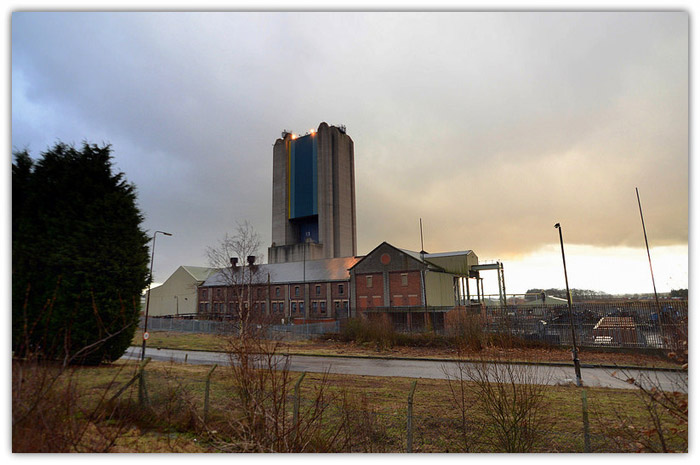
Photo From 28DaysLater.co.uk
It was announced in early June 2006 that after 90 days Harworth was to close for production but would be mothballed. Results at the colliery had still not achieved the necessary level required resulting in the failure to negotiate the sale of 1.5 million tonnes of coal by the parent company UK Coal. I had forecast this several years before. This was ‘make or break time’ for the other two Nottinghamshire pits Thoresby and Welbeck and could have a ‘domino effect’ as suggested by Tom Pegg, Reporter of the Mansfield and Sutton Chronicle Advertiser (The Chad) on 21/6/2006. 310 jobs were to go at Harworth and redundancy notices had been issued.
(Harworth in Limbo Sept 2006)
Possible Future Nuclear Waste Dump?
Shocked villagers at Edwinstowe joined with Greenpeace campaigners when it was suggested that nuclear waste could be dumped underground at Thoresby colliery after its closure. The pit was one on a list of 536 drawn up as early as 1980 by the Nuclear Industry Radio-active Waste Executive (NIREX). With the push for nuclear power to sustain the country’s energy needs in future the PM Tony Blair (Lab) had announced that new nuclear powered power stations were to be built.
Government Outlines Future Energy Situation
The New Labour Government finally outlined the future energy situation. New nuclear power stations were to be built to replace the aging nuclear and coal powered stations as they come to the end of their life.
Oil and gas from the North Sea will last until at least 2020 when other deposits were hoped to have been discovered. Meantime energy from France from their nuclear plants would continue to be sent to the UK via the cable link.
A new pipeline under the sea from Norway would transport gas from Russia. Clean coal technology would increase but did not favour UK coal although it was muted that old closed pits that had been abandoned and shafts filled could be re-opened, but I doubt that very much, in fact I think it impossible.
RJ Budge And Russian Consortium Re-Open Hatfield
Richard Budge and a consortium from the largest mining company in Russia with 52% holding were to re-open Hatfield colliery in Yorkshire that had been closed earlier in the year, but the shafts were known to be flooded. £30m was required for the project by Coalpower and up to £800m before full production of 2m tonnes a year in 2009.
The mine was sunk by Hatfield Main Colliery Co formed by Emerson Bainbridge in 1910. Sinking finished in 1917. In 1927 it was bought by Carlton Main Colliery Co. Thorne and Hatfield were merged in 1967 but separated into separate units again in Feb 1978. However Thorne and Hatfield were merged again in Feb 1986. On 3 Dec 1993 the combine was closed by British Coal. The pit’s management team re-opened the colliery on 25 Jan 1994 by a newly formed Hatfield Colliery Co Ltd. A profit of £2.4m was made in the first year, but on 9 Aug 2001 went into receivership throwing 200 men out of work. Richard Budge former owner of RJB Mining took over the mine under the guise of Compower. The company went into administration in Dec 2003 then liquidation on 22 Apr 2004. Richard Budge formed his Powerfuel Co for £36m (Kuzbassarezugol (KRU) a Russian firm holding 52%.
Development of 2 headings at the pit drifting down from the High Hazels pit bottom area to the Top Hard or Barnsley Bed started in August 2006 and men were being set on gradually including 3 shift Managers (ex Overmen), Reg Pettitt an ex Colliery Overman at Shirebrook, Deputy at Clipstone, Overman at Harworth was one of them. Work on No1 shaft continued as it was badly affected with water when the pit was closed earlier.
In December 2007 the first retreat face was being equipped with chocks. An excavation of 11 yards (10m) at the face entry was needed to get the road header / bolter onto the face line. It would have a run of app 1,205 yards (1,100m). Development headings for the second face opposite were stood down in order to set up the first retreat face. Manpower to date was 320 men.
Rossington Abandoned And Demolished
If money could be found, further working could continue in a revival plan at the closed Rossington colliery (South Yorkshire) to produce coal from a thinner section of Barnsley seam whilst further development could continue to open thicker reserves to the South in the Barnsley / Dunsil seam, following the completion of face salvage operations. There were no takers so after about 3 years the headgear was demolished in 2008 and 2 halves of a winding wheel recovered in the demolition were to be re-sited in the pit village as a memorial to the 92 men who lost their lives at the pit.
Investigations Into Further Ideas

Further ways to produce energy supplies in the future were to be investigated where the use of sea tides, solar, further wind power, and other greener fuel systems as predicted earlier.
Opencast Sites
However many tonnes of coal has been recovered from opencast sites over the years at a much cheaper cost than for deep mined coal.
The following sites have been worked (no dates):
- The Oaks near Ireland
- Ireland
- Tom Lane
- Arkwright Arms
- Poolsbrook
- Longmore Farm
- Oxcroft
- Sutton Scarsdale
- Deepring Bell, Watson near Heath
- Church Hill Blackwell, Hilcote South Normanton, Berristow Lane
- George Pinxton, Starbutal, Banks Farm, Gloves Lane
- Mount Pleasant
- Pettifor Terrace
- Scanderlands
- Primrose Hill
- Westhouse Farm
- Normanton Brook
- Windsend Farm
- Townend Farm
- Greyhound
- Aintree
- Mickley Lane
- Shirland Quarry
- Goose Green
- Stonebroom Lane
- New Higham
- Bumpmill
- Skeggerleg
- Pit Lane, Sheep Lane, Crown Inn
- Peacock Hotel, Glade, Two Farms, Crimea
- Dean and Wren
- Four Lane Ends
- Roman Road, Bacon Lane
- Millstone
- Nix
- Butterfield Farm
- Ogston Ford
- Butter Cott
- Hillsboro Birch
- All Saints
- Wingshrew
- Alfreton Brickworks
- Cemetery Lane
- Cotes Park House
- Greenacres
- Factory
- Dobbs
- Pennytown
- Heathfield Tibshelf
- Sunnybank
- Silverhill
- Harper Hill, Biggin
- Harehill, Watson
- Gildage Forge
- Union
- Hawking Lane
- Peverel
- Austin, Red Buildings. Many more sites have been outcropped in South Derbyshire and Leicestershire. Working sites continue to date in 2013.
Harworth In Limbo (Sept 2006) After 82 Years Production

Harworth colliery, (North Nottinghamshire) was sunk in 1919-1924 by Harworth Main Colliery Co then taken over by Barber Walker and Co. Originally the mine was being sunk by an Anglo German firm, the Northern Union Mining Co but was halted for the First World War in 1914 and the German sinkers interned. Sinking was suspended and abandoned. The shafts were re-positioned a few yards (m) away due to the thinking that the German sinkers had spiked the shafts with explosives. Shaft positions: SK69SW No1 shaft 462538,391248, No2 shaft 462472,391247, 111 feet (34m) above sea level, sinking then recommenced, Master Sinker was William Tupling.
 The base of the Permo-Trias was at 720’ 8” (216m). 39 layers of coal was passed through before reaching the 6’ 9” (2.05m) thick Top Hard at 2787’ 4” (849.5m). The 2 shafts both 6.8m dia were sunk to just below the Dunsil horizon. No1 shaft 972 yards (888m) and No2 shaft 980 yards (896m) deep. The mine was mothballed in October 2006, coal turning had ceased in September. The base of the Permo-Trias was at 720’ 8” (216m). 39 layers of coal was passed through before reaching the 6’ 9” (2.05m) thick Top Hard at 2787’ 4” (849.5m). The 2 shafts both 6.8m dia were sunk to just below the Dunsil horizon. No1 shaft 972 yards (888m) and No2 shaft 980 yards (896m) deep. The mine was mothballed in October 2006, coal turning had ceased in September.
The colliery is situated about a quarter of a mile from the border of Nottinghamshire with South Yorkshire, about 16km south of Doncaster. The nearby village of Bircotes was created to house the workforce mainly Yorkshire miners and others attracted to the new sinking. The colliery did not have steam winding engines but had one of the first electric winders, the original winder a Metropolitan Vickers drum with 2 x 895kw motor raising 200 tons per hour in tubs on multi deck cages 6 days a week.
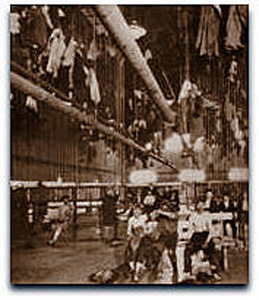 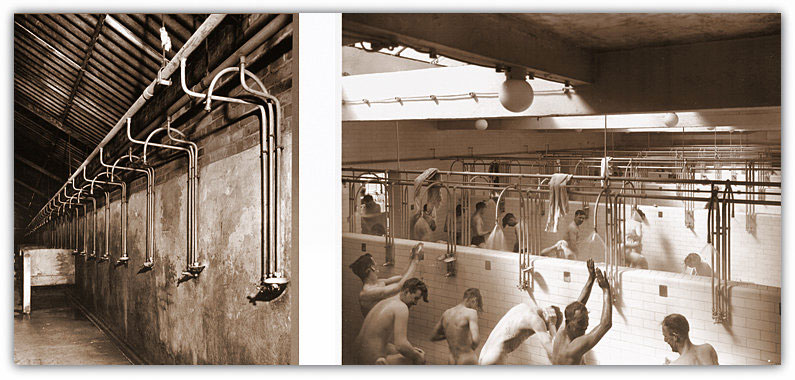
New modern Pithead baths in 1964 replaced the old fashioned kind where clothes were hoisted into the roof of the bath house. |


