2006 - Page 3
Harworth In Limbo
- Continued -

On nationalisation it became a unit of No3 Area of the NCB to 1967, then part of North Nottinghamshire Area to 1984, then under British Coal, then RJB Mining, now UK Coal. Both headgears were replaced with ultra modern types. On the manriding / materials shaft 4 ropes per chair and two rubbing ropes and two guide ropes at either end of both chairs to steady the ride at such great depth. In 1971 skips carrying 7 tons were installed raising the output to 288 tons per hour. These were later replaced with 9 tons skips and again in 1983 with 10 tonnes alloy skips giving an output of 500 tonnes per hour. New up rated winding engines were installed, both by Vickers Armstrong, No1 shaft in 1981 having a 2,980Kw D size Thyristor convertor fed D,C, motor. A similar motor was installed at No2 shaft in 1983.
The main surface fan to ventilate the mine was an Aerex 4.3m dia single inlet radial flow fan driven by a 1,120 Kw motor at 365 revs/min. A similar fan was on standby. High virgin rock temperatures in the Deep Soft reaching 40°C required chilled water air conditioning from a 750Kw plant in the pit bottom was installed in 1981.
Homotropal system of ventilation was introduced but this only reduced the temperature by 2 or 3 degrees. A second chilled water system was installed in Nov 1982. These systems were not adequate in the long term and a new 7,000 Kw capacity surface air conditioning plant was commissioned in July 1986.
 The vast quantities of methane gas from the Barnsley Bed was harnessed and sold to the nearby glass bulb factory but this ceased in 1970 due to the quality and quantity not being assured, however it was diverted to a surface boiler for use as heating to the offices and pithead baths. Drainage was essential on all panels worked and was piped to the surface through a shaft range of 350mm dia to a surface plant by 4 x Nash Haytor H10 pumps and utilised for space and water heating. Crude oil issued from the strata on 20s panel from a methane drainage hole 1967. The vast quantities of methane gas from the Barnsley Bed was harnessed and sold to the nearby glass bulb factory but this ceased in 1970 due to the quality and quantity not being assured, however it was diverted to a surface boiler for use as heating to the offices and pithead baths. Drainage was essential on all panels worked and was piped to the surface through a shaft range of 350mm dia to a surface plant by 4 x Nash Haytor H10 pumps and utilised for space and water heating. Crude oil issued from the strata on 20s panel from a methane drainage hole 1967.
Coal was transported by gate belt conveyors to trunk conveyors to skip pockets at No1 shaft side. The Haigh Moor seam production was controlled by a 400 tonnes capacity horizontal bunker and the Deep Soft run of mine was conveyed to a 1,000 tonnes capacity vertical bunker commissioned in Sep 1983. There was a Crawley static-bin type bunker sited in the pit bottom that could be used for all underground production if it was necessary. Underground manriding and materials transport was by loco and rope haulage systems. 2 way manriding was installed in both the Haigh Moor and Deep Soft drifts. The main surface fan and standby fan were identical Aerex 4.3m dia single inlet radial fans driven by 1,120Kw synchronous induction motors at 365 revs per min. A £2.7m surface chiller plant was installed by 1985.
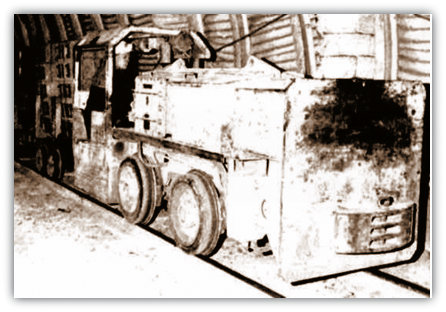
Surface locos like all other collieries had steam engines for shunting operations. These were replaced by diesels. Underground diesel locos 2’ 6” gauge 3 x 4 wheel BEF 10 tons MV 1934, Nos 1,2,3 0-6-0 100 hp HC in 1949, No4,48 4w DMF 1952, No6 0-6-0 DMF 100h HC 1963.Nos 7 and 8 4w DMF 28hp He 1976 and 2 x 4wBEF CRT3+ CE 1979.
Underground battery loco was operational for men and materials in 1934.
Seams worked:
- Barnsley Bed (Top Hard) 6’ 9” (2.06m) at 929 yards (850m) 1924 - abandoned Oct 1984, Blyth coal 2’ 5” (0.74m) dirt 1” (0.025m) coal 5” (0.13m) 482 yards (440m) heads from shafts, face started slowly June 1958, shortened down Mar 1960, finished 14th Apr 1960, headings to North West finished Dec 1960 and Mar 1961
- Haigh Moor, (equating roughly to the 3rd Waterloo of mid Nottinghamshire), coal 10” (0.25m), dirt ” (0.01m), coal 8” (0.22m) seat earth 8” (0.21m), coal 1’ 2” (0.36m) Nov 1982 11th Mar 1988, Swallow Wood (Waterloo) and Deep Soft 1980 October 2006. A vertical bunker was constructed in the late 1970s. £5.5m scheme to access the Haigh Moor seam and £4.5m to replace both winders and larger skips.
No2 shaft at 979 yards (895m) was deepened a further 55 yards (50m) to the Deep Soft horizon. The Surveyor erected a laser beam to shine down the shaft for verticality but because of the great depth a prism had to be sited part way down the shaft to continue the beam. I assisted Peter Thompson (4297) in a minor capacity with the process. Eventually this proved successful.
The new North East development of the Barnsley Bed was started in 1943.
The old coke oven plant in the 1930s was using 6,999 tons of coal a week. An additional 10 new coke ovens built in 1934. By 1935 coke oven bi-products plant erected. An Elemore slurry plant was commissioned. In 1936 an additional 4,000 Kw generator was put to work. Distribution of domestic fuel and industry was road borne and coal destined for power stations was transported by rail. The coal prep plant had wash boxes installed in 1923 and 1934 with a throughput of 300 tonnes per hour.
The modern coal prep plant can cope with over 1.3m tonnes per year and any surplus is put on the 3,000 tonnes capacity stocking ground.
Dirt disposal was by a chain conveyor to a 350 tonnes capacity dirt bunker feeding a conveyor to the tip where it was spread by bulldozer and scraper. Prior to that, it was the aerial overhead bucket system. Restoration work has been done and reclaimed land has been returned to agricultural use and some area for tree planting.
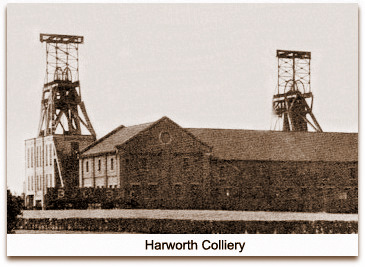 In 1983 a new dirt disposal conveyor system was commissioned. A third drift was driven to the Deep Soft seam. A further 1,200 tonnes capacity pit bottom bunker was constructed in 1986. In 1983 a new dirt disposal conveyor system was commissioned. A third drift was driven to the Deep Soft seam. A further 1,200 tonnes capacity pit bottom bunker was constructed in 1986.
In 1983 Harworth No1 existing DC electric winder system was replaced with a new NEI rationalised Thyristor DC ‘D’ size drive system, stub shaft, Holset coupling and static compensator and using the existing BCC winder mechanicals (existing automated skip plant with automatic winding) with a motor speed of 47.75 rpm and a drum diameter of 26 feet (7.92m), the max rope speed 65 feet / second. This could be used when the rising light-weight skip was loaded, and at other times a rope speed of 30 feet / second was used. With both skips empty at 65 feet / second rope speed they tended to dance with the likelihood of striking the shaft inset structure or wall.
 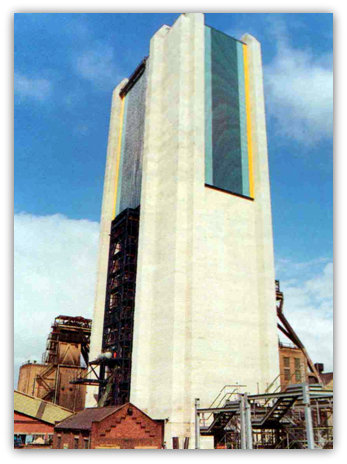 A new unconventional massive concrete headgear with tower mounted 4 ropes, 4 megawatt friction winding engine built to lift 27 tonnes skips from the great depth at 800 tonnes per hour. These replaced the 10 tonne skips. During the 3 week holiday period the old steel headgear at No1 shaft was cut and pulled out from beneath the new concrete tower and the new inner tower was slowly pulled into position and halted at the Surveyor’s mark. I was present at this magnificent achievement and marvelled at the whole scene. The new winding rope, guide ropes and balance ropes were installed and the new engine was commissioned on Friday 18th August 1989. A new unconventional massive concrete headgear with tower mounted 4 ropes, 4 megawatt friction winding engine built to lift 27 tonnes skips from the great depth at 800 tonnes per hour. These replaced the 10 tonne skips. During the 3 week holiday period the old steel headgear at No1 shaft was cut and pulled out from beneath the new concrete tower and the new inner tower was slowly pulled into position and halted at the Surveyor’s mark. I was present at this magnificent achievement and marvelled at the whole scene. The new winding rope, guide ropes and balance ropes were installed and the new engine was commissioned on Friday 18th August 1989.
The new electric winding engine was a new NEI rationalised Thyristor DC ‘E’ size drive system, overhung armature motor and a new Markham’s 4 rope tower mounted friction drive system and up-rated system which is capable of raising a 30 tonnes payload from the Deep Soft level to the surface where a new inner tower was installed with all the relevant equipment to receive and unload the new 30 tonnes payload skips (new fully automated skip plant with automatic winding and winder control from skip top for shaft examination and shaft work).
The No2 shaft used for men and materials was later done similarly and the work carried out by Qualter Hall under commission by RJB Mining who were now owners of the colliery. The old steel framed headgear some 50 years old and weighing about 1,600 tonnes was pulled out in one piece as per No1 shaft. The new engine was pulled into position under the smaller 35m high tower of the two and replaced the existing rationalised ‘D’ drive winding engine and existing headgear with a closed colliery Qualter Hall 4 rope ground mounted friction drum and associated equipment all housed in a new engine house. This equipment with a new headgear forms part of a two rope cage and counterweight system operating between the surface and Deep Soft pit bottom and all those in between (new automated decking plant with push-button winding and winder control from the cage top for shaft examination and shaft work).
The electric winding engine installed in 1989 at No1 coaling shaft was the second replacement and the No2 shaft second replacement was installed in 1990.
A 4,000 tonnes capacity surface rapid loading bunker was built in 1988.
A new methane extraction plant at the surface was commissioned in July 1990. The first booster fan underground was installed during the Christmas break in 1992 and the second booster fan in September 1993. A new surface fan was commissioned in December 1993 and the air was reversed at the shafts and partially in the pit bottom. The electricity generating plant was commissioned in January 1993. An Osprey thermal imager was installed underground to detect any spontaneous combustion. 4s Deep Soft panel was stopped twice prior to Aug 1993 because of large quantities of gas. Output record for a Deep Soft panel was 58,000 tonnes for the week off this face. The air current was reversed round 4s district in October 1993 so that the gas would be exhausted into the new return gate. 11s face was set up as a homotropal panel but was changed to antitropal ventilation after a month. This face was equipped with the latest 3.3kv Electra shearing machine.
RJB Mining created their HQ at Harworth adjacent to the colliery. UK Coal continued to use the facilities for their HQ.
 A further £4m was required to access 60 million tonnes of Deep Soft seam, first face Feb 1981. MINOS control of conveyors installed. Unfortunately a large area of Barnsley Bed and Deep Soft reserves is sterilised due to spontaneous combustion. The mine is one of the deepest and hottest and gassiest in the country (1,012 litres/sec of pure methane) and is not connected underground to any other, the rock temperature being (107 F) 41.7°C. In Nov / Dec 2003, the air was reversed from antitropal to homotropal. It took 5 days to change because it required 7 stoppings and 16 doors to be built. The working temperature on 6s district was reduced from (98°F) 36.7°C to (80F) 26.7°C. However it still took around 1 hour to travel to the last working face in the Deep Soft, southern area. A £1m Electra EL2000 shearer was installed on 30s Deep Soft 320m long first face in the new northern section. This latest double ended ranging drum machine uses a box section mainframe, operating on 3,300 volts, weighing 55 tonnes, installed power of 1,250kW, consisting of 2 x 500kW cutter motors, a 50kW pump motor and 2 x 100kW variable speed AC haulage motors, giving a haulage speed of 49 yards (45m) /minute. A further £4m was required to access 60 million tonnes of Deep Soft seam, first face Feb 1981. MINOS control of conveyors installed. Unfortunately a large area of Barnsley Bed and Deep Soft reserves is sterilised due to spontaneous combustion. The mine is one of the deepest and hottest and gassiest in the country (1,012 litres/sec of pure methane) and is not connected underground to any other, the rock temperature being (107 F) 41.7°C. In Nov / Dec 2003, the air was reversed from antitropal to homotropal. It took 5 days to change because it required 7 stoppings and 16 doors to be built. The working temperature on 6s district was reduced from (98°F) 36.7°C to (80F) 26.7°C. However it still took around 1 hour to travel to the last working face in the Deep Soft, southern area. A £1m Electra EL2000 shearer was installed on 30s Deep Soft 320m long first face in the new northern section. This latest double ended ranging drum machine uses a box section mainframe, operating on 3,300 volts, weighing 55 tonnes, installed power of 1,250kW, consisting of 2 x 500kW cutter motors, a 50kW pump motor and 2 x 100kW variable speed AC haulage motors, giving a haulage speed of 49 yards (45m) /minute.
Babcock Minerals Engineering Ltd built a £16.3m coal prep plant to increase capacity from 600 tonnes / hour to 1200 t/h. It included a dense-medium open bath, dense-medium small coal separators, froth flotation cells, water clarification and clean coal concentrates filtration plant. Also clean coal classifying, crushing and blending schemes to produce singles, smalls and blended small products as well as a rapid loading system. Around 35 to 40 gallons a minute was pump out of the pit from the Barnsley Bed horizon at 860m deep and discharged into Baileys Brook.
The Nottinghamshire mine as stated is situated about a quarter of a mile from the border with South Yorkshire and the nearest neighbouring mine is Rossington sunk in 1912-1915 which was closed in 2006. The concrete tower mounted headgears are an outstanding feature on the landscape. They had to have blue and yellow coloured vertical stripes to comply with Town and Country Planning conditions. Always a difficult pit to work in the past due to circumstances, a change in the ventilation system, and a switch to double-entry mining using Megastrand bolting, and an improved system of methane gas extraction gave the pit a new lease of life in 2003 following the threat of closure once more, and the loss of jobs for the 430 men who worked there. A Government grant of £4.6m in Dec 2003 gave a life line towards a £15.4m, 320m long retreat face and 6,000m of development roadways. Further grants of £1.7m for developments and face equipment totalling £5.7m.
As at all the pits now a card swipe system was operative, similar to a credit card, with photograph and number with the card swiped on arrival at the mine, a further one at the pit bank before descending the shaft, similarly in reverse at the pit top when surfacing the mine and again when leaving the premises after showering. |


