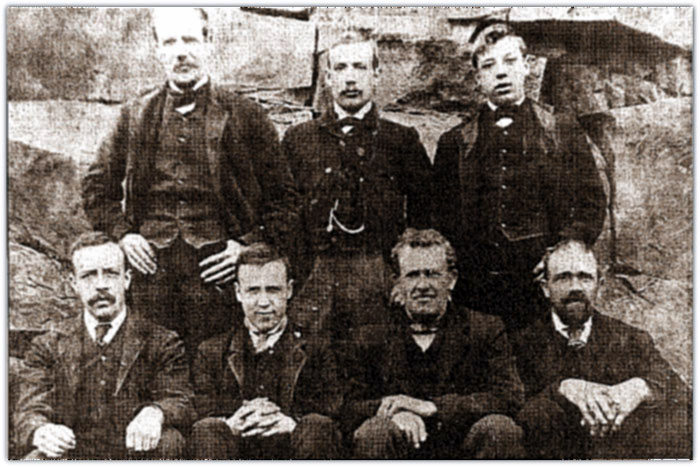
A rare photograph of the men who never expected to see the light of day again ..... the seven survivors of the Thornhill Pit Disaster. Later the men were taken on holiday to the seaside to help them recuperate from the ordeal of being entombed for 30 hours. The picture hung in the Thornhill Combs Colliery until its closure in 1975.
The men are, from left to right: (back row), Henry Wraithmell, Friend Senior, Willie Lightowler. Front: Squire Shires, John Garfitt, Richard Wood, J Mallinson.
The Resumed Inquest
At the Thornhill Local Board, before T. Taylor, Esq (District Coroner). Mr Joseph Brown was foreman of the jury. Mr Alexander Young (London) and Mr F N Wardle (Her Majesty’s Inspector Of Mines) represented the Home Office. Mr Atherley Jones QC, MP, son of the late Mr Ernest Jones, appeared for the Miners' Association and the relatives of the deceased.
Mr Stewart (Stewart Son and Chalker), along with Mr Parker Rhodes of Sheffield, attended on behalf of Mr E.T.Ingham, the colliery owner. Mr Mellors, Mr Hall and Mr Watson, assistant inspectors of mines, were also present, along with representatives of the Yorkshire Miners Association, the Miners Federation of Great Britain, and others.
William.Hy. Rnmsden was the first witness called. He said: I am a mineral surveyor and live at Savile Town. I am colliery surveyor for Mr Ingham for the whole of the collieries and they are all in the township of Thornhill. The cartoon plan produced was under my direction and is in respect to the Wheatley seam. The strata levels are correct and I also produced sections of relative levels of the bottom of the shafts.
Evidence By The Owner Of The Colliery
EDWARD THEODORE INGHAM was next examined and said: I live at Blake Hall, Mirfield, and am the owner of the Thornhill collies which include Combs Pit,
where, the accident has occurred. The pit was originally sunk in the 'same' year or the year after the Crimean War, about 1856, and it was sunk down to the 'New-Hards' level.
The length of one shaft was 115 yards and the other 116 yards. The New Hards coal was on the west side of the 45 yards throw. A pit was then sunk from there, in 1883 and 1884, it was impossible to sink the water pit any lower on account of the pumps and consequently a short drift was driven about 20 yards and a staple pit sunk from the new hards down to the blocking coal, a depth of 50 yards one foot.
By the Coroner: From the bottom of the new hards to the blocking coal is 50 yards.
Mr Ingham: And the Wheatley seam is as near as possible between the two. It is commonly called the 45 yards throw. The blocking bed coal has never been worked but simply drifted through. We followed the coal through the throw and bored until we got to the new hards. We made the road on the left side under the impression that there was a large quantity of coal there. Having touched the New Hards it became a simple matter of calculation, knowing the depth of the strata, to set out a working road.
A Valuable New Field
I was under the impression that there was a valuable field of new hards towards the direction of Ossett and expected to extend the workings considerably, but we had to come back and the New Hards seam, on the left side of the fault, had to be abandoned. This was in 1888. I did not know what to do with my men, I could not afford to sink any deeper, so I decided to go back to the Wheatley seam and the men worked in it.#
After the New Hards seam was abandoned the water made its way into it and as we pulled up the rails and timber it gradually filled up. The overflow water from here has to be pumped from the Staple Pit, the pumps being fixed at the pit bottom. The staple pit, in addition to serving as a pumping shaft from the old roads, also forms the upcast shaft from the workings. Unless something were done the wind would find its way uninterruptedly to the blocking coal, and a landing stage was therefore erected, with air spaces on both sides.
The water power for the ventilation of both pits was supplied by a fan 30 feet by 10 feet. The week before the accident the fan gave 82,850 cubic feet per minute. The fan has been in use since the year my brother died in 1878.
Mr Taylor's Ability
My present certified manager is Mr W. Scott and has been in my employ since the 4th May. Previously my manager was Mr Jesse Taylor, who has been in my service for many years. He worked first as a collier and went away to improve himself. I don't know how long he has been in my service since he came back, perhaps 16 or 17 years. I found that increasing years were beginning to interfere with Mr Taylor's ability to get about the pit and I thought it desirable to have a change in the management as I wanted someone able to get about.
No notice was given on either side and after I had paid him a year's salary we parted very good friends. He also said he would show Mr Scott round the workings, and put him in the way of things.
THE CORONER: I understand that you simply wanted someone stronger in health and more capable of going about the works?
Mr INGHAM: Yes, someone who could go about the pit bottom, in fact all over the workings. The staple pit, in addition to serving as a pumping shaft from the old roads, also forms the upcast shaft from the workings. Unless something were done the wind would find its way uninterruptedly to the blocking coal, and a landing stage was therefore erected, with air spaces on both sides.
The water power for the ventilation of both pits was supplied by a fan 30 feet by 10 feet. The week before the accident the fan gave 82,850 cubic feet per minute. The fan has been in use since the year my brother died in 1878.
THE CORONER: I understand that you simply wanted someone stronger in health and more capable of going about the works?
MR INGHAM: Yes, someone who could go about the pit bottom, in fact all over the workings.
Before Mr Taylor gave up the reins I had been very anxiously watching the ventilation on the south side, and took steps to ensure an improvement before he gave up. The improvements were carried out under the supervision of Mr Ramsden who prepared the necessary plans, and the ventilation was made perfectly good.
When Mr Scott took charge I went to Ireland and returned on the 9th June to see how the new manager was going on. I stayed two days and went all over the place with Mr Scott and had a talk with the foremen and other men in responsible positions, and was perfectly satisfied in the way in which things were going off, indeed, I bundled back to Ireland, feeling pleased that things were going so nicely.
I received a telegram on the unfortunate accident (and here Mr. Ingham appeared deeply affected). I was unable to catch the afternoon train from Limerick, but I made my way.
Excellent And Arduous Work
When I got back to Thornhill I found a number of engineers busily engaged under the superintendence of Mr Garforth. They were doing excellent and arduous work. I wanted to go down the pit, but they said I must not, my place was to be at the pit bank. They told me that I could do more by superintending the things above than by going below. I remained there until the following morning, about a quarter past two, when I found that the men could not go on any longer.
When the last party, including Mr Nevin, returned to the surface they considered it advisable to cease operations and resume work the next morning. I am not a mining engineer, and simply have a practical knowledge of the work and as to details I never interfere with my manager. As far as my judgment goes I have done, all I could to ensure the safety of my pits.
In reply to Mr Jones: I cannot give the extent of the whole workings as some of them are as much as 150 years old.
Approximately the extent of the New Hards works was 1,000 acres. The thickness of the last New Hards seam was about three feet, but there was much confusion of the strata, coal and dirt being mixed up to the extent of about six or eight inches. There was a small steady feeder of water.
MR JONES: Can you tell me, did you find any trouble with gas?
MR INGHAM: No, not that I know of.
MR JONES: Is there anything mentioned in the books of gas?
MR INGHAM: No, not that I'm aware of.
MR JONES: Was that particular district rather fiery?
MR INGHAM: Not that I'm aware of, not at any rate more than new Hards usually are.
MR JONES: Was there any indication of gas?
MR INGHAM: There are always indications of gas in every pit.
MR JONES: Was gas reported to you?
MR INGHAM: I don't think there was any more gas in this place than was usual in the new Hards.
MR JONES: May I take it then that the New Hards seam was not a fiery seam?
MR INGHAM: Certainly it was not.
MR JONES: But more fiery than I understand the other seam which is now being worked. I mean the Wheatley bed.
MR INGHAM: Yes.
MR YOUNG: Who were the persons primarily or immediately responsible for the ventilation in the pits?
MR INGHAM: The manager first, the under manager second and the various deputies afterwards.
MR YOUNG: Do the men all work with safety lamps, I mean all coal getters?
MR INGHAM: Yes.
Mil YOUNG: I understand there were naked lights in the porch.
MR INGHAM: Yes.
MR YOUNG: May I take it generally from you that as far as you could you complied with the Mines Act and Rules?
MR INGMAM: I have sir.
MR JONES: Have you ever heard of gas coming up the downcast shaft from the blocking bed and through to the Wheatley bed?
MR INGHAM: I'm not sure.
MR JONES: Did you receive about Easter a complaint by letter as to gas escaping?
Anonymous Letter
MR INGHAM: I got an anonymous letter from somebody which was neither signed nor anything else saying there was gas somewhere at the south endings. I promptly sent a messenger to Jesse Taylor, the late manager, with a sharp message for him to go and inspect the place himself. And to report to me personally, which he did. He reported that there was no gas. I never take any notice of anonymous letters.
MR JONES: You have never heard of gas being found in the shaft near the downcast shaft?
MR INGMAM: I have heard during the last two or three days a good deal but I never heard before except during the normal course of affairs.
MR JONES: It is a fact or not that before this accident you heard about gas being in the neighbourhood of the downcast shaft?
MR JNGHAM: It was some months after an incident that I heard about a gas explosion. It was mentioned in a casual conversation as if it was of no importance whatsoever. I thought I thought nothing more about it.
MR JONES: Can you at all fix that period?
MR INGHAM: No sir, I cannot.
MR JONES: Would it be 12 months, I8 months or 2 years?
MR INGHAM: Not as much as that.
MR JONES: Six months?
MR INGHAM: I should think so, I cannot say definitely, it was just a matter of conversation.
MR JONES: You appreciate the importance of it now?
MR INGHAM: I do sir.
MR JONES: You heard some months ago of gas firing?
MR INGHAM: Yes sir, Mr Ramsden my surveyor told me.
MR JONES: Did you make inquiries when he told you where that gas came from?
MR INGHAM: I never even heard what it was.
MR JONES: Did you give any directions about it?
MR INGHAM: No it was months after it happened.
The Manager's Evidence
William Scott, of Edge Lane, in answer to Mr Rhodes, said: I am 35 years of age. I am a certified manager holding a first class certificate of the Combs Colliery. I have been engaged in mining since I was 15years of age. l served my time with the late Mr Hepple and in 1883 I was appointed under manager at Brancepeth pit.
On the 4th of May last I took charge of the Combs pit. When I came to my new appointment Mr Ingham told me to make myself acquainted with the state of the mine, not to upset anything that was done; that on his return from Ireland I was to tell him of any alterations that might be required, but that if there was anything necessary for the safety of the pit I was to do it on my own responsibility.
I did not find it necessary to make any material change in this system of ventilation or anything else. I found that about 19,600 cubic feet of air per minute passed into the Wheatley seam. The air was split into two main districts, on the north and on the south side. The Wheatley seam is not a fiery one and there has never been any report since I took charge of gas.
I have examined the report book for sometime before I came and in it there are frequent reports from time to time of gas in the Wheatley seam. Those were made previously to the improvements effected by Mr Ingham at the Ashton endings. I have myself been down into the blocking seam. It was on the 9th of June.
Amos Hawksworth was with me on that occasion. When Hawksworth told me where the gas was I told him to get rid of it as soon as possible. On the 16th Hawksworth visited the place again and reported that it was entirely free from gas.
With that exception he had never heard of gas, even in the blocking bed.
In reply to Mr Jones he went on: For some distance along the Wheatley bed open lights were used in the immediate continuity with the shaft bottom of the Wheatley seam. Hawksworth did not make an entry of the finding of gas on the 14th of June. Neither did I point out to him that he had committed a breach of the 4th general rule. So far as I know Hawksworth had never made a report before and I don't see why he should have done on this occasion. I was on the point of having a form of a report drawn up for under managers.
Further Witnesses
Fisher Ledger, of Thornhill, said he was assistant deputy. He was 25 years of age and had worked in pits since he was 10 years of age. He went underground at 14 years of age and had examined the air at the top of the Staple pit. He left on the morning of the explosion before it took place. He only examined it with the lamp. There was what they call 'a pretty fair draught'. His lamp showed no trace of gas. He had examined it on many previous occasions but had never found any trace of gas. His lamp would tell him whether there was gas. He tested it in the main inlet in the Wheatley seam.
Mr Scott was then recalled to conclude his evidence as to the condition of the mine after the explosion and the arrangements made for the rrecovery of the bodies?"
He replied to the coroner: I went down the Staple pit with two other persons after the explosion so that the bottom of the cage was level with the Wheatley mouth. I had to return again for the smoke and after damp. I came out to the bottom of the outer pit. By that time Crossley the under manager and another person had got into the Wheatley bed after throwing the separation doors wide open. I left them and went into the New Hards seam and endeavoured to turn the feeder water which exists at the place, upon the fire which was raging.
CORONER: Could you see it?
SCOTT: I could hear it. During the time that we were engaged in this work Henry Crossley came back and said “I have got into Wheatley bed and found four bodies'. I told a party to get them out.
CORONER: Who were they?
SCOTT: James Scargill, William Field, Samuel Croft and Rowland Blackburn Garthwaite — or Garfitt as he was called. I thought I detected signs of life in Scargill. I went out with him to the doctor and he pronounced him to be dead. Whilst I was there Crossley and Albert Lodge went down into the Wheatley bed again and I joined them afterwards and succeeded in opening the separation doors between the main intake and the top of the staple. We pushed on until we got close to the staples and I was then joined by Mr Elliott and after consultation with those about we agreed to close the top of the drawing shaft, which was done.
Continued on Page 4, Column 1.
|


