A Survivors Own Story
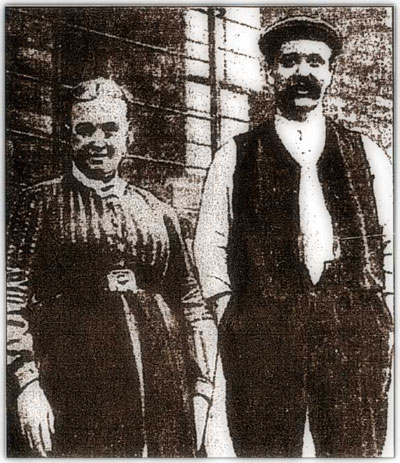
Survivor John Garfitt ? 'the only living man left in place' pictured above with his mother. After the disaster, John returned to the Combs pit for a further 20 years
Some Fought To The Last
The Only Living Man Left In The Place
One of the men who miraculously escaped the Thornhill disaster, John Garfitt, has since narrated what happened on that fateful day and we publish it in his own words:
"I shall never forget that morning, the sun shone bright and warm even at six o'clock in the morning, and the dew brought the scent of the grasses to the nostrils as I tramped my way to work. I remember that the larks were singing high in the sky, and everything seemed so bright and jolly that I whistled merrily to myself as I hurried along to work.
"Had anyone told me that morning that before the noonday menu had been served the Combs Pit would be on fire, I should have laughed at him and gone off to my work with a chuckle. You see the pit had the reputation of being a wet pit and no one ever dreamt of regarding It as a fiery pit, for explosions were practically unknown there.
"Below the seam where I was working was another seam which had been worked out, and it was here that the gas had been collecting. At the bottom of the shaft on the level with the Wheatley seam known as the Pit Eye there were a number of naked paraffin lamps hung up to give a better light to the hewers in their work.
"In the main roads, the hurriers also worked with the open lamps (Orland cotton wick), but in the working we were provided with safety lamps. The WheatIey seam ran north and south; I was employed upon the northern section, as were the vast majority of the men. I should be about 800 yards from the shaft, while in the southern section the man most distant from the shaft would not be more than 400 yards from the shaft.
Alma Bates Goes Home Early Sick
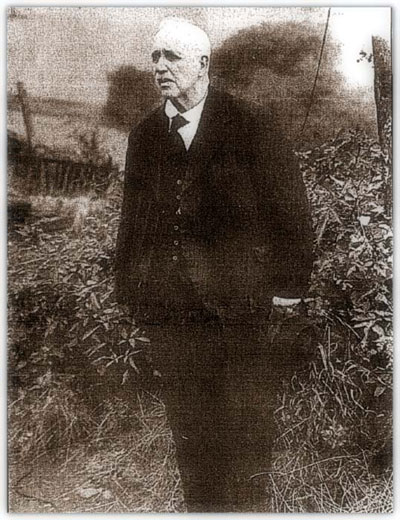
Years later John is pictured mourning friends who died in another pit tragedy, that at Ings Colliery in 1947. He is standing at the graveside of one of the victims.
"Amongst those who went down the shaft at six o'clock that morning was Alma Bates, but he was not feeling very well, and, consequently at half-past eight he left his work and went to the surface again. Had he remained at work he would never have seen sunlight again, for in his district not a man survived to tell the tale.
"At twelve o'clock we were accustomed to knock off for half an hour for dinner and although above ground the explosion was heard for half a mile around not a sound of it reached our ears. First thing we knew was that smoke seemed to be rolling along towards us and some of the fellows went into the main roads to find out the cause. It got worse and a deputy named Wilkinson came up and said:
"There's something radically wrong, lads and it's a case of each man for himself. Take my advice and get away from this. He could have got away himself into the other districts but he went on with his work of trying to arrange the air supply so as to drive the smoke away. We made for the newer workings, and one of the chaps suddenly said 'By gum but there's a good draught here lads. I'm noan leaving it, but you can please yourself.'
Miner Prays And Sings Hymns
"He stayed but the draught was composed of foul air and he was found afterwards dead in the spot where we left him. My brother was with me and an oldish chap, who was a Primitive Methodist. Never in my life have I heard such powerful prayers and such long ones as he poured out of his soul. Hour after hour he prayed and sung hymns, and after our light had been snuffed out by the gas and we were left thirty hours in the darkness, the sound of his voice was very welcome. It was remarkable how " different some were to others in withstanding the gas.
"Some seemed to die in no time, while others fought against it to the very last. I could feel a sudden difference take place in the atmosphere and now believe that it was caused by the shaft being covered. At last I was evidently the only living man left in the place and I began to crawl about in the pitchy gloom guiding myself by the tramlines and blundering, and knocking myself against many obstructions. I felt across the faces at dead men whom I could not see as I crawled my way along.
"At last in horror I found myself getting weaker, and the desire to get back to my own place seized me, and I set out upon my return. At length all consciousness forsook me, and when the searchers came my way looking for living men they rolled me aside as a dead un and passed on. On returning, however the chap who had done so, cast a glance at me and said: 'Why, this chap's moved since we left him.'
"Quickly I was turned over and for a long time it was doubtful whether I still breathed or not. At length I gave unmistakable signs of life, and I was sent to the top. I was taken to Dewsbury Infirmary.
A Number Of Years Before He Recovered
It was a number of years after the accident before John Garfitt recovered sufficiently from the affects of the gas he had inhaled during the 30 hours he was entombed, to narrate this story which he told in his own words.
"I suddenly awoke and sat up in bed, not knowing where I was and certainly never dreaming I was in hospital. The nurse, who I learned afterwards, had attended to me night and day for three weeks, had just previously left the room in which I was the only patient.
"Where the hangment hev I gotten to now?" I said to myself as I looked all around the room. I knew I was not far from the railway for I could hear them shunting. Getting up, I paced about like a sentry on guard, saved that I was clad in a shirt only.
Suddenly I spied a dress coat hanging on a peg, and with it I concluded my toilet, opened the door and popped out my head. I saw a row of beds and got a shock I can tell you. Seeing one chap sitting up in bed, I made for him and sitting down on the box by his bedside inquired in a whisper — 'Say, mate, what place might this be?' and he replied: 'Who are tha trying to kid?'
"I told him I had no idea where I was and he explained I was in the Infirmary at Dewsbury, I clapped my hands on my leg and different parts of my body, but nothing was broken. I then said to him: 'By gow, I mun git out of this. There's nowt matter wi me and I mustn't leave mi work, laikin about here.’
Wanted To Go Back To Work
"The man in the bed asked me where I worked and when I told him Combs Pit he asked if I really didn't know what had happened there. Then the nurse came in and I told her was going back home at once or I should be late for work.
"I had no idea what had happened, I Knew nothing about the explosion, and in a gentle voice she told me what had occurred, but I wouldn't believe her. I laughed at the idea of that pit exploding.
"Going out of the room she returned with a newspaper and handed it to me to read and then I knew that something serious had happened, I had forgotten how to read!
"Read it to me," I whispered,' and she did and all the strength went out of me at once, I thought of the mates I should never see again and the number of weeping widows and orphans that would be left in our village to mourn their loss. I thought of my brother and father, killed, and then thought of the struggle ahead that faced my mother with her family to bring up.
"I was put back to bed but nothing would suit me until I was put in the next bed to the chap who sat up and we became the best of chums. Of Nurse Jenkins I cannot speak too highly. The doctors confessed that they had given me up completely, for no instrument could be found to work. But the nurse took the oxygen into her own mouth and placing her lips to mine, forced it into my mouth, finer than any instrument ever invented could have done.
"One of my keenest regrets is that I have never been able to repay her as I would like to have done far her patience and kindness, to me, but in my heart my gratitude will never falter.
"When I came out into the world again, my memory was completely gone. I had often to inquire my way about in the district where I had been born. I had also to begin at the beginning and learn to read again. "After the accident came the miners' strike, which lasted 26 weeks. Though I was said to be unfit for work I went back to the old pit and today I am still working for the old firm and never wish for a better."
Mrs Garfitt Tells Her Story
Mrs Garfitt, of Thornhill Edge, whose son, John, was one of the survivors, and whose husband and two other sons perished, has given her account of what happened that day. Her story, narrated in her own words, starts at noon, shortly before the first explosion occurred:
"It had just struck twelve o'clock and the housewives of our little village were busy preparing the mid-day, meal. The menfolk were at work down the pit, but the daughters mostly helped to keep the pot boiling by weaving, and they would soon be trooping home hungry and impatient for dinner.
"It was just five minutes past twelve when there came a clap of thunder much louder than that we had been troubled with the week before. Miners' wives live in terror of explosions, and so dropping pots and pans, each woman rushed out of the house to see what the noise could be. Everything seemed as quiet as the grave, and with blanched faces we held our breath, afraid to give expression to the thoughts in each of our minds.
"Suddenly an ominous black cloud of smoke came pouring out of the pit shaft, and the pitiful cry went forth — "The pit's a fire's; It's gone off!... God help our poor men below!"
Frantic Women And Children
"In a minute the road was crowded with frantic women and children, flying to the colliery to hear the worst. And terrible indeed was the news that awaited us. The men engaged at the pit mouth had knocked; off at twelve o'clock and were gathered, in the cabin preparing to get their dinners- when the explosion took place. They were "capped" to hear a clap of thunder on such a fine day, never dreaming for a moment of the possibility of the pit going off.
"Reaching the door, the smoke met their eyes and with pale faces they rushed to the pit mouth to render what assistance they could. Fifteen minutes later another explosion took place and the cage was quickly lowered to the bottom. After a few minutes had passed it was drawn again to the surface and in a short space of time the iron cage had become actually red hot.
"It was evident that a terrible fire was raging below. The explosion had been heard half-smile away, and by this time the yard was full of mothers, wives, and children, wringing their hands in terror and praying to the men to do impossible things to save their loved ones below.
A Raging Hell
"The men went on with the work of preparing for the lowering of a rescue party, but the look upon their faces gave little hope to the distracted women around them. It was impossible to go down the main shaft, so they descended the shaft used for pumping the water out of the pit which is situated about 30 yards away.
"Quickly they were followed by other batches of men, and with haggard eyes we watched the wheel as the cage was raised and lowered again and again. Below the brave fellows found a raging hell and after struggling fiercely with the smoke they succeeded in finding four bodies which were promptly sent to the top.
"By this time water was being poured to drown out the fire, but the smoke and steam became so great that the gallant rescue parties were driven hurriedly to the surface again. A fever of excitement went round the crowd of anxious women when the word was passed along. Some said they were going to cover the pit shaft to smother the fire out and someone uttered the words 'May God have mercy upon them—it will smother our poor lads as well.' And fiercely did some of us protest against such measures being taken.
"After a time the cover was again removed, and it became evident that the fire had been considerably subdued. Less smoke and steam arose, and soon after six o'clock, another rescue party was lowered. Anxiety made the crowd as silent as dead. Hardly did they dare to breathe.
"It was nearly eight o'clock when the rescue party again were brought to the top, looking terribly hot and tired, but still ready to tackle the work again. It was little consolation that we got from their faces, although they tried to put a note of cheerfulness into their voices as they bade us hope for the best.
Prepared For The Loss Of Every Man
"All that night water was poured down the shaft, and we were told that no further attempt to rescue living or dead would be made until the following day at noon. By this time it was evident that the officials were anxious to prepare us for the loss of every man below. But we refused to believe such a cruel thing, and when next morning came the only blinds left undrawn were at the houses where the four bodies recovered had been taken.
"It was a quarter-past twelve, just twenty-four hours after the explosion, that the work of rescue recommenced. The party was headed by mining officials, and at half hour intervals further reports would be made. The hour passed slowly away, and before the time was up we crowded around the shaft, anxiously awaiting the return of the men with their report. As hour after hour dragged slowly by, our hearts began to sink with fresh fears and a feeble cheer greeted the signal bell when it at last was heard to ring.
"Then it was heard they had discovered thirty eight bodies, only three of whom were burnt, the rest having evidently died from the effects of the after-dump. Considering all things, the party had found the ventilation very good indeed. Before three o'clock the rest of the party had returned, reporting that no more dead bodies had been seen. As they made their way to the office the second party, and Mr Scott, the mine manager, advised that his report should be kept from the public, for a time at least.
First Survivor Brought Up
With tears trickling down his cheeks, which he made no attempt to hide, Mr Scott said; “There is no hope, we have been all around the southern section and seen thirty eight dead. It is impossible that any man could survive the conditions that followed the explosion. Poor chaps, they have all gone to their last account”
Just then Mr Ingham, who had been away in Ireland when the explosion occurred, drove up in his carriage. With his eyes red with weeping, unashamed of showing his grief or mingling his tears with the families of his brave men, who had met their doom below. His coming seemed to give fresh heart to all the anxious workers, and shortly afterwards, ten minutes past five, to be exact, the cage brought the first survivor to the surface.
Previously-a message for blankets and hot waterhadbeenreoeivedand as the cage reached ' the top n man was seen liiic! upon n stretcher, blinking his eyes at the sunlight, and what a cheer rent the air. The police hud to keep back the women by force, but as the stretcher was conveyed to the joiners' shop the word went round. "It'sHenryWraithmell!" Hiswife.with " her little lad clinging to her skirts, broke into tears of joy and glad ness as she hurried to where her husband lay. Every woman's eye was upon her and I am afraid that every look was filled ' With envy.
Son Found Alive
"Hardly had the excitement reached it's height when the cage came up again, and from it, stepped Joseph Mallinson, who was assisted by his mates to the joiners' shop, where he lay weak but comparatively uninjured. Mallinson had only commenced work at the pit for the first time on Monday.
"Mr Embleton of Leeds, the mining engineer, sent word to the top that he required blankets. At this time I was giving evidence before the Coroner and his jury and was bewailing the loss of my husband and three sons, when an excited messenger brought me word that my son, John, had been brought out of the pit alive. I never stopped to finish my evidence, I'm afraid. I was away to make sure that the news was true.
"The news that my son was alive was true enough, but that he would outlive the night seemed most unlikely. He was taken to the Infirmary, but as he will tell of his experiences himself, I will not say any more than this, that the anxious days I passed, sometimes hoping and sometimes despairing, as his condition was reported, better or worse, kept me from brooding as much as I should otherwise have done at my terrible loss.
"To conclude my narrative of the disaster details of which my son only knows from hearsay, I may say that out of the 145 men and boys who went down the pit that July morning only nine were found alive, one died before he was brought to the top, and poor Joshua Ashton died an hour after his removal from the pit.
"I still remember the message found chalked upon a tram by the search party. It ran; "Dear Betsy, look after yourself, do the best you can. Goodbye, Betsy love. Farewell. Have mercy upon us oh God!"
"There was no signature, but the writing was that of Sam Wood, and his dead body was found by the side of the tram, his fingers still clutching the chalk with which he proved that his thoughts were with his wife even in death."
|


