Extremely Sad Cases
Six MotherlessChildren Lose Father
Many Lose Breadwinners
There are numerous instances of families who have been robbed of their sole bread winner by the terrible calamity. Foremost amongst, these is the family of Eli Firth, of Thornhill Edge, who has perished along with his two sons, Sam and George Firth. He has left a wife and seven children, none of whom are able to work.
Another case, which is even more distressing, is that of Sire Roberts, also of Thornhill Edge, whose wife is dead and who has left a family of six children, the eldest of whom is but 16 years and the youngest only 12 months old.
Another pitiable case is that of William Wood, Thornhill Edge, who, along with his two sons, Friend and John have perished. In this case he leaves a wife and six children to mourn their sad and irreparable loss.
Joshua Ashton and his son, John, are also amongst the dead. Mr Ashton leaves behind him a wife and five children, none of whom are able to earn a livelihood. John Ellis also leaves a wife and four children unable to gain a livelihood.
The family of Robert Scargill, Combs, Thomhill, have sustained a grievous loss by the death of their father and brother, Rufus. None of the members of this family is able to gain a livelihood.
Interviews With Survivors
Did Not Hear The Explosion
On Thursday morning a number of survivors were well enough to be interviewed, and the following is an account of what happened on that fateful day:-
Squire Shires: said that when his light went out, instead of going forward, he turned back and laid down on the heap of coal he had just got out. He fell asleep, as he thought, for about two hours, and then he awoke and shook another miner, Richard Wood, who was laying nearby. He did this several times to keep him awake, or, in all probability, he would have been numbered amongst the dead.
They did not hear the explosion, but a hurrier had told them that all the galloway driver's lights had gone out. They had not seen the hurrier afterwards. On Wednesday afternoon, a little after one o'clock, as they thought, they heard the exploring party and so struck the trams with their hammers to attract their attention. According to their calculations it would be about three hours before they were found.
They were both in a very weak and faint condition, but after they had been found, were well attended to, and by the aid of stimulants they began to slowly recover. He said they remained conscious all the time and as long as they lived they would never forget the awful experience they had gone through.
Willie Hightowler, a youth of eighteen, who resides at Thornhill Edge, said he had been employed at the pit since he was eleven years old. It had been a terrible experience and he thought it was remarkable how he had kept up his spirits throughout the fearful ordeal.
He stated; "I went down at six o'clock on Tuesday morning, but the man I was accustomed to work with did not turn up. Instead I worked with Charlie Brook, a married man, who lives in Thornhill. After getting down the shaft we walked just over a mile to the workings at the north end. We were soon joined by Joshua Ashton, John Haywood, Harry Lightowler, Bill Wood, Tom Ellis, Harry Wilcock, William Goldthorpe, Ezra Field and Joe Coates”.
The First To Die
Mr Lightowler continued: "At about twelve o'clock we smelled a lot of smoke. It got worse and worse and we soon knew that something was wrong. One or two of the men went out into the main roads, but crawled back again much the worse. I heard no explosion, and nothing seemed wrong. The gas got so thick that we could hardly breathe. We didn't talk much, and most of us laid down. I got as far into the new workings as I could get.
"Charlie Brook was one of the first to die, and the others, excepting Haywood and Ashton, didn’t last long. I never lost consciousness once all the time. I believe some of the others would have lived if they had not tried to find a way out. Every time they attempted to get into the main way they came back a lot worse.”
"The gas was strongest about half-past twelve on Tuesday afternoon. It was so bad that none of us could keep our safety lamps on, and we were left in darkness nearly thirty hours. It was horrible. When we tried to walk we were sure to knock our heads against something. I got a nasty scratch on the cheek and I believe it was that which kept me quiet afterwards. It was between nine and ten o'clock on Wednesday night when I heard the noise of somebody rattling the wall, and I shouted.
"In a few minutes, Fisher Ledgard and two other men came to me and helped me to walk to the pit eye. I was rather weak and there was something very peculiar about my chest. At one time, I felt as if I were going to choke, there was so little air in the mine, but I think it got better towards Tuesday night.
"When I got up to the top the people were very Kind to me, they gave me some arrowroot and beef ten, and I felt much better for it. They afterwards sent me home in a cab, and today (Thursday) I am almost well enough to get up."
‘I Thought It Was All Over’
Richard Wood, aged 48, had a remarkable escape. He had been given up as lost by his wife and family, whose only support he is. When he made his appearance the joy of the family can better be imagined than described. On Thursday, his wife and children could be seen around his bed watching every movement, and listening intently to every utterance. For thirty years, Wood had worked at the pit, and on Tuesday, he was working nearly a mile from the shaft at the north end. He was some distance from the group in which Lightowler was working with him at the time of the accident were Squire Shires and Ben Ramsden. They heard no explosion, but soon felt the gas. Ramsden died in about an hour, but Wood and Shires managed to retain consciousness.
Mr Wood said: I never thought of coming out again. I thought it was all over. As to the condition of the mine, I have worked at the pit for 30 years and have never known any gas before. It was thought to be free of it.
Little Display Of Festivities At Desbury; Town Mourns The Dead Miners
Standard Raised But Few Celebrate
Crowds in Batley and Heckmondwike
There was very little display at Dewsbury on Thursday, in honour of the Royal Wedding, not from any want of loyalty, but because the feeling was that under the present sad circumstances anything festive would be out of place. The Royal standard was hoisted on The Town Hall, as was the Union Jack at the Volunteer Barracks, the same flag in the several varieties being displayed in the principal and some other streets. The bells of the Parish Church were rung merrily and on Sunday they will ring a muffled peal.
The proposed treat for the school children was abandoned, but the one for the aged poor duly took place at the Industrial Hall (lent for the occasion), and the inmates of the workhouse were feasted. Mr William Machell presided over the party and made a little speech.
He was succeeded by the vicar, who said he had been looking forward with great pleasure to coming to this gathering. He had hoped that he might have been able to speak of their feelings of gladness on such an important day. But they met together with mixed feelings of rejoicing and trouble, for he was sure they all felt the deep trouble caused by the catastrophe at Thornhill. It was, of course, uppermost in all their minds, and they could not have taken part in any great amount of rejoicing. Instead of having an entertainment they would leave the room after the speaking was done.
The vicar then referred at length to the affection in which the Queen and the Royal family were held by the people, and remarked that he for one was glad that the Duke of York had married an English Princess. In feeling words the vicar referred to the sad accident, and said that it had been stated that £20,000 or more would be required to provide for the afflicted families. The disaster not only appealed to the town but to the country at large, and he hoped that contributions would come in from all over the country. A vote of thanks was passed to the Co-operative management for the use of the hall, and to the vicar for his address.
On the motion of Mr E Hemmingway a vote of condolence with the widows and orphans caused by the catastrophe was carried. Mr Walmsley proposed that a telegram be sent to London with the following words:- "Best wishes for the Royal pair from a large gathering of aged poor at Dewsbury." This was seconded and unanimously adopted, and then the large assembly broke up.
Heckmondwike Festivities
Thousands March To The Green
A Collection For The Thornhill Miners
The arrangements at Heckmondwike for the festival, promoted by the Tradesmen's Association, were complete and satisfactory in every detail, and carried out in all their variety without a hitch of any description. The promoters and their assistants are indeed to be congratulated on the triumphant success of their efforts, and as we prognosticated last week, the day was verily a red letter one in the history of the town.
The energetic committee distributed nearly 1,000 tickets to the aged and poor of the town and district, who were catered for at the Mechanics Institute and the Freemasons Hall, where a substantial meal was 'served by the committee and their wives, with a posse of willing toilers, who made the recipients of the bounty cordially welcome. The Heckmondwike Glee Club attended both events alternatively, and enlivened the proceedings with a number of inspiring musical selections, including the popular and appropriate glee, "Here's life and health to England's Queen," To the meal and: singing the people devoted themselves with great earnest.
The children of the town and district were taken under control by the various Sunday schools where they met in the first instance, and then marched to the Green. Here a couple of hymn tunes were sung, one being the well-known marriage hymn, commencing, "How welcome was the Call," and the National Anthem. The singing, which was accompanied by the Heckmondwike Old Brass Band, and conducted by Mr J Bowling, was very effective. There are about 4000 children on the rolls of local Sunday schools and as the invitation to take part in the demonstration was extended to all the children of the locality whether on the rolls or not, this number was of course considerably augmented. The gathering at the Green - children and adults - was estimated not less than 6,000 people. After the singing, a monster procession was formed, and marshalled through the principal streets in the following order as drawn: - Westgate Congregational and Salvation Army School children were preceded by their band, St Patrick's, Wesleyan Free Church, Primitives Upper Independent, Norristhorpe Congregational and Primitives, George Street Congregational, and Spiritualists. The rear of the procession was brought up by the Parish Church and St Saviour's which was preceded by their beautiful banner. These schools being at the back of the procession provoked some comment, the explanation being that the Nonconformist element objected to their taking precedence unless they drew the position — a process in which the Parish Church school authorities declined to take part. In connection with the whole celebration this, as far as we are aware, was the only incident in which any party feeling manifested itself. But the good folk of the Establishment seemed to bear their humility with exemplary fortitude and cheerfulness.
Children March Four Abreast
The whole procession was headed by the Old-Band, and the children, walking four abreast, looked charming, entering as they did with great zest and delight into the day's festivities. They were afterwards served with tea and buns at the schools, and on leaving each child was presented with a rice bun, an Eccles cake, and a packet of sweets. The cricket field and the fields adjoining were the locale for the evening's enjoyment. Instrumental and vocal concerts were given by the Old Band and the glee party; amusements in the shape of Punch and Judy and marionette exhibitions were provided, and there were sports and pastimes. At intervals a number of montgolfer balloons of grotesque shape were let off to the great delight of the youngsters. Sheets were provided for the Thornhill colliery disaster fund and contributions amounted to nearly £189. A cricket match was played the previous day between teams of gentlemen over and under forty years of age respectively, with the players wearing tall hats and white waist coats. The novel event was witnessed by a large assembly of spectators. All business in the town was suspended till noon. Bunting was displayed and the shops and principal buildings, and the whole of the afternoon passed off with great eclat, and to the evident satisfaction and delight of everybody.
Rejoicings At Batley Factories And Shops Closed For Afternoon
The Royal wedding was celebrated in Batley by entertainment for all the school children and aged people in the borough, for which purpose the sum of £200 has been subscribed. In the afternoon about 4,000 scholars assembled in the Market Place and sang specially selected composition, entitled "God Bless you, Prince and Princess" as well as "God Bless The Prince of Wales" and The National Anthem.
The Batley Old Band accompanied them and many thousands of spectators assembled. The factories and shops were closed for half a day and there was no lack of decoration in the town. In the evening an open air concert was given by the Batley Choral Society and the Batley Old Band. There was also a magic lantern exhibition by Mr W. Barraclough, and the inmates of The Workhouse had a social dinner and tea, and thoroughly enjoyed it. At the conclusion cheers were given for the Royal couple. For tea, instead of the customary fare, tea and spice cake were served and everybody appeared to thoroughly enjoy the change.
Duke of York Marries Princess Mary
Spectacle Of Splendour And Grace
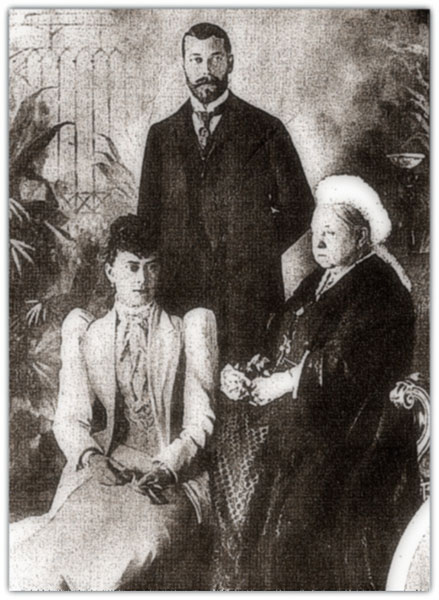
Princess Mary, Pictured With The Duke of York And Queen Victoria
The marriage of the Duke of York to Princess Mary was solemnised on Thursday, in the Chapel Royal, in the presence of Her Majesty, and a brilliant gathering that included many Royal personages and many others who are distinguished in our political and social life. London practically gave herself a holiday in honour of the event. The weather was delightful and the streets were richly decorated and densely crowded.
There were many local demonstrations of rejoicing as the bridal party were driven from Buckingham Palace, by Constitution Hill, through Piccadilly, to the garden entrance of St James' Palace. There were three processions made up of the Royal Family and Royal guests, the bride and bridegroom, and the Queen which all proved to be spectacles of splendour, grace and majesty.
The route was kept by some of our finest troops, and among these were Indian and colonial contingents, who were loudly cheered by people. The scene in the chapel was a memorable one, but none of the English noblemen present could equal the Indian princes in the picturesqueness and vivid colouring of their dress. The Maharaja of Bhownagar, the Maharajah of Gondal and the Maharaja of Kapurthala added much to the glitter and brilliancy of the scene. The diamonds worn by each of them equalled those worn by any three of the Duchesses present.
The ladies, too, were magnificently attired in Court dresses with extremely low cut bodices, but without trains or feathers. The dresses and diamonds were most resplendent and bright tints seemed to be the order of the day. Absolutely the last to arrive were the Prime Minister and his wife, Mr and Mrs Gladstone, the former walking with some difficulty with the help of a stick. By twelve o'clock the distinguished visitors had arrived and taken their seats.
Queen Victoria Looks Radiant
It was just half-past twelve when the sound of distant "hurrahs" gave the first signal that the waiting was over. Almost immediately after-wards the blare of the trumpets, sounding a fanfare, announced the arrival of the Queen, and the whole assemblage rose. The Queen was proceeded by only the Lord Chamberlain. She looked quite radiant, and responding with a pleasant smile to the formal greeting of the splendid assembly, walked unaided up the aisle, with the Grand Duke of Hesse in close attendance. Her Majesty had discarded for once the sombre raiment she always wears, and her black silk dress was entirely covered by rich lace. She also wore a low bodice covered with lace, crossed by the blue ribbon of the Order of the Garter, and wore several stars and decorations which were a blaze of diamonds. From her hood was draped white lace reaching almost to the ground, surmounted by the small diamond crown which she always wears on State occasions. Following at a short distance behind came the Royal visitors, representatives of foreign countries and the great officers of State. The costumes and uniforms of the English nobility had been brilliant in the extreme, but the foreign uniforms were simply superb, and made a dazzling display. There were the King and Queen of Denmark, the former in blue uniform and the latter in a white dress that was very becoming. The Princess of Wales looked as youthful as her daughter. The Duchess of Fife, in a white dress similarly made. The Marchioness of Lorne wore a bright shade of heliotrope, The Duchess of Edinburgh was in salmon pink and the Duchess of Connaught in sea green. The ladies-in-waiting, if at all possible, outvied their Royal mistresses in the gay colouring of their dress — violet, blue, green, rose, pink, and various shades of heliotrope adding to the display of colour.
Fanfares Announce Arrival
The guests had scarcely been shown to their seats when another fanfare outside announced the bridegroom, The Duke of York, with a good colour and radiant face, advanced between his father and uncle. The Prince of Wales wore his magnificent uniform of Lord High Admiral and the Duke of Edinburgh was attired as an Admiral of The Fleet. The Duke of York, in the less resplendent but very becoming uniform of a post captain in the navy, followed. There was another fanfare and a whisper of “the Bride" and in another moment the bride crossed the threshold — looking a perfect picture of youth and beauty. Her bridal dress was perfectly magnificent and she wore a small wreath of orange blossoms on her head, from which a veil hung down her back, leaving her face uncovered.
Behind were the ten bridesmaids in white gowns trimmed with pink flowers and they carried bouquets. |


