1994 - Page 26
Ollerton Was Closed 1994, After 69 Years
- Continued -
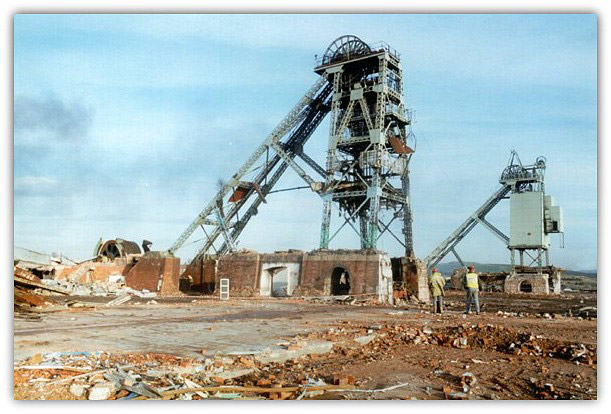
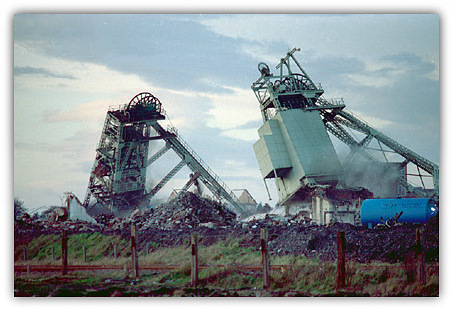
Ollerton Awaits Demolition 1994
 The choice of site for the sinking of Ollerton in 1923 was obviously a good one and Henry (Harry) Eustace Mitton, Agent for the Butterley Company (died on the eve of nationalisation 1946) who was charged with the task of sinking a new mine to the east of the coalfield would have been very pleased indeed to learn of its success after nationalisation. Working the ‘black gold’ of the Top Hard and Parkgate seams was very successful as was borne out by the incredible profits made both under private enterprise and nationalisation. The choice of site for the sinking of Ollerton in 1923 was obviously a good one and Henry (Harry) Eustace Mitton, Agent for the Butterley Company (died on the eve of nationalisation 1946) who was charged with the task of sinking a new mine to the east of the coalfield would have been very pleased indeed to learn of its success after nationalisation. Working the ‘black gold’ of the Top Hard and Parkgate seams was very successful as was borne out by the incredible profits made both under private enterprise and nationalisation.
Ironically, the last Group Director Brian Wright and the last Manager in charge Steve Wright (1994), were no relation to the Butterley Company Director Edward Fitzherbert Wright (to 1934) and Montagu FM Wright the first Manager of the mine (1923-1934), but the wheel had turned a full circle!
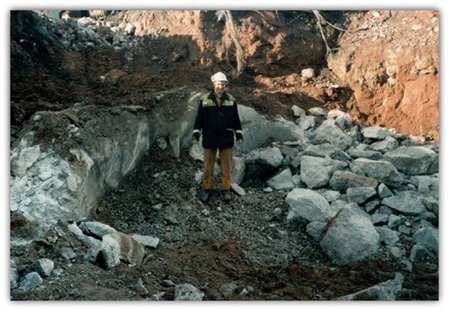
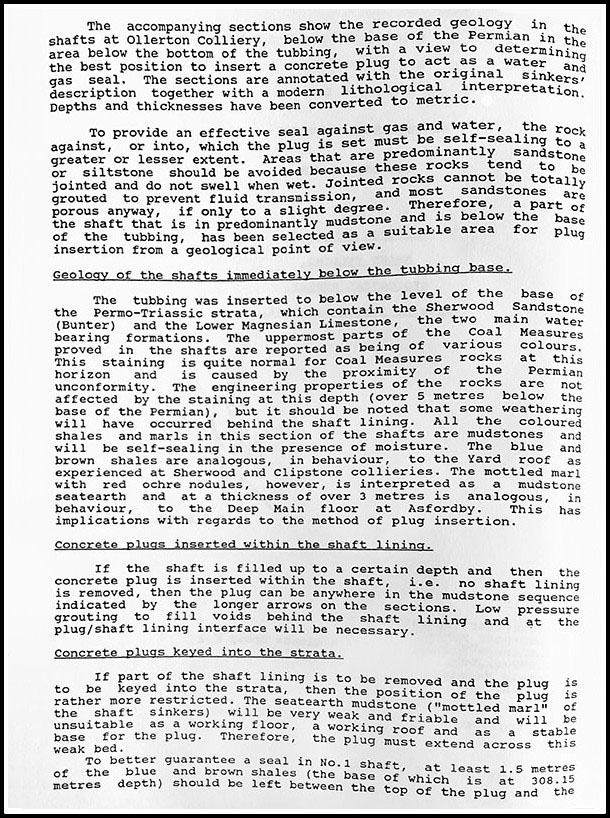
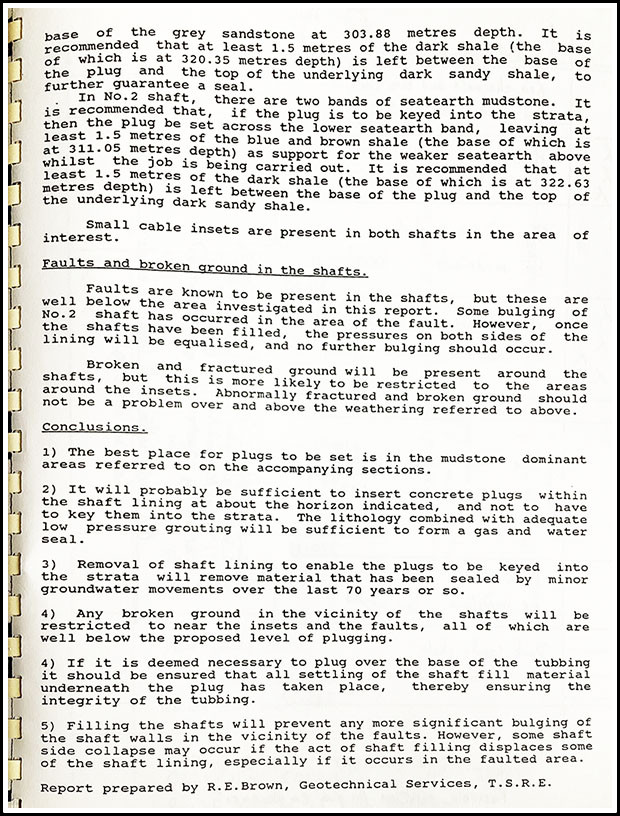
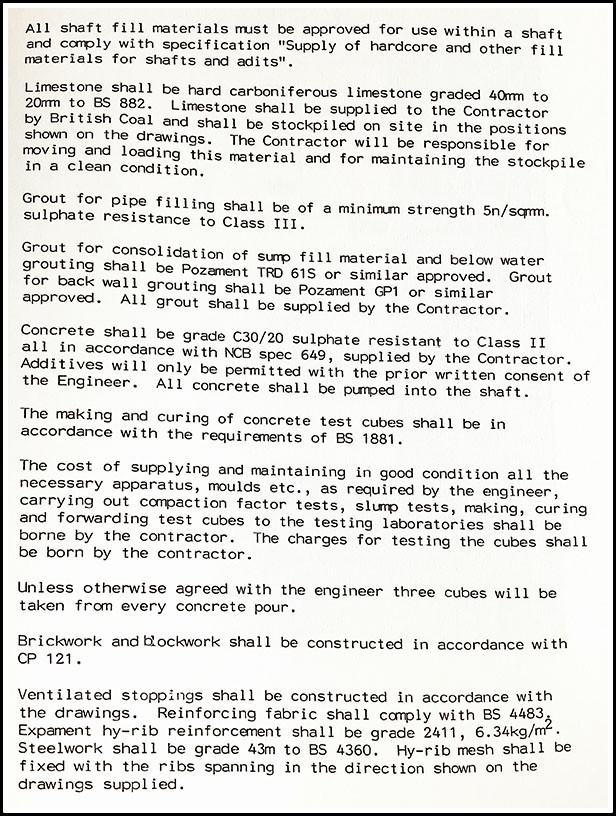
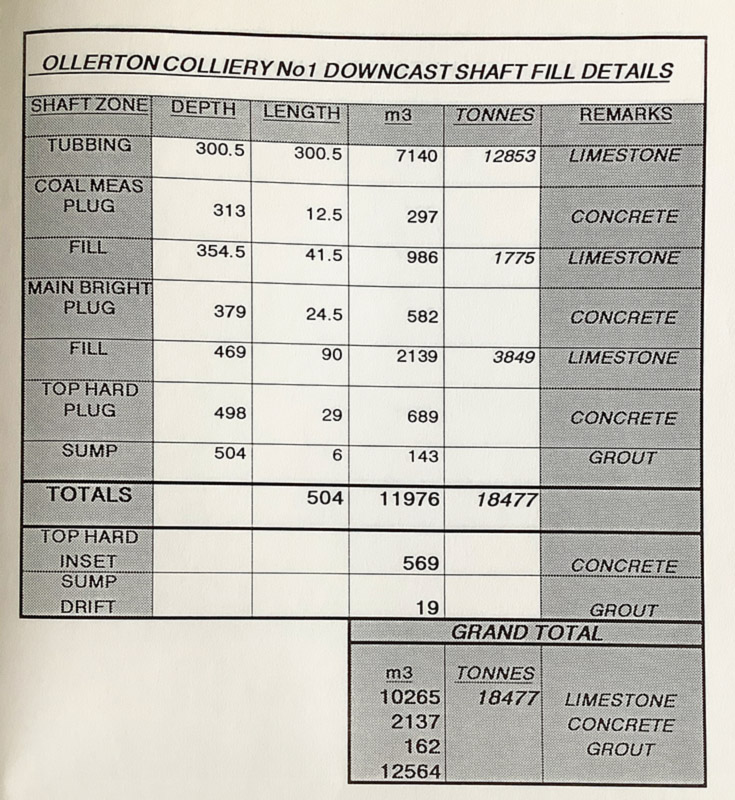
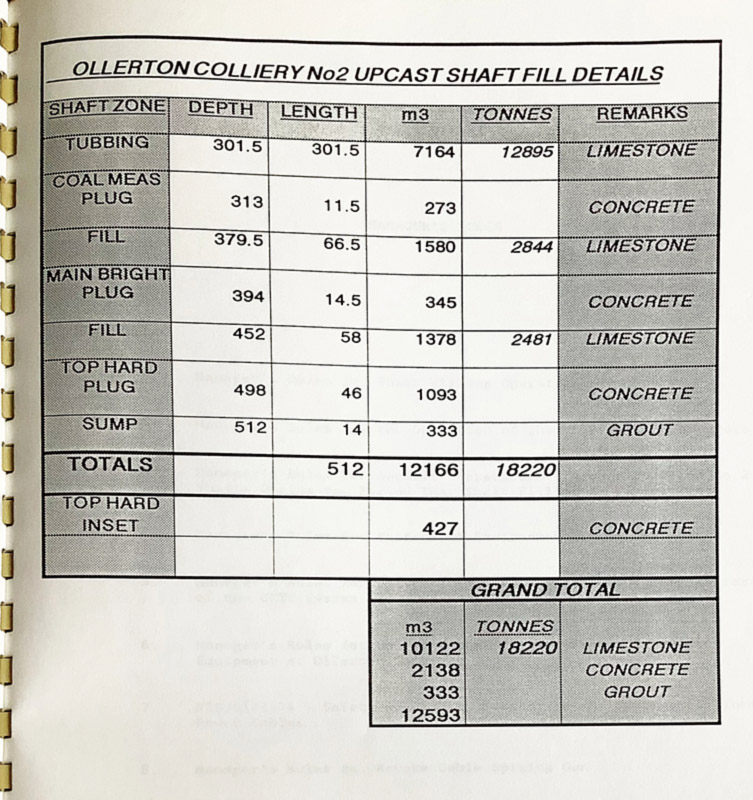
Both shafts were filled with limestone chippings with concrete at sump and pit bottom and inset levels and fan drift with stoppings walls built previously at these positions.
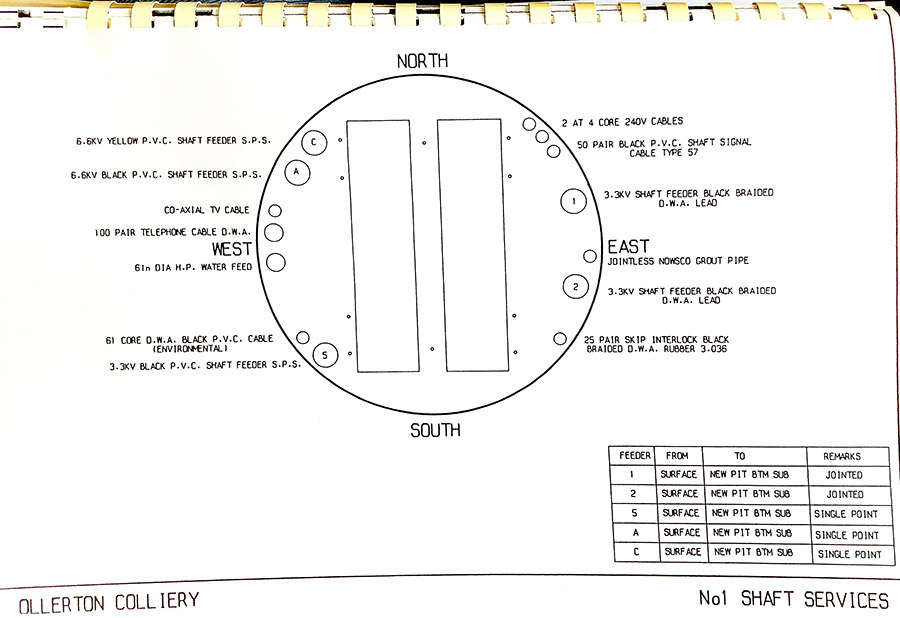
 The shaft equipment at No1 shaft West side: prior to filling consisted of two 3.3kv feeders (one jointed and the other single point suspension), two 6.6kv shaft feeders (both single point suspension), co-axial TV cable, 100 pair telephone cable, 61 core environmental cable, 25 pair skip interlock cable, East side: two 4 core 240v cables, high pressure water feed pipe, and a jointless Nowsco grout pipe. The shaft equipment at No1 shaft West side: prior to filling consisted of two 3.3kv feeders (one jointed and the other single point suspension), two 6.6kv shaft feeders (both single point suspension), co-axial TV cable, 100 pair telephone cable, 61 core environmental cable, 25 pair skip interlock cable, East side: two 4 core 240v cables, high pressure water feed pipe, and a jointless Nowsco grout pipe.
Each cage/skip had 4 conductor ropes to outside plus 2 rubbing ropes between the skips hung with cheese weights. A balance rope connected the two skips. Winding ropes plus bull chains etc attached to each skip.
At No2 shaft West side: two 4 pair Interlock cables, 6.6kv yellow pvc single point suspension, Unor tube bundle cable, Rising main water pipe, two red 6.6kv pvc shaft feeder cables, single point suspension, 3.3kv shaft feeder, single point suspension, two 4 core push button winding cables, East side 50 pair signal cable, 3.3kv yellow pvc shaft feeder, single point suspension, water pipe, 91 pair telephone cable, white plastic conveyor control cable 30 pair. Each of the 2 cages had 4 conductor ropes down each side and 2 rubbing ropes between the cages, all hung with cheese weights.
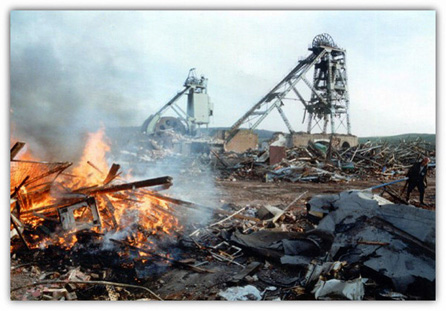
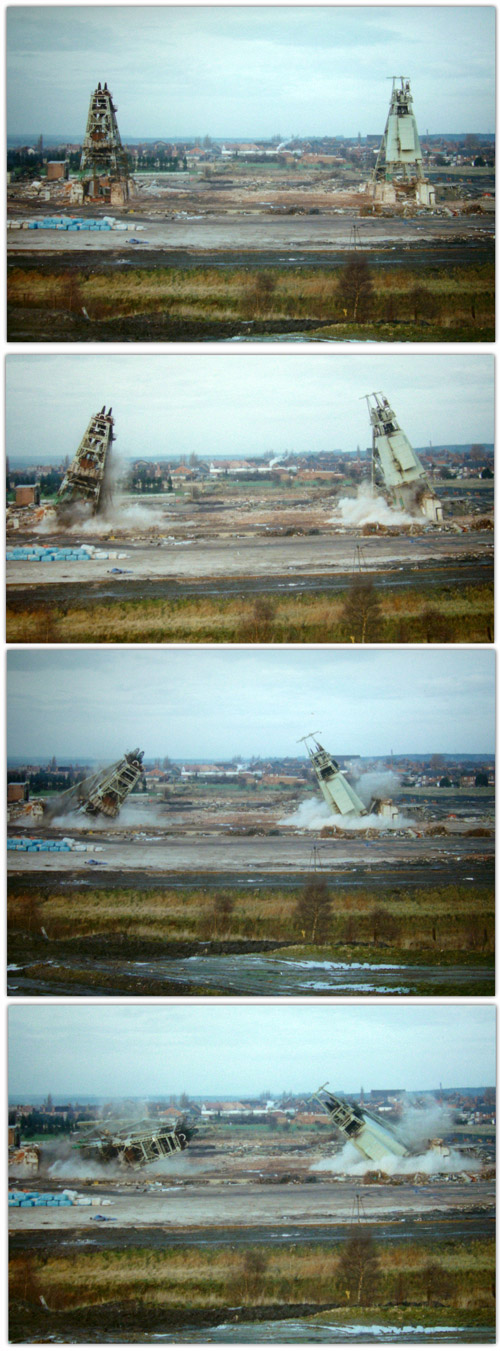
The headgears were demolished by controlled explosion at 3pm on 20th December 1994.
I heard the bang but missed the sight. I was at Bilsthorpe that afternoon. I was deeply disappointed.
A large heap of coal around 200,000 tonnes was stored on the sidings and RJ Budge the new owner from 1st January 1995 would benefit from the windfall when selling to the power stations.
Main Bright Seam Headings
Referring to the Main Bright seam development headings at Ollerton driven during 1943-1946. As I mentioned earlier I made arrangements to access the seam and was accompanied by the Deputy Manager, Undermanager, Mechanical Engineer, Electrical Engineer, an Assistant Surveyor and Ventilation officer all who had expressed a desire to see the workings as like myself they had no idea the headings existed. It was one Saturday morning and the shaftsman Eric (Slog) Harrison a blacksmith was to organise our getting off the cage at the inset level. However when the cage stopped at the inset some 100 yards (90m) above the Top Hard pit bottom we were told that the drop gate that allowed you to walk from the cage into the inset had seized up and could not be lowered. Slog casually breached the gap between cage and inset and grabbing each one in turn pulled us across the gap. I remember seeing a fleeting glimpse of the lights below. We were all thankful to be on safe ground, none of us relishing the thought of the journey back when we had to jump across the gap into the cage. Anyway we all ventured into the unknown armed with oil lamps, smoke tubes and a canary in a cage. We tested for blackdamp and firedamp and watched the canary. We were taking no chances as these headings had not been examined for years although they should have been as there was a small flow from one shaft to the other. We shortly came across a set of doors that needed opening to access a steep 1in2 drift from one pit bottom level in the No2 UC shaft to the other pit bottom level in the No1 DC shaft. This was where a large fault passed through the shaft found in the sinking in 1924. Of course there was great pressure on the doors being that the shafts were only 80 yards (75m) apart and it was a good job that there was several of us to put some shoulders to them to get them open. The hinges were rusty of course. Surprisingly the roadways were in good condition apart from water drippers and a few rotten boards. We were able to go round the circuit and examine the headings some of which were deep in water. Anyway with help we measured all the roadways with a tape so that when back on the surface I could check to see whether the lengths of the roadways were correct as shown on the plan I had found. I had to estimate some distances where the roads were waterlogged by counting the arches, knowing that the distance between arches was 3ft (0.91m).
On the following Saturday me and my assistant went back with help once more to check level all the accessible roadways using a mark at the inset level which we used later after measuring the shaft. Some roads had not been levelled before and some of the levels showed substantial floor lift. Assuming that the access roadways had been set out using magnetic bearings as a line with a value was shown on one of the plans I had found. I made a new flat sheet plan and replotted the roadways and came to the conclusion that they were in the correct position allowing for any error being within the rules laid down in the Code of Surveying Practice. As stated before this seam should have been abandoned in 1946 and the abandonment plan deposited through the Mines Inspector. To save any major queries Percy Hett (2111) in charge of the Mining Records at the time agreed to accept the plan as an extra to the Top Hard abandonment plan in 1979. Guy Adamson (5391) was Inspector and he asked how many plans there were? I said 29, but he said that he had to count them himself. However the sectional flat sheets of the mine plan were aluminium covered with cartridge paper and quite heavy. He dragged them to the edge of the table and lifted them one at a time and began counting. One, two, three...oops they slipped due to the weight. He started again. One, two, three, four...oops, they slipped again. He pushed them to one side, gave me a sly grin and said ‘29’ and wrote it on the form. I couldn’t stop laughing.
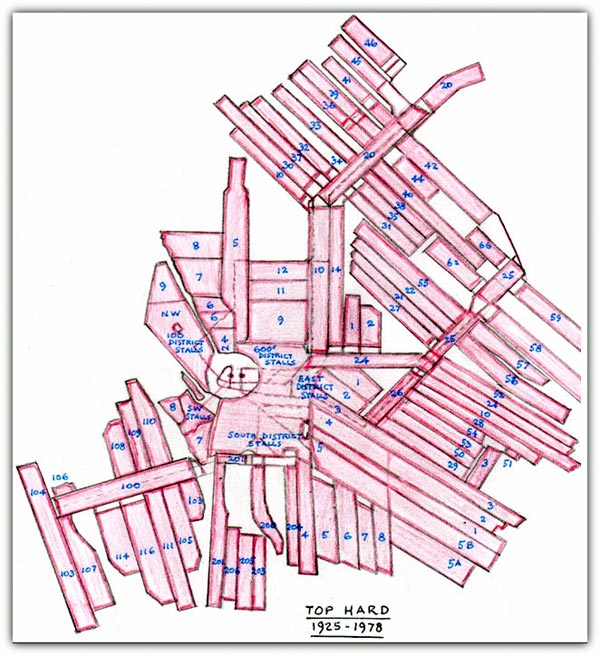
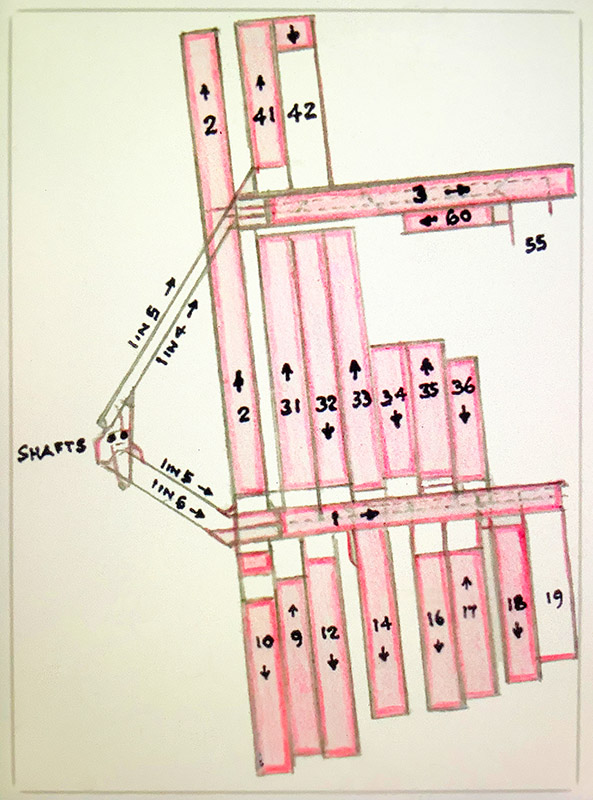
Parkgate seam workings 1976 to 1994
Ollerton 1994 Shafts Closure



Click Plan To Enlarge - Double Click Plan to Reduce Size

NUM Banner Returned And Restored
 The NUM banner made about 1950-1951 depicts a bond between the NUM and the Australian miners (note the Kanagaroo behind ‘Digger’). Prior to the making of the banner the Australian miners were out on strike for some considerable time over conditions at the mines and the NUM backed them and also the dockers in London refused to unload Australian ships. That is where the comradeship came from. The NUM banner made about 1950-1951 depicts a bond between the NUM and the Australian miners (note the Kanagaroo behind ‘Digger’). Prior to the making of the banner the Australian miners were out on strike for some considerable time over conditions at the mines and the NUM backed them and also the dockers in London refused to unload Australian ships. That is where the comradeship came from.
During the Miners’ strike of 1984-1985 when the majority of Nottinghamshire miners and a few in other Areas were working, they were picketed strongly particularly by the Yorkshire flying pickets. Police were drafted in from all parts of the country to quell the violence, and injuries on both sides were reported. During this period the Ollerton banner was ‘stolen’ and a piece cut out of the middle. The banner was found rotting in a garage in the south of England and returned in that state by possibly someone with a conscience. It was repaired on behalf of the ‘Ollerton of Yesteryear’ members at a very high cost having first being ill repaired. However it was rededicated at a service at St Paulinus Church on Sunday 12th May 2013 at 11am and is now in a frame in the Church. Unfortunately although invited to the ceremony I was unable to attend owing to a prior commitment.
Staff Personnel Ollerton at Closure in February 1994
Bagshaw, Paul. Store
Baker, Ken. Mechanical Engineer
Bradford, Paul. S & C Manager
Bradford, Paul. Supplies & Contracts Manager
Burns, Ian. Time and Wages
Clarkson, Mark. Stores
Coope, Mark. Stores
Cooper, Eddie. Asset Manager
Cooper, Eddie. Deputy Engineer Assets
Davies, Steve. Time & Wages
Fifoot, Tim. Under-Manager
Fitzackertey, Harry. Electrical Engineer
Fox, Nigel. Surface Superintendent
Francis, Ruth. Typist
George, J L
Grant, P W
Hall, Gordon. Computer Manager
Hill, Keith. Assistant Under-Manager
Hill, Pete. CAD Survey
Houghton, Dave. Stores
Jest, Mick. Training Officer
Lindsay, Steve. Finance
Lunnon, Steve. Planner (Geologist)
McLennan, Steve. Under-Manager
Morris, Stuart. Safety Engineer
Newton, Mick. Deputy Electrical Engineer
Nicol, Jim. Ventilation Engineer
Orchiston, Mick. Colliery Manager
Palmer, Jim.
Rathbone, B.
Searson, Andy. Deputy Electrical Engineer
Selston, Janet. Nursing Sister
Shaw, Philip. Deputy Surveyor
Sheppard, Gary. Deputy Mechanical Engineer
Sisson, Kev. Time & Wages
Slater, David. Deputy Manager
Slater, David. Deputy Manager Services
Stevens, John. Finance, Colliery Accountant
Stewart, DR
Terry, Dave. Personnel Manager / Employee Relations
Thomas, Jed. Assistant Surveyor
Walker, Dave. Head Weigh Man
Watson, Steve. Surveyor for the Mine
Whitmor, P. Coal Prep Manager
Whyatt, John. Deputy Manager
Wilmot, Alan. Apprentice Surveyor
Wood, Dave. Full Weigh Bridge |