A Unique History From My Work Diaries - 1953 - 1990
Surveying Jobs
No4 Sub-Area, No4 Area, East Midlands Division, NCB from 1st January 1947
Page - 2 -
I left Queen Elizabeth’s Grammar School, Mansfield in June 1952 and was employed as a trainee Architect at Warner & Dean, Sutton in Ashfield for 6 months where I learnt the very basics of measuring properties with a Clerk of Works, Sam Watson, who just dropped me in it up to my neck by saying ‘ Get on with it … Have you got me? That was his standard phrase and we went to varying places around Sutton in his big black car with ‘running boards’ and a wandering steering wheel as Sam always concentrated on stoking his pipe with tobacco and trying to light it as we snaked down a road and he continually had to adjust the steering to avoid hitting a kerb or grass verge. Of course there was very few vehicles on the roads at that time. Some of the places within 20 miles radius I had never heard of, and I would be left to measure up a job whilst he was inside the house having a cup of tea. On two or three occasions on the way back to the office he stopped the car, gave me a couple of shillings for bus fare to get back and drove off. Where to I don’t know, because he never said. I had to find a bus going to Sutton obviously. On one occasion two buses, the first one to Chesterfield then on to Sutton. I always found my way back to the office eventually, even on one occasion to find him sitting there. No explanation! Whether these were initiation tests or what, I don’t know. Anyway I survived. I was taught the basics by the architects in the office, Ken, Brian and Bob and another Brian? and overseen by Frank Shepperson, Chief Architect. I learnt the art of preparation of plans, use of drawing equipment and pens and tracing, calculations, use of a printing machine and hand washing the prnted copy with the ammonia medium using a sponge, tuition on how to hold a staff and a ranging pole then how to use a Levelling instrument and a Theodolite etc. Following that initial period of training I was offered a permanent job but that meant paying the Architect articles of 3 guineas (£3.3s) per week. That was impossible as I lived with my grandparents who were pensioners and could never ever afford to pay such an amount so I was advised by the Architect George Warner (who used to be a Mine Surveyor at New Hucknall in the 1930s) to apply for an apprenticeship with the National Coal Board and he arranged an interview for me with Tom Bush, Area Chief Surveyor at Edwinstowe HQ who said he could offer me a job but then asked me how I would get to Harworth? Had I got a motorbike? I hadn’t. At that time I had never heard of Harworth or knew where it was. Some of the other pits in No3 Area were slightly remote also and not on a regular bus route from Sutton for starting time. He said I would be better getting a job in No4 Area with HQ at Huthwaite with pits that were nearer home and on local bus routes so he arranged an interview for me with Leslie H Watson Area Chief Surveyor who offerred me a job. I was able to furnish a letter of good character from Harold Neale MP for Bolsover who had known me from a young boy, living next door to Uncle Jack. The following week I received a letter instructing me to attend Bentinck Training School, but two days before I was to start there I was notified to attend Silverhill Training School instead. It turned out to be very fortuitous because had I been sent to Bentinck Colliery Survey department for example where they had a large team of survey staff I could have been one of about 5 on the staff plus experienced Linesmen who used instruments and I would not have achieved the experience that I got in the Teversal Group of pits. I had been down Shipley Woodside pit when I was 10 so I had no fear of riding the shaft like some of the lads who had to be consoled by the Instuctors, even one 15 year old crying with fright as the cage dropped down the shaft and I could just hear the puff puff of the steam engine for a second or two. The lad was even more terrified as the 2 cages rushed by one another at the halfway point in the shaft.
I attended Silverhill Training School 22 Dec 1952 to 12 April 1953 … doing 54 underground shifts … and was taught all haulage duties such as clipping on, dogging and undogging and lockering tubs etc. There was a small coal face and work included shovelling coal, setting wood and steel props and W bars and wooden chock supports with steel quick release, packing, conveyor erecting and dismantling, pony handling in the Training Gallery. I had a couple of shifts drawing off rings in old abandoned Threequarter workings nearby. I had a visit to the Yard seam and also to 71s panel in the Deep Hard seam where I saw my best friend Ron Clayton casting ripping dirt into the right hand packhole whilst the chargeman Joe was standing on the ripping heap sweating and saying … ‘I’m absolutely lathered’. Ron with his quick humour said ‘He’s sweating, not because he’s done any work, but because he might have to do some!’. The instant one liners in a pit were precious, a sort of skill only found in mining.

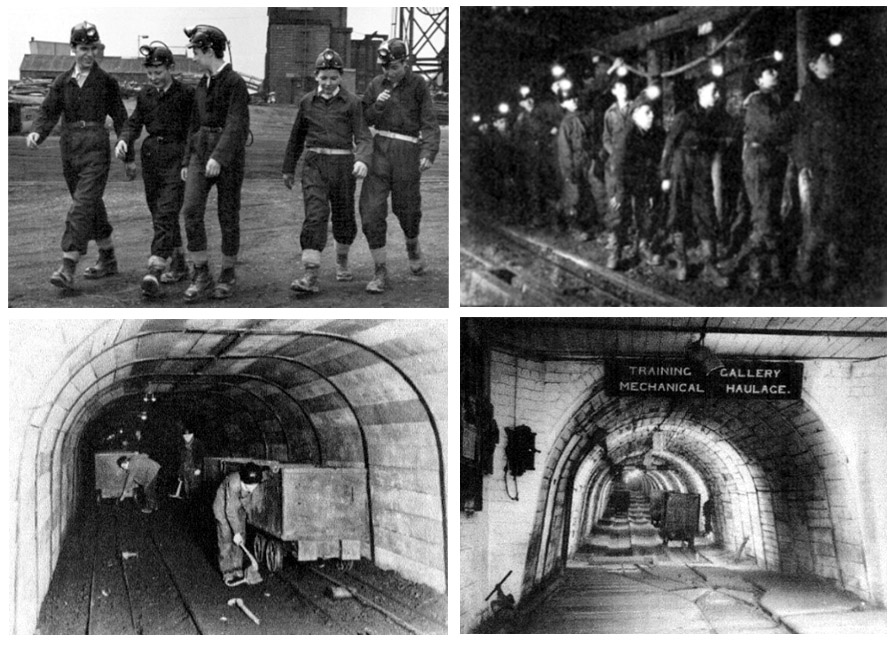
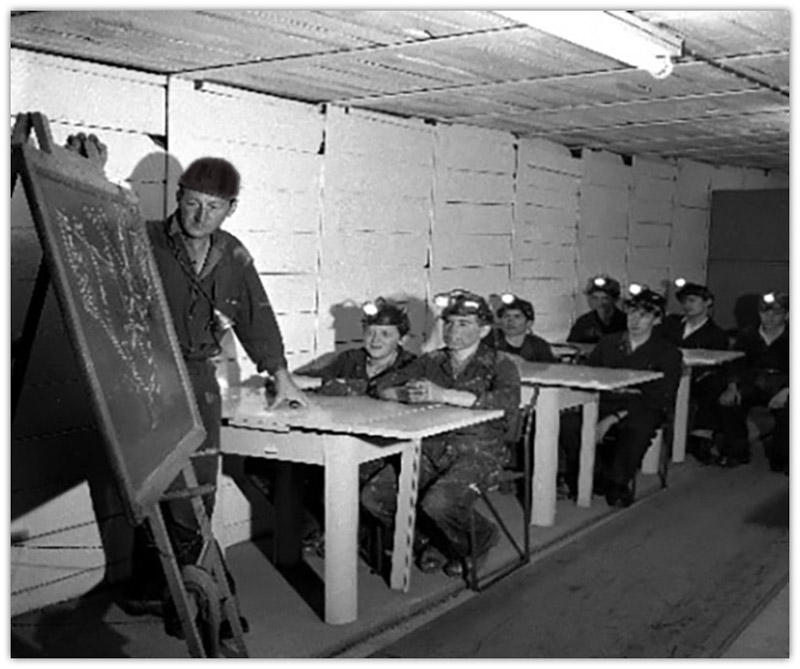
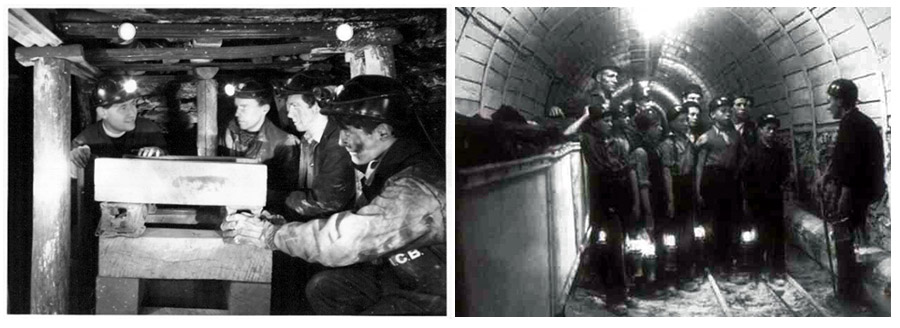
Two other trainees at same time as me had signed on at Pleasley but would later join the staff and Dennis Jackson did qualify as a Surveyor. Dougie Crofts was the other Linesman who became a Surveyor’s Assistant later stayed at Pleasley till merged with Shirebrook until that closed in 1993.
Two days a week was spent at the Technical College, West Gate, Mansfield for theory of mining, maths etc and I excelled in that. I also had to construct a spanner in the workshop from a solid piece of steel and then back at the pit we also had practical lectures by the Instructors in the underground class room in the Training Gallery. Horace Marshall was the Chief Instructor and others included Bill, Sam, Tom, and Arthur as I remember. Our course lasted 16 weeks for under 18 year olds but those entrants aged 18 plus only had 3 weeks training. (total now 54 + 1 u/g shifts)
We all had a separate oral exam with Horace Marshall and the Undermanager Mr Eley asking the questions. I got 199 out of a possible 200 points but didn’t know at the time. On the last day I was picked out to escort a run of 4 tubs into No2 pit bottom from the Training Gallery. I felt quite proud being chosen for such a task out of all the trainees. I put some wooden lockers in the run of 4 tubs (laden with bricks and coal and stone dust and all the contents of the latrines over the 4 months). Pong! The tubs were destined for the dirt tip. I had put a Star clip on the back of the run and a Smallman clip on the front after removing the dumpling safety block. I took out the lockers as I started the automatic haulage up with a signal of 2 rings. At the bottom of the gallery I brought the engine to a stop by ringing one on the bell wires. I put a wooden locker in one back wheel of the 4 tubs then took the Smallman clip off the front and then I went to the back and knocked the Star clip off the rope with a steel bar and as I did so due to the weight in the tubs they started to move forward slowly at first down the slope and suddenly a wooden locker at the back snapped under the strain and the tub banged into the next one and the next one and all the lockers had now snapped. The tubs began to approach the junction and I ran to the corner, picked up several more wooden lockers from a pile and as I deftly put them into the spokes of the tub wheels they snapped like carrots too and now gathering speed the tubs went round the curve out of the gallery onto the coal road. Three of the Training Instructors ran after the tubs and hung on the back tub to try to stop the run but the weight was too great and the 4 tubs hit some tubs of coal at the squeezers or Jack catches and in doing so the last tub flirted up in the air and cast detritus all over the place. It was mayhem. The instructors had been shouting and waving their lights to attract and warn the Onsetters at the shaft side and they took action and ran out of the way. I went to ground whilst Horace Marshall the Chief Instructor was trying to pacify the Onsetters who were letting 2 tubs of coal a time run run from the sqeezers onto the chair to knock 2 empties off to the other side. I was exonerated because I had placed several wooden lockers in the wheels correctly as the tubs careered round the junction but they had all snapped. The wooden lockers were so dry they had no strength and were scrapped and steel ones were used in future.The smell was there for days so I was told. That was a close call for getting blamed for something …. but it would get worse!
There was a ceremony at Bentinck Welfare on 13 April 1953 where I was presented with a mantelpiece clock by Harry Hicken NCB Labour Relations Officer for being the best trainee of the session. It was quite a shock when my name was called out as I had no idea of my achievement. Even so next day I attended work at Teversal office where I was asked why didn’t I come to work after the ceremony? !!! I didn’t know until that day where the office was. I knew it was only about ¾ of a mile from Silverhill to Teversal because I had seen the steam from the winding engines when going down the gantry. As before I caught a Midland General bus on Mansfield Road Sutton opposite where I lived with my grandparents but this time just before 8am and not 6am and alighted at the Carnarvon Arms PH and walked the ½ mile or so to Teversal Colliery where I was escorted upstairs to the Survey office by the Clerk.
It was a 5½ day week until the Saturday voluntary coaling shift finished in 1957.
Apr 1953 Date in bold and U/g denotes underground shift and in the bracket are the person’s initials). Invariably after most u/g shifts various work would be done in the office and some jobs not mentioned, particularly in my early career.
Tues 14 … Office … Introduction to all the staff by Clary Skeavington. Norman Smedley the Pleasley Surveyor with a wink in his eye to the others asked me ‘What is that in the corner near to where I sit?’ ‘It’s a fire’ I replied and he added ‘As long that fire is up the chimney back my lad when we come in a morning, you’ll be alright’. It was still a bit cool and I noted that the large office would take a lot of heating and a fire was to be additional to the radiators.
General familiarisation to the office and facilities and tea mashing etc. Instruction with a drawing pen and tuition on paper showing the 360 degree compass and quadrant bearings etc with Denis Hill my boss and his Assistant, Keith Mitchell.
We had our half hour snap time in the Sutton office and played a few hands of cards, a game called Crash and for the first two weeks I got fleeced every day until the penny dropped and I was as smart if not smarter than them and began to win. Throughout the years a game of cards at lunch time made the mind sharper for the afternoon session. When I became a boss we played Cribbage, Solo and others but probably the game I loved most was Black Maria because it was exciting. All my Assistants and Apprentices were taught these games with the object of me trying to take money off of them. I was always pleased when they started to win because I knew then that they were thinking sharper like I did all those years before. When I started work as an Apprentice Surveyor in April 1953 I knew most of the basics which were similar to the Architectural work. I never mentioned that I could use surveying instruments or do plan work so my new bosses seemed impressed when I was able to do jobs with very little ‘training’ ….. and it was very obvious when I started at the Technical College in September 1953 and even a couple of years further on that I was far more advanced practical wise than any of the others in the class as they had not had the opportunities to use instruments or do jobs in the pit or office on their own. Note the number of shifts with just 2 men, me and another. At all other pits the complement would have been no less than 3, if not 4, so the other lads told me at the Technical College.
All jobs underground or surface at Teversal Colliery unless stated otherwise until Feb 1971
* Denotes in charge of a job or using an instrument or alone.
The 5 or 6 faces and a couple of development headings working at Teversal were in the Dunsil seam and handfilled by colliers using shovels and picking large lumps by hand onto top belt conveyors on the coal face, the coal having been undercut to 5 ft 6in with an AB 15 coal cutter with jib and usually 1 or 2 shots exploded by a Shotfirer using a ‘Little Demon’ battery exploder. A stint of 8 yards yielded about 20 tons per man in a seam height of about 3 feet. In some areas 7 or 8 inches of top coal was left up due to scabby mudstone roof or inverted pot holes that had a slickenside surface like glass with no adhesive power at all and crashed down frequently. Of course the colliers were wary of them and took precautions to avoid getting hurt. Rigid steel props with wooden cap lids and steel W bars were set at max 4 feet apart. In several parts of the pit the coal was washed out in irregular patterns and replaced by solid sandstone and impossible to mine at the coal face so the working skirted round the edge of it or that face had to be abandoned. Wooden pit props and wooden split bars were used occasionally in bad ground areas as extra supports. The coal was loaded onto a gate belt delivering to a loading point in the gate where empty tubs were filled with coal then in runs of 4 were clipped onto the gate haulage and taken to the end of the gate to be clipped onto the main road haulage rope on the way to the pit bottom. Generally 5 turn overs per week Monday to Friday on Day shift with a voluntary shift on Saturday morning on some panels making 6 cuts, (that was until 1957 when the Clean Air Act was passed and coal production dropped and Saturday working ceased). Ripping the gate and gate side packs of about 6 yards and packs of 3 yards built and 8 yard wastes along the face line usually on Afternoon shift and cutting and some maintenance on the Night shift, a fairly regimented routine. That carried on until 1966 when the Power loader Agreement came in and all handfilled faces on contract ceased then or when the face finished.
A steel ‘Bobby’ would cover all panels in the week to make sure that steel props and bars were not left in the gobbin, particularly where 3 yards packs were built and 8 yard wastes. A man got fined for doing so unless it was for safety, usually agreed by the Chargeman and the Deputy. At one period 15s Dunsil water infusion would be used as an experiment for breaking the coal down instead of explosives and later on 30s compressed air as another alternative.
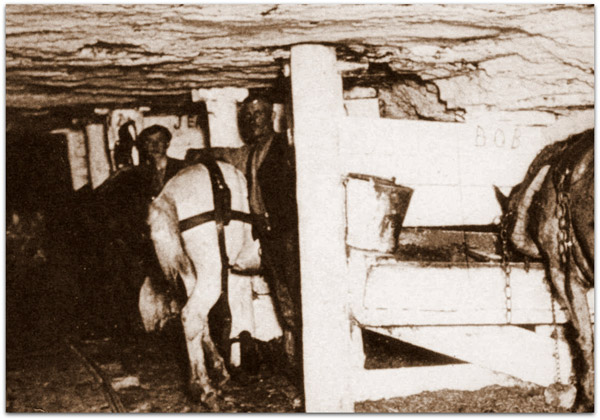
The Stables were in Top Hard No1 pit bottom and the Ostler was Tommy Smith who’s other duty apart from looking after the ponies was to be Onsetter at the No2 Shonkey shaft. Because we had completed our surveying tasks and generally in the pit bottom by 12.30 to 1pm on numerous occasions and although we were staff people he would refuse to leave the Stables, saying he was busy, so unless you waited until 2 pm or later to come out of the pit with the dayshift men which I did on occasions you rang yourself out of the pit (completely illegal of course). There were about 10 pit ponies on supplies in the Dunsil seam workings when I started, occasionally obstructing our jobs in the gates. They were also used in the Waterloo seam on supplies from 1957 / 1958 before small Pikrose engines were installed. A bit of ancient and modern … ponies on supplies and a modern Anderton shearer coal cutting machine loading coal onto a panzer (armoured face conveyor) on the face. Two ponies were kept on salvage duties in the Dunsil seam when that was abandoned in 1969 and would be the last to be brought out in the North Nottinghamshire Area in July 1970. On a couple of occasions I assisted in catching or trying to catch the ponies somewhat cowboy fashion by lassoing them with a rope after several of us including the Ostler had herded them into a corner of the Pit Lane field where they had been released from their underground drudgery for two weeks during the pit holiday period. It was lovely to watch them frolicking about in the field but what a difference when the holiday period was over and they needed to be sent down the pit again. They seemed to know of their fate and resisted catching at all times. Eventually each one was caught and a hood placed over its head so that it could not see where it was going and then gently walked from the field across the pit yard and tied in the cage, each one in turn separately and lowered into the 217 yards deep pit on the slow speed and then led back to the pit bottom stables in readiness for starting work again on the following Monday. They were very well looked after and practically all the gangers were extremely kind to them bringing tid bits of carrots and apples and such for their daily snap time where they had the nose bag or ‘leather bucket’ fastened round their neck to be able to eat their chaop etc. At one time until eradicated by poison in the late 1950s dozens of rats infested the snap time areas where they lived on the pony food droppings and carelessly thrown away bits of bread etc. My first boss Denis, of the old school, insisted that we knocked off for our 20 minutes snap and on occasions I remember sitting in a switch house where we attempted to catch rats and sometimes did by using a large piece of rock or bind pulled out of the pack side and carefully balancing it on a stick of wood, say a split piece off a cap lid and fastening a length of millband string to it. We would place a bit of bread or meat or cheese under the stone and sit there with our cap lamps on pilot bulb and wait for a rat to emerge from the packhole where they lived and cautiously creep towards the food. With great dexterity we would in turn yank the string pulling out the stick and in doing so squash the rat. That was the plan, but on numerous occasions the rat would sense what was happening and escape, however they always came back, the food being too tempting for their sparse existence. In the 1953 holiday period we and others caught several and threw them into an empty tub nearby. At the end of the holiday the stench of the dead rats was indescribable, a smell never to be forgotten. Pleasley was joined to Teversal Top Hard by a common goaf and had rats too. At Silverhill we would catch mice. There we would use an empty glass bottle. Placed on its side and armed with a bit of bread, cheese or fruit the mice eventually would be tempted in and were caught in the bottle as they could easily get in but found it difficult if not impossible to get out up the inner slope of the bottle. It was different, because you never find rats and mice together in the same pit. There was only one pony at Siverhill and that was in the Training School. I think they had mice at Sutton as well as they had pit ponies in both Piper and Low Main workings. I was told that the vermin found their way into the pit in the bales of straw or pony food being sent from the pit yard store where all the food for underground was prepared, generally a mixture of straw or hay, beans, peas, chaop and so on sent down the pit in tubs to the stables where they spread and multiplied and followed the ponies inbye.
Manpower 786 underground and 166 surface men. Output was usually round about 7,000 tons per week.
Panels working were 10s, 20s, 40s, 50s, 60s, 70s, 80s (the latter 2 panels almost finished)
Abbreviations used:
LG or DG denotes Loader Gate or Delivery Gate.
LH denotes Left Hand Supply Gate. RH denotes Right Hand Gate, TG denotes Top Gate and BG is Bottom Gate. MG is Middle Gate. AW is Airway or Supply Gate. TG is Tail Gate, again a Supply Gate for materials. |