A Unique History From My Work Diaries
Surveying Jobs
North Nottinghamshire Area from April 1967
Page - 40 -
Feb 1971 - Page 2
Part 3 - First Assistant Surveyor at Ollerton
Mon 8 … I transferred to Ollerton from Teversal as Senior Assistant.
Albert Littler transferred from Silverhill as Assistant Undermanager at Ollerton on the same day.
We were both allocated a Locker in the Official’s Shower Room in the Pit Head Baths.
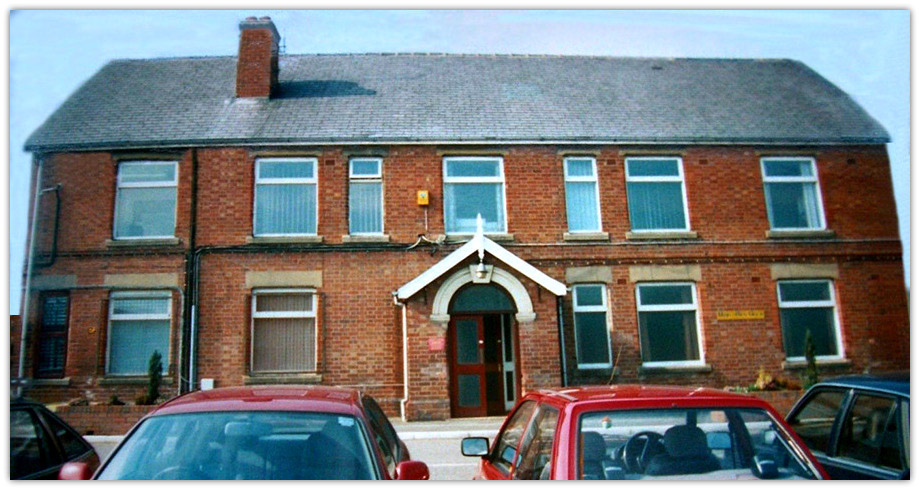
Front View of the Office Block Built 1927
Description: - Entrance door to corridors on the ground floor and up the stairs to corridor and other offices. The large first storey Survey office was adjacent to the rear of the Manager’s Office, end right window that had a Clerical department adjacent. The Deputy Manager’s Office was situated along the corridor to the left, along with offices for Electrical Engineer Alan Sinclair, Deputies Jim Goodwin and Peter Noone and Mechanical Engineer Wilf Pearson and Deputies Jim Hooley and George Hartley, and a small Conference room at the top left. The Wages department covered a large part of the ground floor to the right and rear and a tiny Office adjacent at the front entrance door accommodated the Cost Clerk and his Assistant, Stuart Farnsworth and Mike Furniss.
The Undermanager Jack Taylor’s office was in the Green Hut to the right adjacent to the office block plus an office for his Clerk, Peter Crawford. Other accommodation was for the Training Officer Brian Wormald and Assistant Colin Marshall, Safety Engineer Bill Prothero and Safety Officer Len Collins, Fire Officer Bill Maun plus an Office for the Ventilation staff, Alan Blyton, Ventilation Officer, Tony Tryner, Assistant. Also Dust Suppression Officer Bill Stafford and Sos McKay, Methane Drainage Officer. A Canary aviary with about half a dozen birds was also in the building. Ted Hodgson, Surface Superintendent had an office adjacent to the Stores building up the Pit yard. Peter Longden was the Coal Prep Manager and Ken Burns Assistant and their office was located in the Coal Prep Plant. The time office and check board was situated in the Lamp Room until the new Time & Wages office was operational in 1972.
Later office changes: Top Left window Deputy Manager, bottom left Undermanager and a separate office adjacent was the Undermanager’s clerk, second left upstairs, Mechanical Engineer, bottom second left, Assistant Manager then later in 1977 Electrical Engineer. Top right Manager’s office, second top right Admin Officer, Bottom right windows Conference room. To the rear of Conference room, Survey office, to rear of 3rd right ground floor Surveyors office, next door Bathroom for 6 officials, above top rear, Manager’s bathroom, top left rear Costs dept, bottom left rear Assistant Manager Development. At the top of the stairs was a small tea mashing facility for the Management staff.
David Rodden General Manager, David Oliver Deputy Manager, Jack Taylor Undermanager, Derek Stephenson, John Ross and Albert Littler, Assistant Undermanagers. Overmen were Ray Flint, Frank Clarke, Roland Rose, Alan Dolphin, Roy Nunn and Ken Boundry.
Introduction and Synopsis
Ollerton Colliery Survey staff W Keith Houghton Surveyor (since 1959) (WKH), Assistant was self
 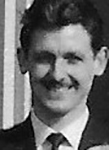 I (RB) started 8 Feb 1971, Kevin Bradley (KB) Apprentice, Paula Routledge (PLL) Lady Tracer. Supervisory Linesman just joined WPIS, Dougie Stockham (DS). 6 Linesmen … David Evans (DE), Hadawi Abdul Razak Al Rekabi BSc (Hadi) (HAR), Stefan Bak (SB), Jim Gill (SMG), John Gilroy (JG), Billy Humphries (WH). I had replaced Barry Flint who had left to North Derbyshire Area HQ Computer department / Planning. I (RB) started 8 Feb 1971, Kevin Bradley (KB) Apprentice, Paula Routledge (PLL) Lady Tracer. Supervisory Linesman just joined WPIS, Dougie Stockham (DS). 6 Linesmen … David Evans (DE), Hadawi Abdul Razak Al Rekabi BSc (Hadi) (HAR), Stefan Bak (SB), Jim Gill (SMG), John Gilroy (JG), Billy Humphries (WH). I had replaced Barry Flint who had left to North Derbyshire Area HQ Computer department / Planning.
The Survey Office had a very large table for plan work (similar to the one at Teversal when I started work) and a small table for the Surveyor. There was no plan safe and the Working plans of the mine were kept in a steel fire-proof cabinet in the office.
Any work pending at knock off was just left on the tables gathering dust and became quite dirty. No table cover. The plans although well documented with a card index system were classified, but for example all Junction plans were all on one roll, mixed up, as were Support plans and unable to be put in a drawer as they were too large. They should have been in two or three smaller rolls and put away. This I did and to sort and re-reference later. There were 2 banks of large drawers. There was an ammonia printing machine and a filthy piece of well-used conveyor belt to be able to trim the prints with a blade. (I was introduced to Ted Hodgson, Surface Superintendent a day or two later who at my request arranged for a brand new piece of conveyor belting delivered that day and the old piece taken away. He and I became firm work colleages).
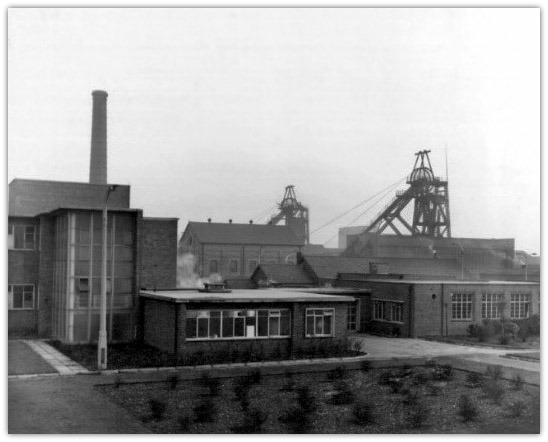
All the pit note books were tossed into a box underneath the large table, un-referenced and again were filthy and covered in dust. The office was none too clean either. Everyone came into the office after an underground visit in their pit muck and lounged about. There was a lean-to ‘Conservatory’ outside housing dial tripods and levelling staffs etc. It was originally a covered walkway for men queuing for their wages. Again the place was filthy and disorientated with tackle strewn about. There was a sink in the corner of the Survey office so that pens could be washed out and paint for plans could be mixed in pallets and there was a small cupboard under to accommodate such, plus there was a kettle and an arrayment of mugs, some chipped, for tea mashing facilities. I replaced them all with a set of clean white mugs, courtesy of the Canteen Manageress.
Keith Houghton the Surveyor who, in tears, welcomed me warmly as his Assistant, for he said he needed help badly. He looked worn out. I would find the Linesmen to be most belligerent and idle and some even liars, as the daily work record for gate lines was filled in on loose leaf sheets of paper and pinned up. Within days I realised that after several requests by Deputies on the phone to have the centre lines extended it appeared that although they had been deployed to that district the lines had not been extended nor on occasion had the linesmen even visited the district, however the information on the sheets stated that the jobs had been done. It was found that on some occasions certain lads had not even gone inbye from pit bottom but had found a hidey hole in an old engine house false roof on 600s to lay about and play games until knock off. This was unknown to all including the Surveyor or even the Pit bottom Deputy. By chance walking by this engine house whilst exploring the pit bottom roadways I heard voices but could see no-one so I listened carefully and when the conversation started again I found some of the Linesmen up in the roof void. I turfed them out and later reading the work to be done on that day realised they had not done it, confirmed by the Deputy on the district. They were all threatened with the sack and it was not to happen again. I informed the relevant Deputies to report to me if necessary.
Over the years I had a poor and overall belligerent and idle team of linesmen. Not all of them of course but as one or two left any new linesman was ‘taught the ropes’ so to speak, so the dissatisfaction continued. Numerous warnings failed to work other than sacking some, which I did … 6 altogether over my tenure. The pits I had previously worked at had linesmen who were trustworthy, who wanted the job, loved their job, felt part of the team and were accepted as part of the team and were respected by all, workmen and officials and were allowed to do surface work as well. Maybe I had too many, averaging 6, whereas, at one period I had 10 linesmen due to odd ones being foisted upon me by officials and management, because they were no good at other jobs in the pit and were trouble makers. I didn’t want them but they thought I could straighten them out, to some degree I did. That was far too many but because of regular absenteeism it found that 6 or 7 would be at work to do lining and assist on survey work. On all occasions of confrontation with me the Linesmen contacted the NUM Representative who naturally had to follow up the problem but had to listen to my side of the story as well. They always went away after discussion, with the verdict being on my side, the Linesman losing the argument. Some had to be sacked … There were several good ones though over the years who were reliable and they tended to work together better. There were even meetings with the Deputy Manager and Undermanager on several occasions but usually then the problem faded away to come back again later. I used to think that had it not been for limited experience and time at the large spread out pit needing lines laying up and accurate measurements and check lines every week. I should have sacked all but two, Hadi Al Rekabi and David Evans and let them and D Stockham train up a new team of willing lads. I regretted the decision not to do this many times. I should have taken that risk! My reasoning not to was because it was a very large spread out colliery in 3 different areas, North, South and East some 4 miles, 3 miles and 3½ miles from pit bottom with several panels finishing and development for new panels and I thought that it was necessary to keep all surveying duties as well as lines up to date and there was only me and one Apprentice on staff when Keith Houghton went off sick.
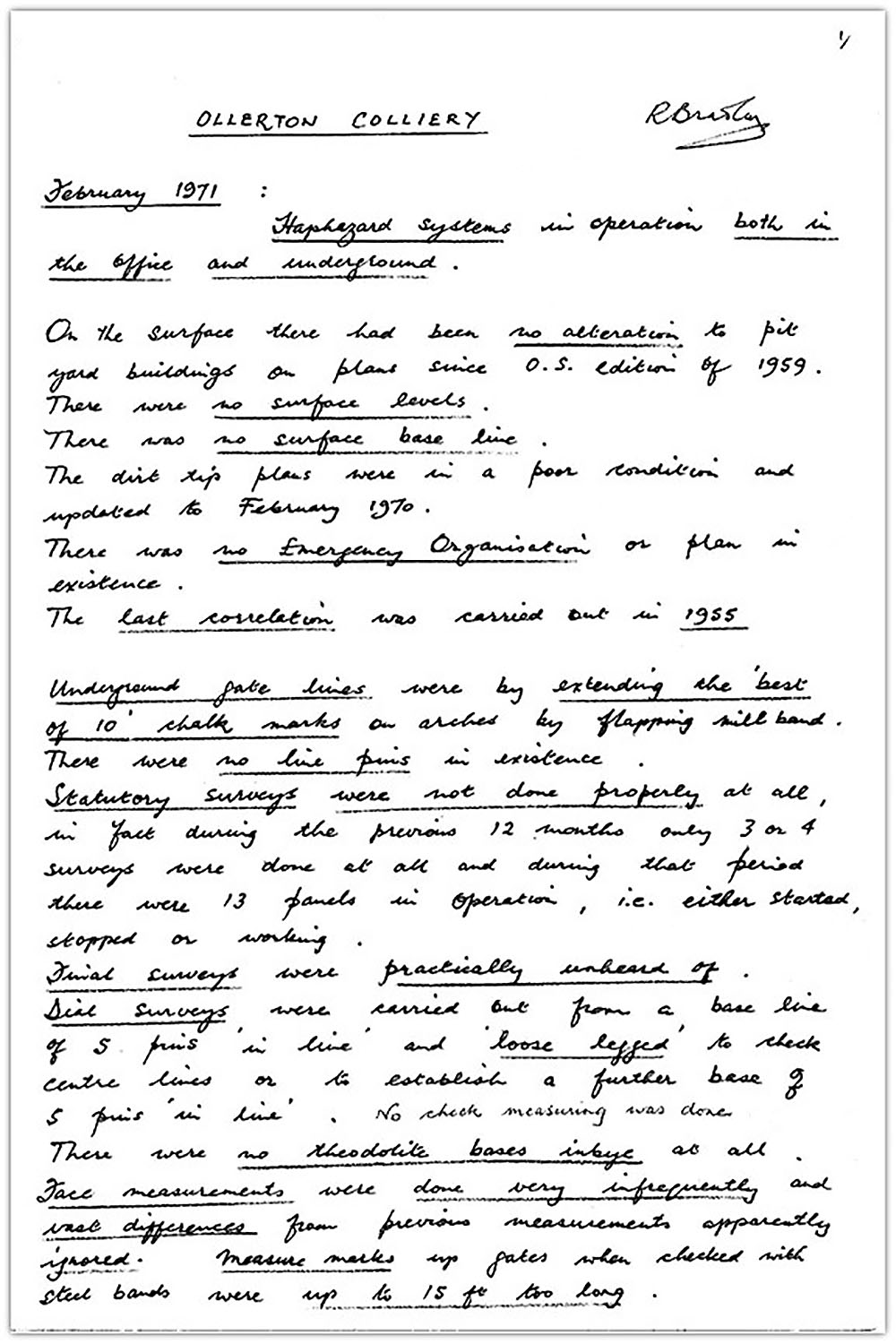
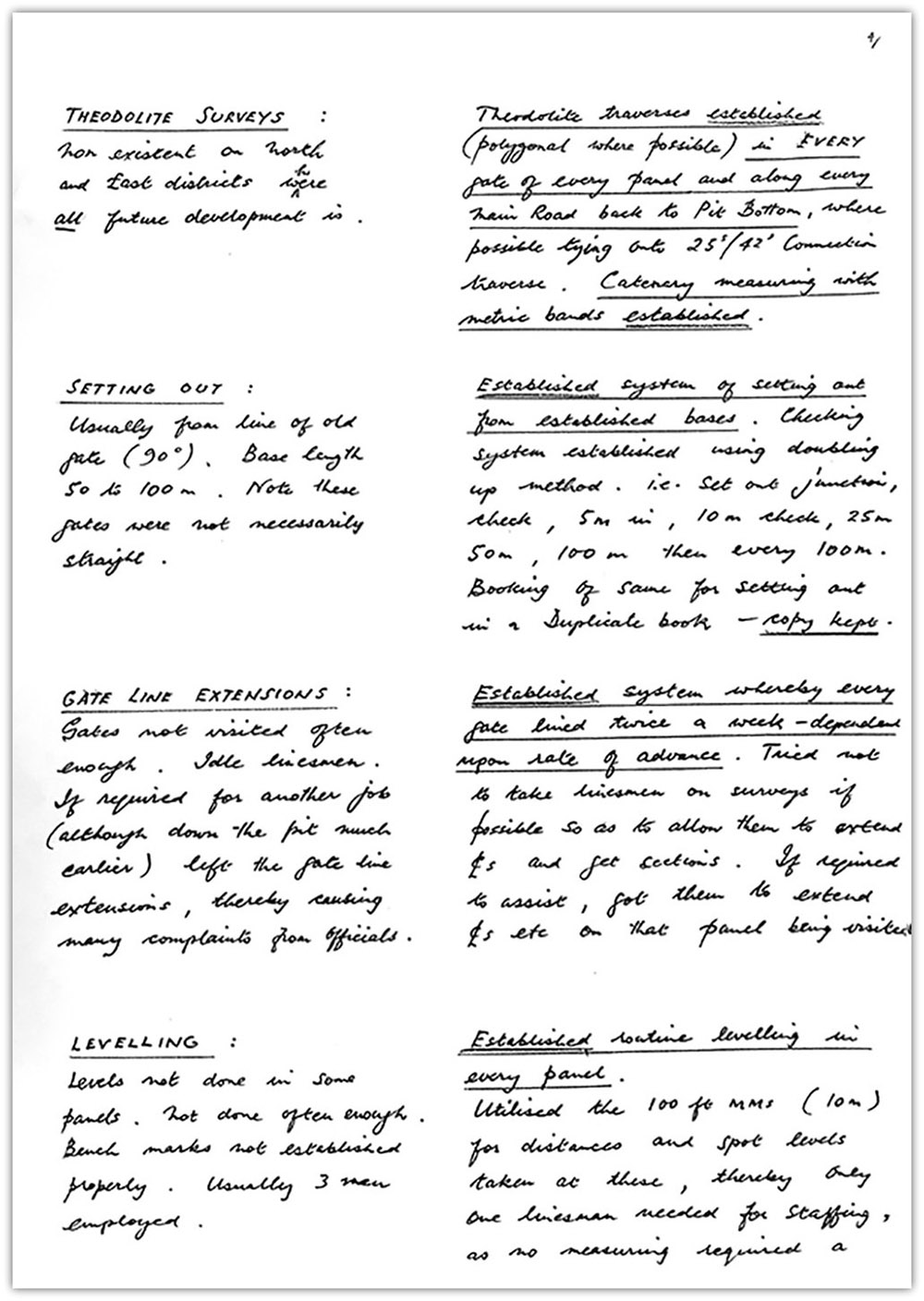
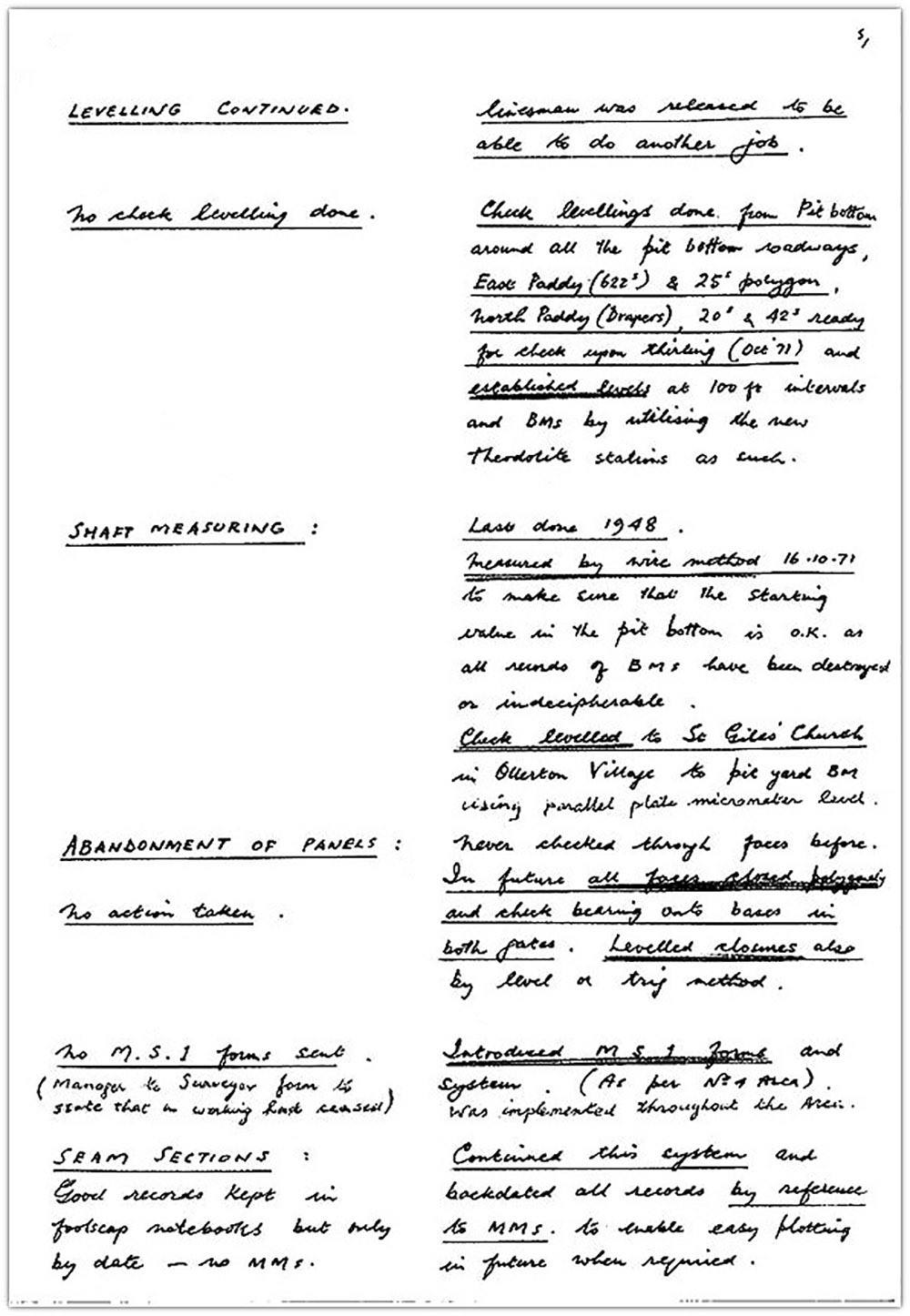
The method in use when I arrived for extending centre lines forward in a gate, was to hold a length of millband string along the previous line chalked on the arches and take the best of 10 marks and project that line forward irrespective whether the line was straight or not from back down the gate. All of the gates in the pit when checked by theodolite later proved to be incorrect and needed adjusting for correct alignment and bearing and in some gates it was noticeable that there was a kink in the adjusted line, however no-one seemed to notice, or care. I think they had got used to poor workmanship. Once I had introduced accurate line pins, properly chalked white lines and later reflective clips for all to see, attitudes throughout the pit changed dramatically for the better. I won the confidence of all Officials and Deputies steadily getting to know each one personably by name over the next couple of years and anything that they could do to help was forthcoming. Some would phone me asking for advice or have a chat when I was on their district. Similarly with all the panel Overmen and Colliery Overmen. Measure marks were non-existent and the method of measuring the gates for progress was to measure to the last arch set and write the distance on it in chalk, however this measurement was added to a previous odd mark measured to on an arch before and so on back to the gate end. For example … 654 feet 2 inches add 31 feet 5 inches advance gave a measurement of 685 feet 7 inches, irrespective of any weight on the arch being measured from, that may have leaned over by crush or settling. And of course it relied on correct adding up by the linesmen as I didn’t find any evidence of checking in the office. I assumed later that they had possibly made mistakes adding up on occasion. Several times early on I began to wonder whether they had actually measured up or guessed it from the number of cuts taken. When measured properly from the centre line of the Main road up the Loader Gate or Airway not one gate was correct, because I introduced 100 feet measure marks that were chalked accurately and in future measurements would be taken from that mark to the coal face and when that measurement exceeded more than a hundred feet another 100 feet mark was chalked up accurately, and so on. Not one gate in the pit was correct, some being 4 and 5 or even 6 feet too far but one gate, 57s LG was 16 feet too far. This gate was also 3 degrees out of alignment requiring fortnightly dial surveys to gradually bring the gate line onto its correct bearing. Help was given by the Conveyor department who knowing my predicament when I explained the problem were able to angle the top rollers systematically so that the belt in effect ran round a 3 degree bend. It was no good informing any of the management of these errors because the blame would then fall firmly and squarely on my shoulders as by then Keith Houghton had fallen off work sick and would never return, and he was transferred a few months later to the Subsidence department then based at Eastwood Hall, under the charge of Charlie Shadbolt. No abandonment surveys were done properly or closed through face lines with an instrument. All abandoned face lines and gates were drawn straight irrespective of whether they were bent or not. Not one face in the pit had the correct length between gate centre lines when checked by steel tape (Silverline as they were known as). Calculations between gates from surveys then agreed within a foot or 18 inches allowing for dip of seam, bends etc. If there was a distance exceeding that it was measured again by a different team. No surveys were carried out at 100 yards intervals as per the Surveying Code of Practice. Only Quarterly face lines were drawn on the plans. In fact due to pressure of the thirling survey 42s North side to 25s East side being carried out using old fashioned time consuming methods, such as bay measuring plus the driving of a 1in3 sump drift and deepening No1 shaft 5 yards for a skip installation it became obvious that hardly any normal panel surveying jobs had been done during the past 12 months. Completely irresponsible and wrong. 10 panels stopped, started or working were neglected. I found one survey in a note book but could ffind no evidence of measurements between gate centres when a face was abandoned. As luck would have it both 25s and 42s old face lines were still open so I was able to survey through the faces from LG to AW, proving that both panels had veered off line prior to them being abandoned, in fact there was eyesight in it. Later levelling was tied through the faces from the two LGs and through the faces into the AWs. Errors in feet were found when the bench marks in existence were checked.
It had been assumed that 42s panel would pass by the line of 25s panel then 25s gates would be driven forward to couple through to 42s gates, a simple exercise creating right angles. However the Top Hard seam section deteriorated until the panels were stopped short, but it was still planned to couple the North and East sides for conveyor belt efficiency, the North side panels delivering their coal via the East side trunks to the pit bottom and abandoning the North side trunk conveyors releasing manpower, maintenance and drop in power consumption. This was a big shock for the Surveyor as it meant doing a monumental 5 or 6 miles or could even have been a 7 mile traverse between the ends of the proposal using a theodolite. The shortest connection was by sighting through a small opening in an overcast so the 5 mile traverse was chosen. Only dial surveys had been done in the past and they were carried out infrequently on panels using an old fashioned method of 5 pins in line and ground taping between with no check readings (I found errors) and another 5 pins in line established inbye to be used next time. I was told that on several occasions the spads that were in cover boards were not in line due to gate crush or the board had fallen so a mean line was accepted whether it was right or wrong. The measuring for the thirling survey traverse was to be done using the old fashioned system of bay measuring. It was to be a very time consuming and onerous task that would need to be done twice, the second time as a check survey, as was necessary and required for such a large exercise and was viewed at Area HQ that a different team be deployed for the check survey. That is where I fitted in, supposedly temporary on several days a week, but then that was deemed unwieldy as it was possible other jobs could crop up and my part could have been cancelled after I had turned up. It was therefore decreed that I moved to Ollerton permanently.
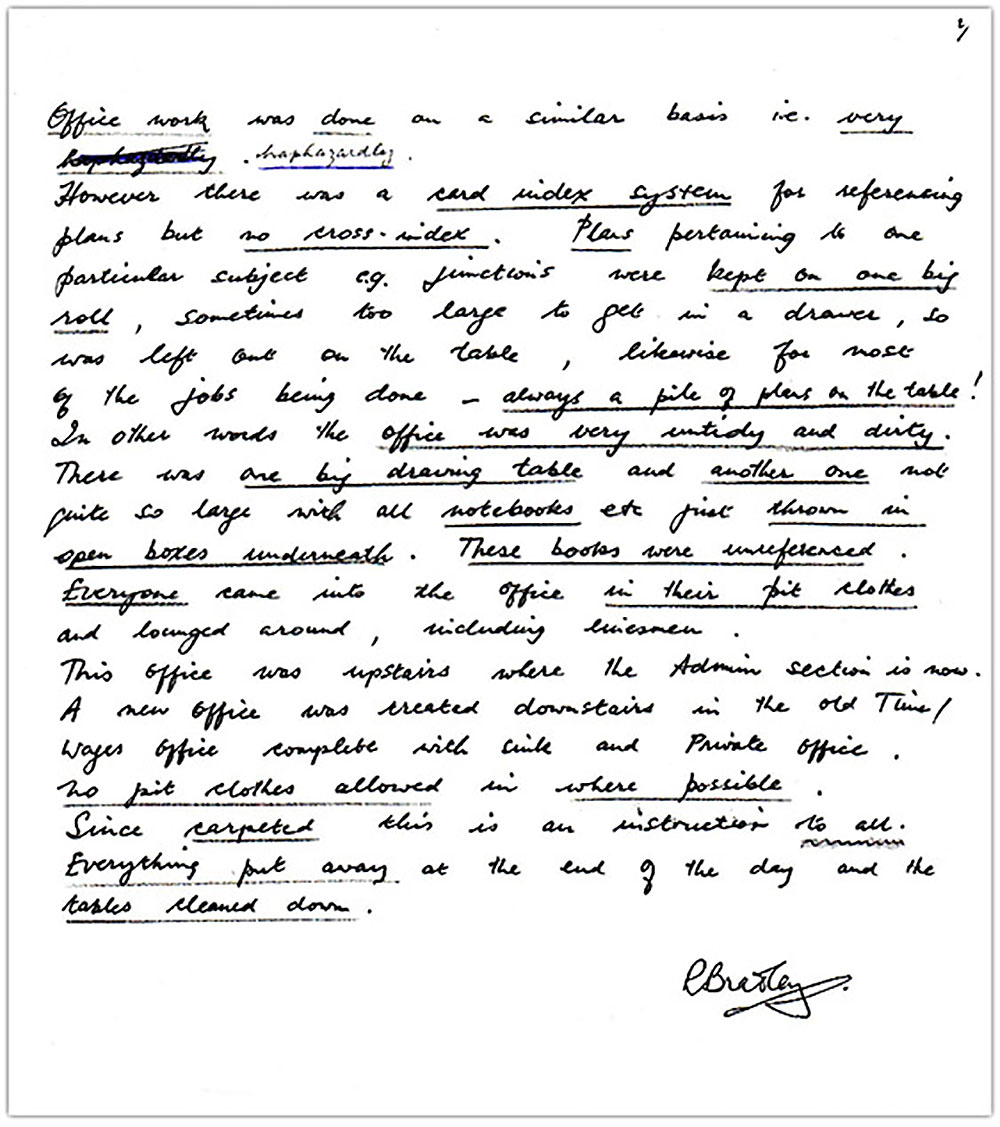
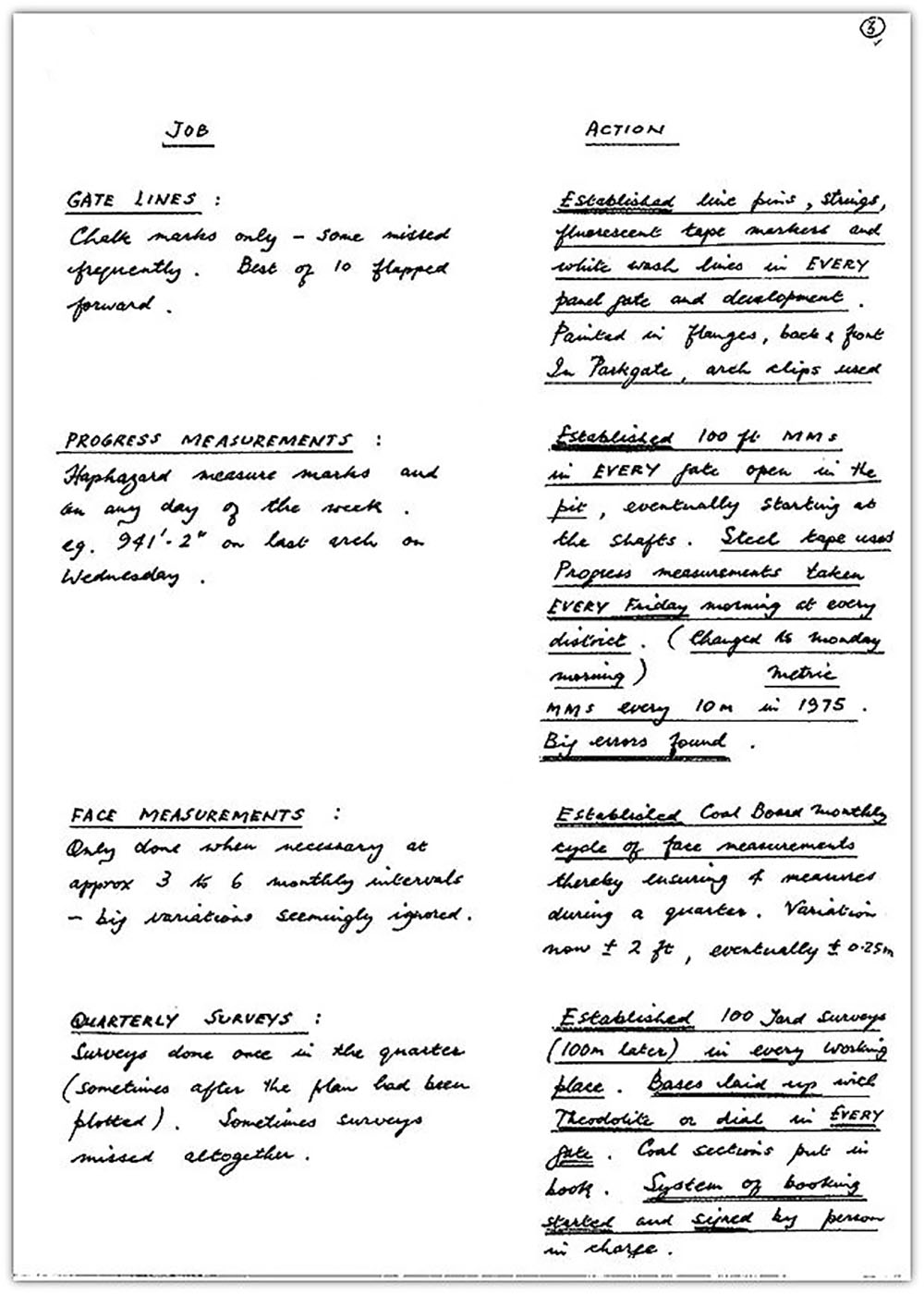
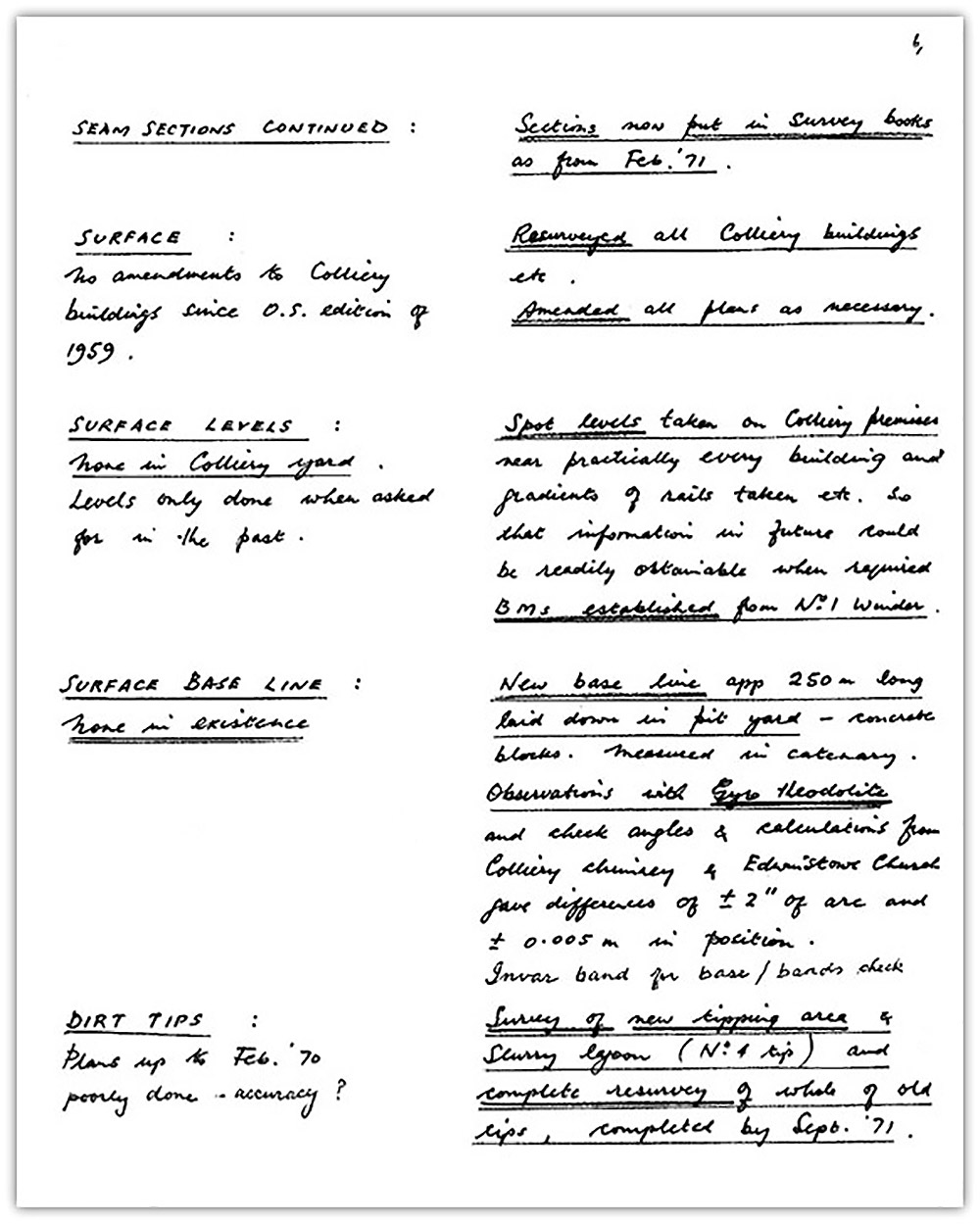
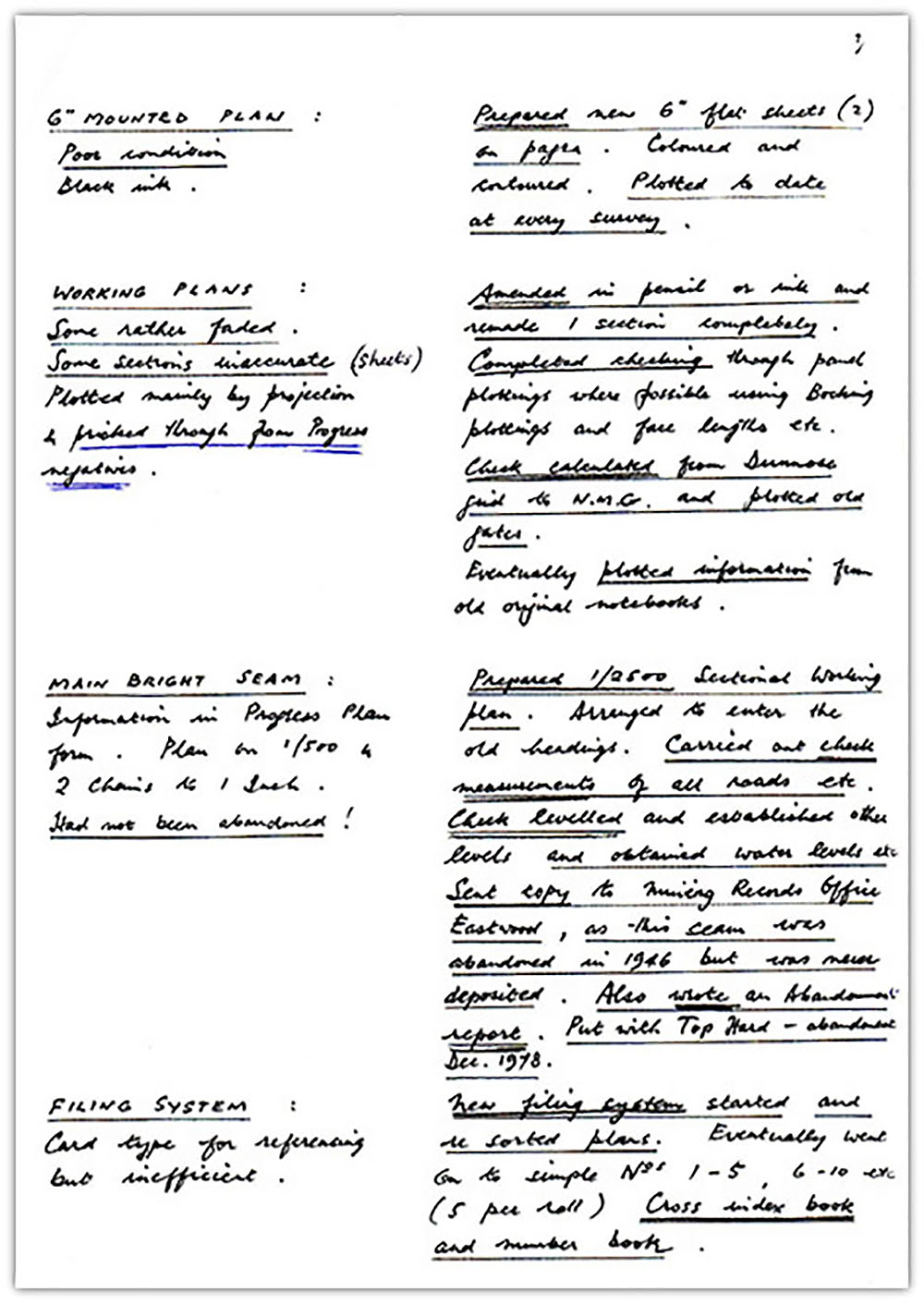

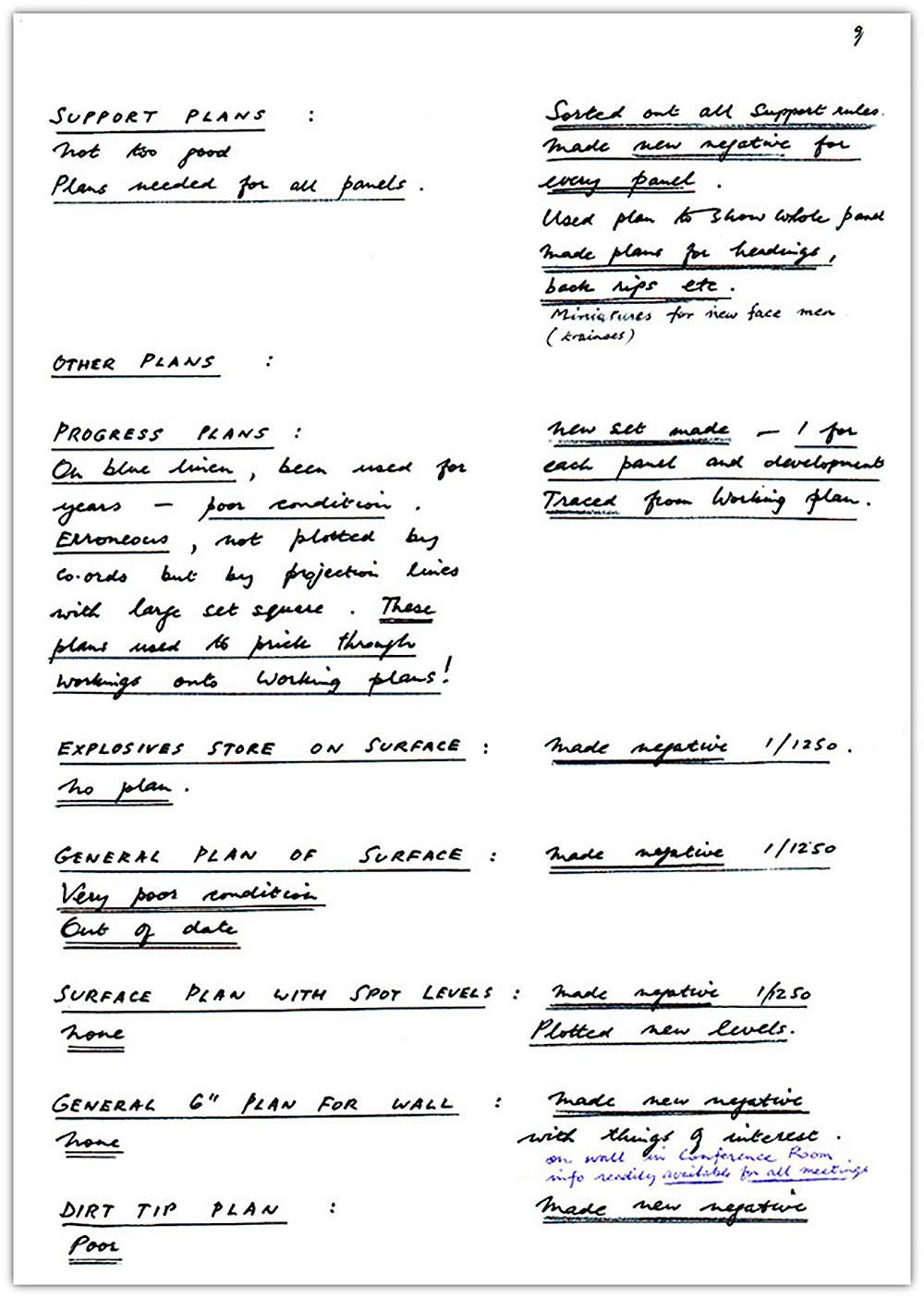

Regarding routine work on panels and headings the measurements supposedly taken using linen tapes, but booked at any day of the week, adjustments and additions etc were made to estimate the distance to the coal face or heading for the end of the Friday night shift. Not one complied or was accurate. I arranged immediately for all measurements to be made on Friday day shift to start with, just adding on the number of arches set or strips taken on the afternoon and night shift, the measurement was accepted knowing that the distance would be picked up the following Friday so that the true advance for the week was booked. This system was not good, with spasmodic advances, so I changed the measuring time again, this time for the end of Friday night shift giving a proper accurate measurement for the week. It meant that Saturday overtime tickets for several lads were necessary, plus Dougie Stockham who worked every Saturday and these had to be obtained from the Undermanager’s Clerk Peter Crawford out of the overtime budget. Dougie then began to realise the inaccuracies and he would go to a different district on a Saturday morning to check it. The distances that had been given to the requisite people for the men’s pay now had to be adjusted and I did it very carefully by losing half a strip a week until parity was obtained. It took just a few weeks but for 57s between 1 and 2 feet was ‘lost’ every week for about 12 weeks or so. No-one noticed. I was quite afraid that someone would, but then it would have been no use me trying to explain to management, under-officials and men that they had already been paid for that advance, when in effect they had not worked that coal. It was only on paper and created by wrong measurements. The linen tapes tended to stretch after some use but were never checked with a Silverline steel tape so that adjustments could have been made. They were all checked by me and some re-marked, temporarily. Later Fibron plastic tapes were introduced and they were less likely to stretch. Even so each tape was checked against a standard every month and once errors were noticed a new refill tape replaced the old one that was thrown away. Records of face lengths similarly showed vast differences from one month end to another and errors of 5 or 6 feet were seemingly ignored. Again when checked properly by steel tape from centre line in one gate to the centre line in the other gate differences from one month to the next varied by up to a maximum of 1ft 6in allowing for dip of seam etc. Stable holes were worked at each end and both fast ends were added on to give the face length. The linesmen were also supplied with 6 feet tapes to measure sections. Over the years there would be a constant list of excuses why tapes were lost or went missing (some probably went home or given away) and I had to keep ordering a further half dozen tapes when our budget allowed, because for all small equipment such as a tape and any stationery had to be ordered via the Admin department and authorised by the Manager. On a couple of occasions over my early tenure I was to find that tapes or books had not been ordered by the Admin Officer Eric Spencer as he had decided that it wasn’t necessary but he did not tell me, therefore altercations arose and I stated that I did not order things unless they were required or necessary. I told the Manager and after that I never had a problem.
Checks later when metrication was implemented in 1975 new measure marks were every 20m along every panel gate and every main road gate open from No2 pit bottom shaft centre and checked against all theodolite marks at the gate Junctions and on route and adjusted fractionally if required. The check measurements using 20m Silverline tapes were found to be very good. When it became general knowledge that the measure marks appearing in every gate and main road meant that everyone, no matter who, would know where they were.
Eventually I changed the system again and it was agreed that the line lads could start very early on Monday morning clocking on at 4am and getting to the heading or panel before the day shift started cutting, and they split up or went in pairs to measure the progress, take dirt measurements, coal sections or even a check line on the face if it was bent. All these measurements and lots of other information such as panzer sprocket measurement from the centre line to give an iindication of panzer creep. The later chock installations were fixed almost skin to skin with one another at 1.5m centres and attached to the panzer, fantastic for safety and very useful for us as a measurement to the first chock at each end every time they visited told us which way the panzer was creeping, also it did not require the face being measured as once we had fixed each chock mark and measured through the face from the first to the last mark it was a constant measurement and all that was necessary was the short measurement to the first chock at each end from the projected centre line. The chocks were numbered so when swilleys or faults were on the face a read off to the chock numbers involved was all that was necessary and a measurement could be worked out in the office and plotted. All of us on staff and the Linesmen also had a Dr Dollars clinometer. It was a simple device with a small steel ball bearing inside a clear plastic case with a graduated half circle, 0 at the bottom and 90 degrees to left and 90 degrees to right and used to measure the dip of swilleys etc using the top of the panzer spill plates, allowing very accurate positioning for plotting and also used for simple jobs requiring a short grade. Other measurements required on Monday morning were … end of switchgear, end of rails and return wheel for materials stack, methane drainage hole or holes, last manhole (if any), last fire hydrant or valve, ambulance tube if required, stone dust barriers and other bits were phoned to the office in turn and true weekly advances were accepted by all for payment purpose etc without question. There was a period when it was decreed that the linemen’s measurements were checked by the Deputy on the district. Of course anomalies happened and I had a job sometimes convincing the wages team that our measurements were correct. It came to a head one week when a Deputy sent his measuements out of the pit. Firstly he said he had lost his tape so this is what was recorded … it went something like this … 12 wooden props at 3 feet, 5 chock nogs and 2 arch spacers plus the panzer width. It was laughable in some respects but serious in others, particulary from the NACODS side. The measurements at the time were in metres so it was a complete farce. I told them straight then, accept our figures or their figures but no way was I accepting a check measurement by Deputies on our figures in future. After a few minutes discussion they realised the folly and in future they would accept the survey measurements for payment and bonuses etc. Their measurements had always been some centimetres out anyway. I taught Dougie Stockham how to deal with all this information so he stayed in the office on Mondays and booked the measurements down on a printed sheet and information was given to the small committee next door in the Conference room, Cost Clerk, Admin Officer, Time / Wages dept, NACODS rep and NUM rep to work out the rate of pay, bonuses, incentive payments, adjust norms for advances etc etc etc. They would pester us for the measurements most weeks, sometimes around 9.15am before all had been phoned out, so I delayed the time of giving the sheet even later to around 10am although we had got the information probably half an hour before. It stopped them keep asking. I told them to hold the meeting later but that would have spoilt their chit chat! I arranged for a blackboard on the wall that Dougie filled in weekly with the measurements for each panel and heading, and their final projected end was marked on the board so it was easily seen at a glance approximately how far the heading or panel had to go and in another column the estimated position for the next dial survey and one for levelling, usually at the 100yards and later from 1975 at 100 metres distance from the last one. Anyone of the management entering the office could read the requisite information without bothering us. The day could be planned in advance, the line staff to carry tackle inbye to the requisite gate and then meet the staff member or members and assist on the levelling or theodolite or dial survey or catenary measuring in whatever capacity necessary and on many occasion extend the centre lines as well and then at the end of their shift takie the tackle back out of the pit sometimes riding the shaft early with staff members because generally after all jobs the instruments, tripods and steel bands were wiped down, ready to be used for the next job and also checked for damage that could be repaired or otherwise, and I would check to see if the instruments were out of adjustment occasionally and put them right. Sometimes it was necessary to send the instrument to a specialist firm. Dougie Stockham used a Levelling instrument and carried out much of that task but did not work out the values. This was rectified by me and he learned quickly. He was also able to carry out dial surveys and adjust line bearings also. He would do most of the levelling and some dial work as well, sharing it with the Assistants or Deputy and even myself and most of the Apprentices were taught by him and when they became confident and proficient were then able to do the instrument work themselves. Dougie became a very important member of the staff and rose to his position enjoying the authority I had given him. He sorted jobs and tackle out and took measurements of face check lines out over the phone and then took copies round to the Manager, Deputy Manager and Undermanager, Overmen and Deputies office and getting their confidence in him, so much so that he was able to get several of the management and officials to join his Littlewoods Pools coupons, collecting his money on Friday afternoons, a concession from me he had earned for his good work. I took him on quite a few surveys early on to show him how I organised and carried out theodolite and dial work and booking, using a pit note book (we all had one) which then was copied into a proper survey book in the office on that day. Similarly we also used 2 levelling books, a pit book and an office fair copy book. Whenever I had carried out a theodolite survey in the office in the afternoon following the underground visit I would copy out the survey, then calculate and plot it on 1/2500, 1/5000. 1/10560 and later also on 1/10000 scales in pencil whilst someone checked my copying into the survey book. Whoever was free would check the copying of work done by others. I normally inked the surveys in using rubbed up carmine stick ink and stippled all before I went home. The plans were always up to date and the skill with stippling was to blend in with the previous stippling with no apparent difference in colour. I was very quick at those tasks and rarely did I have to stay after office hours to finish same and then that was due to being interrupted. Doing it all on that day meant that you could remember what the gates were like and if there was a bend due to panzer creep for example or a widened gate to house a Pikrose haulage engine I did offsets from the line of sight and the gate was drawn bent whereas if the survey was left uncalculated and not plotted for several days like at many pits it lead to a backlog of jobs. Naturally of course the Apprentices were quite slow but I taught them how to calculate and plot their surveys in pencil but not ink, that was my job.
I organised and used the string method of catenary measuring in panel gates for theodolite surveys and taught Assistants and Apprentices how to do it and sometimes on the same day I or an Assistant or my Deputy could be carrying out a survey somewhere else at the same time, thereby increasing the efficiency of the department. It took around 18 months but eventually we got there. I did not encourage Dougie to use the theodolite as it would have prevented Apprentices from gaining the required practice for their exam. Assistants also did theodolite work after my initial blitz of the pit and Dougie Stockham did mainly dial work with Apprentices and similarly with the Level. After the measure marks had been established it then required only 2 men to do the levelling, one on instrument and a staff man, the levels being taken at the established marks or a short distance measured from the nearest mark if necessary, for example on a drift, thereby releasing the normal third man to update lines etc. We arranged with the Officials that the survey team and particularly linesmen could get into the heading at snap time 10am – 10.20am and put lines on etc whilst the workmen were having their snap and machinery was stood. The concession the lads had for working through snap time was to come up the pit early and have their snap time in the canteen before coming across to the office to do their bookings and get the proposed work sorted for the next day. We became an extremely efficient team. It was noticeable with every Apprentice I had that they had never been given the chance to use instruments at their previous pit, where some Surveyors relied on senior Linesmen or Assistants doing theodolite work thus depriving them of practice. I found out much later that at Teversal they had taken the Code of Surveying Practice to the nth degree. Any panel working between 2 others that had been levelled and surveyed by theodolite were never levelled nor were theodolite surveys done, only frequent basic line surveys by dial, due to bad gate conditions so then the various Apprentices, changed about every year by CJ Whyte did not get what I call ‘proper tuition’ on the use of instruments, particularly the theodolite after I left. All the Apprentices I had at Ollerton spent most days down the pit every week when possible for half a shift firstly assisting then learning how to use instruments and then in the office in the afternoon to learn how to calculate and plot the survey or levelling done. When they were at Technical College on block release for several months it was imperitive to be able to use instruments and do measuring underground when they returned full time at the Colliery. I set out a circuit with a set of survey marks in the surface galleries at the back of the offices. It was an old air raid shelter from World War II and ideal for practice. It was dark like underground so cap lamps and oil lamps to sight to were required. Most Apprentices I had did the closed circuit with a dial, theodolite and level and of course the results were able to be compared so it was immediately seen whether they had done it correctly. It was also used to assimilate seam sections, particularly for the linesmen when we graduated from imperial to metric measures, sooner than praticing down the pit on the face.
Where possible surface work was experienced by the Apprentices as well, such as assisting on Dirt tip surveys and coal stock surveys etc. D Stockham would assist on surface work also at times. I got a dozen plumbbobs made in the workshops one each for the team and other bits and pieces made for the job and some for home from the welders and blacksmiths, cables and catenary wire and lights for the garage, it was marvellous what you could get for a bit of friendliness and a cup of tea at the back door. I would get to know all those in charge on the pit top as well as all underground. I wanted a girder for home as I was knocking a wall out to extend the lounge. I spotted one in the ‘grave yard’ where all old steel was left rotting away. Asked Walter Standage if I could have it. Pink ticket from Stores for £1, in other words I was purchasing it, a word with Ted Hodgson, Surface Superintendent and Bert Nock the welder, who would cut the angle for the roof pitch. When I got home at 5 o’clock it was on my back yard all cleaned up and in pristine condition. Two or three of them had had a ride out on the lorry, better than working. What about that for service. In the lamproom I had my name on the motties Mr R Bradley and No1 oil lamp supplied by the genial Ernie Worthington and his Assistant Bill Lacey who would take over the job when Ernie retired, but Bill then could not do enough for me, fetching my battery lamp, sometimes feeding my belt through the lamp slot and getting my oil lamp and looking out for me coming back to take them off me, such was the friendliness. He liked to think I was very important and he was helping me. I got treated better than the Managers. When I left in 1986 he made me 2 motties … ‘for my briefcase’! ….
Assistant Surveyor
Feb 1971
Mon 8 … Office … General introduction to the Office organisation etc. I had been supplied with a 6 inches to a mile scale plan of the Top Hard workings whilst at Teversal so on paper I was familiar with numbers of panels. I deliberately arrived at 9am knowing that the personnel started at 8.30am so that I could observe the running of the office routine. I was not impressed with my initial view but after a brief introduction and a cup of tea with Keith I cast my eye over a Rescue & Firefighting plan that Kevin Bradley the Apprentice was updating. He was using a different sized stencil to the script that was on the plan so I told him to find the right sized stencil and erase the work he had done. He said that it was good enough and didn’t need altering. I insisted he erase it whilst Keith and Paula looked on in amazement. He became quite belligerent and threw the stencil on the floor, so I told him to pack his bags and go and see Mr Morley Area Chief Surveyor, or do as I said. At that he glowered picked up the stencil but began to erase the stencilling he had done. I then explained to him that any job done by a Surveyor had to be right and should be done properly. Later Keith thanked me for my attitude because of his ‘weakness’ he let the lad tell him what to do. The message would soon get round that I was a ‘trouble maker’. When the Linesmen came into the Office in the afternoon in their pit clothes to fill in the line report I could tell that I would have a bit of bother with them. I mentioned to Keith that anyone in pit clothes should not be in the Office and that he should lay the law down to them himself.
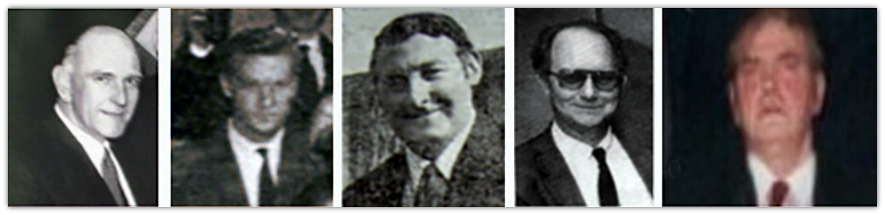
David Rodden to 1973 David Oliver & Jack Taylor to 1972 John Daniels 1972-1976 Vic Brown to 1973
Keith introduced me to Mr David Rodden, General Manager whose Office was next door. He welcomed me with a genuine warm Scottish handshake and said he was pleased I had come to help Keith. Later I met the Deputy Manager David Oliver down the corridor. Jack Taylor the Undermanager would remain slightly elusive and my first introduction later in the week was a rattle on the upstairs window with a pebble that Jack had thrown to attract my attention as he made his way in his pit muck to his office in the Green Hut. It meant lifting the sash window to hear his request, a line needed laying up, I remember… nothing about who I was! He rarely ventured into the main office block. I think he left it to the Assistant Undermanager on Day shift as I was to be introduced to Derek Stephenson who obviously eyed me up and down and endeavoured to obtain information about me. The Assistant Undermanager on Day shift was in charge of development so he called in every day regarding some information. The other two Assistant Undermanagers covered the Afternoon and Night shift in charge of coaling operations. They rotated doing 3 months each on Days, Afternoons and Nights. John Ross and Albert Littler (who started on the same day as me transferred from Silverhill) were the other 2 Assistant Undermanagers.
Although Paula Lesh the Lady Tracer seemed to be doing a good job, maybe haphazardly at times I made out a list of duties with her co-operation … Making tracings for new plan negatives and information on them, and updating same, using the printing machine to take dyeline prints, colouring same with colour wash made from stick ink or using coloured pencils and folding if necessary and distributing them to the relevant personnel, Ozaloft tracings off negatives, revision of negatives and prints, Rescue & Firefighting amendments, Stencilling, many and various, notices for management, safety, mechanical, electrical, welfare and admin and others. Stationery, printing paper and ammonia and stores orders. Filing correspondence, plans, books etc and indexing. Telephone calls and taking messages etc. Note book preparation, covering and stencilling titles and numbering pages. Other miscellaneous duties and errands and last but not least tea mashing. In return I allowed her ¾ hour lunch break where we had ½ hour.
Abbreviations used:
LG or DG denotes Loader Gate or Delivery Gate.
LH denotes Left Hand Supply Gate. RH denotes Right Hand Gate, TG denotes Top Gate and BG is Bottom Gate. MG is Middle Gate. AW is Airway or Supply Gate. TG is Tail Gate, again a Supply Gate for materials. |