1991 - Page 2
Creswell Closed After 95 Years

Creswell Colliery
- Neil Potter -

Sunrise Over The Creswell Winding Gear
- Neal Potter -

More Photos in Darren Haywood's Pages
Creswell, colliery (Derbyshire pit in Nottinghamshire Area) sunk in 1894-Feb 1896 to 445 yards (407m) by the Bolsover Colliery Co to the west of Creswell Crags and to the west of Holbeck, and app 13 km to the north of Mansfield was closed at the end of September 1991 after 95 years.
Shaft positions: SK57SW, No1 shaft 452288, 373606, No2 shaft 452312, 373626. Surface was 298.5 feet or 91m above sea level.
The main ventilation fan was a 600hp steam driven back bladed one and the standby fan was a Single inlet Walker Indestructible. These were replaced later.
Output from the thin Threequarter seam had fallen until it had become uneconomical.
It was continued as a pumping pit, to protect other collieries in Nottinghamshire. Water from the old Oxcroft workings would be allowed to flow down the drifts from the Top Hard horizon and flood the lower seam. Submersible pumps would be suspended in the shaft. For years the amount of water pumped at the pit had been in excess of 120m gallons and almost 160 million gallons, 300 g.p.m. (gallons per minute), by the 1980s, (however pre 1941, the amount had only been about 6 million gallons a year). In the late 1980s an electronic sensing device was used at the surface to measure the amount of water pumped, replacing the paddle system which invariably used to clog up with the mineral deposits in the water.
A pumping station at Hollow Lodge was commissioned in Dec 1986. A connection was made to Langwith No2 pit bottom as a secondary means of egress for the pump man. However this access flooded when Langwith was abandoned.
I remember seeing it on a visit. The pit had become the responsibility of the Creswell management from Aug 1984 and a pumping station was made at Langwith No1 shaft position, mainly by the North Nottinghamshire Area Tunnelling team who were picketed several times during the 1984-1985 strike period. It was not appreciated by many that Creswell had to deal with more water than coal, to keep the workings safe from flooding or even an inrush from the surrounding old pits!
Because it was ‘Derbyshire water’ and Creswell, although a Derbyshire pit was administered by North Nottinghamshire Area. It was always a contention as to which NCB Area should pay for the pumping. About 255 gallons per minute was pumped to the surface via No2 shaft from the Top Hard horizon at 444 yards (406m) deep and delivered to a tributary of the River Poulter. It was not possible to deliver into the Creswell Crags stream that led to Welbeck Lakes due to affecting fish breeding stocks.
Of course unfortunately, the pit will always be remembered for the tragic disaster of 1950 when 80 men lost their lives underground due to a conveyor fire. (see 1950 report).
In 1925 a 25,000v electric overhead power line was connected to Creswell from Bolsover colliery. The overhead line was eventually connected to the other Bolsover Co pits meeting at Thoresby. The idea was that should a feeder fail then by using a special transformer and 1500kW generator power could be transmitted to any colliery suffering a breakdown of power. Creswell colliery supplied power to Welbeck Abbey at 1/2d per unit and the Duke of Portland allowed the main linesman to live in one of the lodges such that he would be first in the queue to have power restored should there be a power cut.
The shafts both 18 feet (5.49m) diameter at 466 yards (426m) deep with the Top Hard insets at 444 yards (406m) at No1 and 445 yards (407m) at No2.
There was an inset at the Clowne seam at 212 yards (194m) in No1 shaft and High Hazel pit bottom at 330 yards (301.75m).
No2 shaft deepened in 1939 to the Low Main at 736 yards (673m) to Threequarter seam (thought to be Low Main at the time).
At No1 shaft 124 yards (113.4m) of cast iron tubbing was installed through the water bearing measures then 324 yards (296.3m) of brickwork.
At No2 shaft only 90 yards (82.3m) of tubbing was needed then 720 yards (658.4m) of brickwork. Hand-got stalls in Top Hard averaged 44 yds (40m) cut off by cross gates every 120 yds (110m).
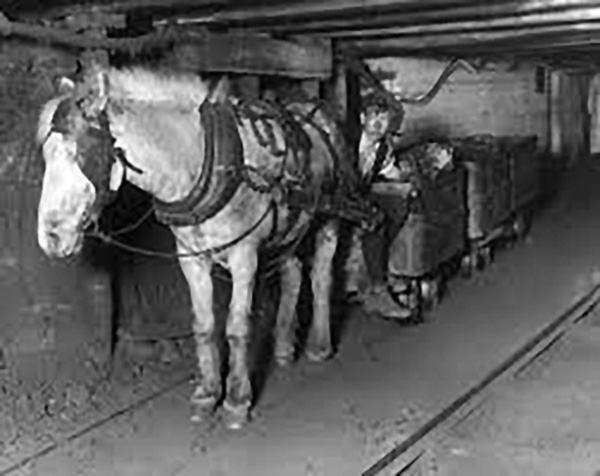
Ponies were ganged by boys who took the coal from the stalls to the rope haulages and took empties back to the stalls where coal was loaded on the face.
Soon after sinking the shafts, stables were made in the pit bottom area and as the workings extended further from the pit bottom more horses for the high roadways and more ponies for the low roadways to the working coal face stalls were sent down into the pit. The following few years gives some details. The boy gangers would go to the stables and get their allotted pony and limber it up and take it to the starting point of the shift, days, afternoons and nights and at the end of the shift take it back to the stables, take the hauling gear off and hang it up in the stall. Many gangers would treat their animals well and take apples and carrots etc to give to their pony at snap time. An Ostler was the person in charge and he had assistants. There was generally a horse keeper for up to 15 ponies each. They would examine and clean them down at shift end and put them in their own stable with manger and food and drinking water.
In 1921 there were 151 named ponies and horses, 109 were injured and 7 died or were destroyed. In 1922 … 145 ponies, 133 injured, 5 destroyed. 1923 … 138 ponies, 80 injured, 6 destroyed. 1924 … 133 ponies, 111 injured, 3 destroyed. 1925 … 134 ponies … 108 injured, 12 destroyed. 1926 … 130 ponies …58 injured, 1 destroyed. 1927 … 115 ponies … 56 injured … 1 destroyed. 1927 … 115 ponies and horses…56 injured, 6 destroyed. 1928 …109 ponies … 30 injured, 11 destroyed. 1929 …. 48 injured and 7 destroyed. 1930 … 35 injured and 7 destroyed. All the injuries would have been treated by the Ostler and obviously those ponies that were badly hurt were put down.
Most of the ponies, now mainly taking materials inbye to the coal faces, were phased out by the 1960s when conveyors and haulage engines were introduced. The last ones in Derbyshire were at a neighbouring pit Shirebrook till 1970. The ponies were generally brought out of the pit for the summer holiday weeks and would frolic in the fields and be contented eating grass but when it was the end of the holiday all the horses and ponies had to be captured and sometimes had to be lassoed and each one led and tied in the cage as they rode the shaft on their own, not with a keeper. Some had to have a hood over their eyes to stop them kicking out when they realised they were going back down the pit. An HM horse Inspector would visit each mine, maybe every year or every 2 years and note the well being of the ponies and the stables etc. and read the daily record of the ponies for any anomalies.
However it shows in the records for those few years that it was a very poor life for a pony (at Creswell) and some were overworked leading to a painful death. How sad.
The general dip of the seams was 1in25 to the East.
Coal was wound at DC shaft and planned for 2,400 tons per day.
In 1933 a cross measures drift was driven at 1in3 from Top Hard up to High Hazel. Output was gradually increased from this seam to replace the dwindling Top Hard reserves.
The steam engine at No1 DC had 2 cylinders 40” (1.01m) dia x 7ft (2.13m) stroke with a drum 21ft (6.40m) to 23ft (7.01m) dia.
Winding was by 3 tubs of 12 cwts on 2 decks.
There were mechanical tipplers at the pit top delivering to jigging screens.

The Pit Chimney Was Felled in 1974
Thanks to John Fretwell For The Information
No2 UC winder had 2 cylinders 25” (0.635m) dia x 4’ 6” (1.37m) stroke x 12ft (3.65m) dia drum designed to wind 700 tons a day on one single deck using 3 tubs and simultaneous decking.
The surface sidings were extensive but no locos were required.
Prior to July 1948 coal from High Hazel was loaded out using under tub endless rope haulage. A new trunk belt system was introduced.
Electrification of the winding engines No1 in 1960 with a 1,800 hp motor and No2 having a 700 hp motor in 1961.
A new medical centre opened in 1964.
A new Coal prep plant was operational in May 1969, run of mine being delivered by conveyor.
2 x 6 ton skips were installed in No1 shaft in 1972, giving 360 tonnes per hour, replacing the mine car system with No2 shaft having cages with 2 decks for 20 men, and materials having 3 tubs on the bottom deck.
Wagon controllers were operational in 1973.
A Hirst Fine Coal washer was installed in June 1975.
A rapid loading bunker was commissioned in 1977 and delivered the product via merry-go-round trains to the CEGB for use at the power stations.
Dirt disposal by 30 tonnes capacity dump trucks loaded from a bunker and delivered to the tip and spread in layers and compacted by a grader. This replaced the previous system of overhead bucket tipping.
Restoration of the tip was by soiling and grassing as tipping areas were completed.
The old surface mine fans a 130" dia Aerex single inlet radial flow fan, driven by a Lawrence Scott variable speed motor. With 7.6" of water gauge 350,000 cu ft of air circulated the mine. The standby fan was a 20' 0" (6.1m) single inlet Walker indestructible. These were replaced in Dec 1985 by 2 identical Davidson 1,500 Kw A.V.P. axial flow fans. These fans and the booster fan in the Threequarter seam were monitored in the surface control room.
The village houses built at the turn of the 19th Century were modernised by the NCB in 1974.
A coal hopper and bunker were installed in 1978.
The maximum amount cut in 24 hours was 2,900m and the maximum for the week 12,700m culminating in the record output of 22,707 tonnes produced in week ending 4th Feb 1978.
 The original ‘model village’ of 280 two storey houses was built in 1900 by the Bolsover Co. There was an institute, billiard room, reading room, library, smoking room, refreshment bar and lecture hall (cost £3,700). Playing fields were laid out for football, cricket and other field sports. The original ‘model village’ of 280 two storey houses was built in 1900 by the Bolsover Co. There was an institute, billiard room, reading room, library, smoking room, refreshment bar and lecture hall (cost £3,700). Playing fields were laid out for football, cricket and other field sports.
In July 1901 1,400 men and boys produced a world record of 3,001 tons (3,200 tonnes) in 24 hours. Underground there was 160hp endless rope haulage and 2 others of 80hp and 20hp on the rise side where the coal was jigged down to the main levels.
The Bolsover Company was very progressive, and 1,500 hand-held safety lamps lit electrically were issued at the pit in 1907.
Pithead baths were opened in the 1930s allowing men to bathe at the pit instead of going home in their pit muck.
It was a Derbyshire colliery close to the border of the two counties, and after nationalisation, originally in No2 Area East Midlands Division it was first transferred to No1 Area after the reorganisation in 1949 then No3 Area of the NCB at Edwinstowe, Nottinghamshire from April 1967.
 In the 1970s conveyor mounted trepanners and shearers for tail gate stable were the main machines. In the 1970s conveyor mounted trepanners and shearers for tail gate stable were the main machines.
The loader gates were bored and fired and hand packed whereas the tail gates rip was by Mavor boom rippers and packed by slusher.
Eickhoff shearers were pioneered in the thin seam. In 1986 there were 4 faces using these machines, the tail gate stables being eliminated by the main machine.
The run of mine from the faces was transported by gate belt then trunk belt through a 200 tonnes static bunker up the steep drift to the High Hazles horizon through a 400 tonnes static bunker and delivered into the skip pockets. Materials transported by rope haulage and manriding by rope haulage and conveyors.
Methane drainage was practised with holes drilled upwards over the goaf at 45º and downwards into the Yard seam similarly and coupled to 6” (0.15m) dia pipes in the gates to a main 10” (0.25m) pip and up No2 shaft by 2 x 100hp extractor pumps to feed surface boilers.
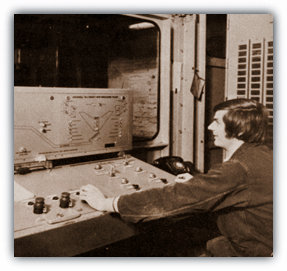 NCB/Dosco In-seam miner installed on 11s panel in July 1974 holidays. NCB/Dosco In-seam miner installed on 11s panel in July 1974 holidays.
A large diameter borehole was reamed out in 1989 using the Robbins Raise drill to an inset in the steep drift to the Threequarter seam from the Top Hard horizon to assist the ventilation.
The reduction in manpower with the increase in output raised the face output per manshift of 59.81 tonnes and the overall o.m.s of 5.91 tonnes both in the week ending 3rd Aug 1991.
Using Eickhoff double ended shearers in the max 2’ 9” (0.8m) Threequarter seam with efficient gate end elimination of stable holes placed Creswell in the top tier of collieries working thin seams.
The pit was heavily picketed by Yorkshire striking miners in the 1984 strike.
Seams Worked: Production had been obtained from four seams at Creswell:
- Top Hard 1897- Sep 1941
- High Hazel coal 3’ 9” (1.14m), dirt 2” (0.05m), coal 11” (0.28m) 1933 - 26th June 1969,
- Clowne 3’ 8” (1.12m) 1958 - 3rd Jan 1969 (worked to 50 yards (45m) cover line to Permian water-bearing measures)
- Threequarter seam 2’ 9” (0.80m) (originally thought to be Low Main) at 736 yards (673m) deep started 29th Dec 1939 and then fully from 1967 until closure Sep 1991. Maximum output 829,097 tons in 1969/70 produced by 1,144 men, and maximum manpower 1,578 in 1947.
|


